
 Worksheets
Economics Complete Study Guide
Total questions: 150
Worksheet time: 1hrs 26mins

What are the characteristics of a traditional economic system?
Relies on government
Driven by consumers
built upon traditions, customs, and beliefs
An economic system in which individuals and businesses make decisions about what to produce.
Market economy
Mixed economy
Communism
Command economy
Competition and profit motive are important characteristics of a:
command economy
traditional economy
market economy
socialist economy
Which economic system uses bartering?
Free Market
Command
Mixed
Traditional
What would happen if globalization stopped?
The world would end.
Countries would become more rich
People would not have a variety of goods
We would get more products
What type of economy is socialism?
When the economy is privatized
When the economy is nationalized
When the people do not use money but trade
When the government owns certain parts of the economy and the people other parts
What is elasticity in economic terms?
The measure of how much a product can stretch
The fluctuation in demand of a certain product in relation to pricing
The ability of a product to be recycled
The measure of a product's durability
Who is a consumer?
Someone who produces goods
Someone who sells goods
Someone who uses goods and services to satisfy wants and needs
Someone who distributes goods
What term describes produced physical products?
Services
Goods
Necessities
Wants
What is the study of the production, distribution, and consumption of goods and services called?
Sociology
Economics
Psychology
Anthropology
What is the Law of Supply?
The principle that the quantity supplied is unaffected by price changes
The principle that as the price of a good falls, the quantity supplied will increase
The principle that as the price of a good rises, the quantity supplied will increase
The principle that as the price of a good rises, the quantity supplied will decrease
In a Command Economy, the government provides and controls the goods and services.
True
False
In a market economy, goods and services were privately owned businesses.
True
False
Although there have been small market reforms in North Korea, the majority of legal economic activities are centrally controlled by the government. What type of economy does North Korea have
Market
Mixed
Traditional
Command
In China, 40% of the economy is based in state-run industries while 60% is based on the private sectors where producers and consumers make production decisions. What type of economy does this reflect?
Mixed
Command
Traditional
Market
Money, products, and supplies used in the production of goods and services are called
Capital Resources
Natural Resources
Human Resources
What is the definition of scarcity?
The unlimited availability of resources.
The limited availability of resources, forcing people to make choices.
The abundance of money and time.
The ability to have everything we want.
Which of the following is an example of a "need"?
Designer clothes
Concert tickets
Basic clothing
Streaming subscriptions
What happens to prices when demand is high and supply is low?
Prices go down.
Prices remain the same.
Prices go up.
Prices fluctuate randomly.
Which of the following is a "want"?
Food
Shelter
Video games
Medicine/healthcare
What is the cost in the decision-making process?
The benefit you gain from a decision.
The reward you receive for making a choice.
What you give up when you make a decision.
The total amount of money spent.
If a store offers a discount for buying two items instead of one, what type of incentive is this?
Negative Incentive
Positive Incentive
Neutral Incentive
No Incentive
What is the benefit in the decision-making process?
The amount of money you save.
The consequence of a poor decision.
What you gain from the decision.
The time you spend making a decision.
Which of the following is an example of a negative incentive?
A store offers a free gift with purchase.
You receive a bonus for good performance.
You have to pay a late fee for returning a library book late.
A company offers a discount for early payment.
What is the definition of supply?
How much people want a product or service.
The amount of money available to spend.
How much of a product or service is available.
The total demand for a product.
If you choose to buy a $10 lunch instead of saving that money, what is the cost?
The $10 you won't have later.
The enjoyment of the meal.
The time spent eating.
The nutritional value of the meal.
What is the definition of demand?
The total supply of a product.
How much people want a product or service.
The price of a product.
The cost of producing a product.
Which of the following is an example of a positive incentive?
A penalty for late payment.
A reward for completing a task early.
A fine for breaking a rule.
A tax increase.
What happens to prices when supply is high and demand is low?
Prices go up.
Prices remain the same.
Prices go down.
Prices fluctuate randomly.
Which of the following is an example of a "need"?
Streaming subscriptions
School supplies
Eating out
Concert tickets
Imagine you have $20 and can either buy a new book or go to the movies with friends. What economic concept does this scenario illustrate?
Supply and Demand
Costs and Benefits
Scarcity
Incentives
What is the opportunity cost of spending an evening watching TV instead of studying for an exam?
The enjoyment of watching TV.
The knowledge you could have gained from studying.
The cost of electricity for the TV.
The time spent relaxing.
Which of the following is an example of a positive incentive in a workplace?
A penalty for missing deadlines.
A salary deduction for being late.
A bonus for meeting sales targets.
A warning for not following rules.
What is the opportunity cost of choosing to work overtime instead of attending a family gathering?
The satisfaction of completing more work.
The time spent with family.
The extra money earned from overtime.
The cost of transportation to work.
Which of the following is an example of a negative incentive in a school setting?
Extra credit for completing assignments early.
A certificate for good behavior.
A detention for not completing homework.
A reward for perfect attendance.
What happens to the demand for a product when its price decreases?
Demand increases.
Demand fluctuates randomly.
Demand remains the same.
Demand decreases.

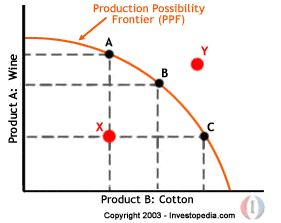
If a point lies on the curve this means the company/country/individual is being efficient. If a point lies inside the curve, what does that tell?
They are being over efficient
They are being inefficient
It is not impossible with the given resources
They are still efficient, just at another point

What does point B represent?
Production at greater than the country's minimum potential
Production is less than the country's minimum potential
Production is greater than the country's maximum potential
Production at the country's maximum potential
Benjamin confides in Lily and Olivia that he has a low credit score after a financial setback. What is the single best way for Benjamin to improve his score?
Cancel his credit cards
Make on-time payments
Get a car loan
Check his credit score
Arjun is reviewing his credit report. Which of the following would NOT appear on Arjun's credit report?
The salary from his current job at Mason's company
Payment history of the car loan he took for his daughter, Isla
Credit card payment history
Student loan activity from his college days
Samuel is applying for a loan and he is curious to know who tracks all of his credit information. Can you help him?
Federal government
Companies named Equifax, Experian and TransUnion
Consumer Financial Protection Board (CFPB)
Lenders

What is a budget?
An estimate of how much money people will give you.
An estimate of how much money you will earn and how much you will spend.
An estimate of how much money you will give to charity.

Which of the following is an example of a fixed expense?
Clothing
Food
Gas
Rent

Which of the following is an example of a variable expense?
Rent
Food
Car payment
Health insurance
Which of these best describes the law of demand?
if prices go up, quantity demanded will fall and if prices go down, quantity demanded will go up
if prices go up, quantity demanded will also go up and if prices go down, quantity demanded will also go down
there is no law of demand, each situation is unique and demand and prices cannot be predicted
prices will go up for certain goods when quantity demanded goes up and vice versa


What is the relationship between the Price and Quantity Demanded?
Positive Relationship
Direct Relationship
Inverse Relationship
Mixed Relationship
The law of demand states; there is an INVERSE relationship between price and quantity demanded. Which of the following is not a true statement?
Price goes up qty demanded goes down.
Price goes down, qty demanded goes up.
Price goes up, demand goes down.
All answers are correct.
In a corporation, owners share profit, but liability is limited to __________.
investment
theft
distribution
production
A form of business organization that is authorized to act as a legal entity regardless of the number of owners.
Corporation
Partnership
Sole Proprietorship
None of the Choices
What is a disadvantage of partnerships?
ease of formation
limited liability
owners share responsibilities
possibility of personality conflict
What is the advantage of corporations?
minimal government regulation
short life span
limited liability
has one owner
In which type of organization does one person take all the risks?
Corporation
Cooperative
Partnership
Sole Proprietorship
Floral Shops, Bookstores, and Farms are examples of what type of business?
Sole Proprietorship
LLC
Corporation
None of the Choices
Nike, IBM, and Google are examples of what type of business?
Partnership
Corporation
Sole Proprietorship
None of the Choices
A father who wants to take his son into the business with him should form this type of business.
Sole Proprietorship
Corporation
Partnership
LLC
How is a general partnership organized?
Every partner shares equally in both responsibility and liability.
No partner is responsible for the debts of the partnership beyond his or her investment.
The doctors, lawyers, or accountants who form a general partnership hire others to run the partnership.
Only one partner is responsible for the debts of the partnership.
Agricultural, Housing, and Credit Unions are examples of what type of business?
Partnership
Corporation
Sole Proprietorship
Cooperative
The money left after production costs are subtracted from revenue is called
Free rider
Profit
Subsity
Scarcity
A person who chooses to, and is free to, open a grocery store is participating in a
command economy
centrally-planned economy
free enterprise economy
traditional economy
Most people are inspired to start a business by the
free contract clause
marginal benefit
open opportunity clause
profit motive
What is the role of producers?
make the product
buy the product
carry out government program
increase the profit of other retail stores
Which is an example of competition changing the marketplace?
a chain bookseller forcing many individual booksellers to go out of business
a chain hot dog restaurant failing to make a large profit
a chain coffee shop having no effect on individual coffee shops
a chain restaurant expanding its menu to include desserts
Free contract means that people can chose
for themselves what legal agreements to enter into
for themselves what positive externalities to support
to enter and compete in the marketplace
to enter into open opportunities
The incentive to improve material well-being by seeking to gain from economic activities is called
legal equality
marginal benefit
open opportunity
profit motive
Government restricts free enterprise through
deregulation
income redistribution
public policy
goods and services
In the marketplace, producers are looking to
buy goods for personal use
earn a profit
find incentives
find the latest fad
Open opportunity helps to ensure that everyone is free to
be efficient
invest in stocks
start businesses
maximize production
Producers determine the allocation of scarce resources by seeking
incentives and responding to consumer votes on a product
incentives and responding to all open opportunities
profits and responding to consumer votes on a product
profits and responding to all open opportunities
Consumers "vote" by choosing
a product over competing products
a resource over other resources
to become entrepreneurs
to keep away from fad products
If dry pasta began to receive more consumer votes through increased purchases, producers likely would
allocate fewer resources into the production of dry pasta
allocate more resources into the production of dry pasta
increase the amount of frozen pasta being produced
decrease the types of dry pasta being produced
Which is an example of allocating resources based on profit?
A bakery earns a profit by baking excellent muffins
A coffee shop earns a profit, making the owner a millionaire
An ice cream shop takes a loss, but other ice cream shops still open
An Italian restaurant earns a profit, causing other Italian restaurants to open
Typically, when households are shown on the right side of a circular flow model of a modified free enterprise system, businesses are located
on the left
in the center
at the top
at the bottom
The center of a typical circular flow model showing a modified free enterprise system is occupied by
businesses
products
government
resources
A modified free enterprise system
is dominated by elements of the command economic system
is dominated by elements of the traditional economic system
has no government involvement in the economy
has some government involvement in the economy
In modified free enterprise system, the government makes money by
taxes
making products
buying products
resource market
In modified free enterprise system, the government produces
nothing
public goods
businesses
households
Which is a modified free enterprise economy?
an economy that emphasizes a communist approach more than free enterprise
an economy that emphasizes a traditional approach more than free enterprise
an economy that has a few regulations in a free enterprise
an economy that has no regulations that adjust free enterprise
A market failure occurs when people who are not part of a marketplace interaction
are not affected by it
make no profit from it
benefit from of it
pay none of the costs of it
Public goods are funded by
charitable donations collected by the government
profits made by private businesses
profits made by public companies
taxes collected by the government
A person who does not pay for a service but benefits from it is called a(n)
free consumer
free rider
investment risk
subsidy risk
Street lighting is an example of a
local service
public good
private product
government subsidy
A common way of dealing with the free rider problem is for
the free riders to provide the good or service
the government to provide the good or service
individuals to provide the good or service
private business to provide the good or service
An example of a toll good is a(n)
antique store that charges high prices
highway that can be used without payment
public park with an entrance fee
swimming pool open to the public free of charge
An externality is a side effect of a transaction that affects
both the producer and the buyer
someone other than the buyer or producer
the buyer but not the producer
the producer but not the buyer
A public transfer payment happens when the government transfers income from
donors to recipients who do not provide anything in return
donors to recipients who provide something in return
taxpayers to recipients who do not provide anything in return
taxpayers to recipient who provide something in return
Goods and services that are necessary for society
free rider
positive externality
infrastructure
public subsidy
The U.S. government often makes transfer payments to
the aged and disabled
healthy people with high incomes
people over 50 years of age
the wealthiest people
A capitalist system is also known as a
Communist
Socialist
Free enterprise system
Traditional
Which is vital to a free enterprise system?
Government
Dow Jones
Profit
Competition
What role does the government play in the free enterprise system?
None
Limited
Large
All
Side effect of the transaction that affects someone other than the producer or the buyer.
Externality
Positive Economics
Profit
Competition
The amount of goods and services available per person in an economy.
GDP
Specialization
Standard of Living
Interdependence
The total dollar amount of all final goods and services produced in a country in a year.
Gross Domestic Product (GDP)
Gross Domestic Product per Capita
Standard of Living
Exports
Goods are __________________________________.
places where you can buy stuff.
a physical item that can be purchased.
the way I am supposed to behave.
an activity, such as banking or car repair, that people pay for.
A doctor treating his patient.
This is an example of a ___________________.
service
good
A waitress bringing food to your table.
This is an example of a _________________.
goods
service
The new PS5 is an example of a__________.
good
service
The three main factors of production are:
school, work, and retirement
land, labor, and capital
economy, specialization, and trade
goods, services, and people
Specialization focuses on producing______________.
a variety of activities or products.
one particular kind of activity or product.
Interdependence is
when one country is self sufficient and does not rely on other countries for goods or services.
when two or more countries rely upon each other for goods and services.
A tax on imports
tariff
import tax
supply
embargo
The total dollar amount of all final goods and services produced in a country in a year divided by the country's population.
Gross Domestic Product (GDP)
Gross Domestic Product per Capita
Standard of Living
Scarcity
A limit to the number of imports that may enter a country
tariff
embargo
demand
quota
A government order stopping trade with another country
tariff
embargo
quota
Which is an example of a quota?
The U.S. stops trade with China.
The U.S. limits the amount of foreign cars brought into our country.
The U.S. pays a high tax on BMW cars brought into the country.
What conclusion can be drawn from this situation?
What is the inflation?
What is the importance of social security?
which option is an economic goal?
Why price stability is important?

Medicare is
Economic equity is important because
In a free enterprise economy
Economic security and predictability means
Economic efficiency leads to
Setting minimum wage will

