wayground logo

Free Printable Worksheets

Font size

S
M
L
XL
Worksheets

Evolution, Classification, Plants and Animals

Total questions: 50

Worksheet time: 38mins

Name
Class
Date
1.

What do we call a trait that improves an organism's ability to survive and reproduce?

a)

tumor

b)

mutation

c)

adaptation

d)

allele

2.
According to fossil records, the horses that lived 50 million years ago were much smaller, weaker and slower than modern horses. Which process is most likely responsible for the changes that have led to the increased size, strength, and speed in horses?
a)
commensalism
b)
inbreeding
c)
migration
d)
evolution by natural selection
3.
The diagram illustrates an embryonic stage of two organisms.Which of the following can be determined by observing the embryos shown in the diagram? 
a)
The organisms share a common ancestry.
b)
The organisms belong to the same genus.
c)
The organisms are native to the same geographic areas.
d)
The organisms will grow into anatomically similar adults.
4.
Scientists are studying the evolutionary history of a group of plants in the United States, and they developed an evolutionary tree, as shown below.Which statement can be inferred from the evolutionary tree?
a)
Species 1 is most closely related to Species 8.
b)
Species 2 is most closely related to Species 3.
c)
Species 3 is most closely related to Species 7.
d)
Species 5 is most closely related to Species 6.
5.
 The diagram represents the relationship between beak structure and food in several species of finches found on the Galapagos Islands. The different beak structures observed in the diagram are evidence of
a)
 different species of finches adapting to different environments over many generations
b)
 finches changing their beak characteristics so that they could feed efficiently
c)
finch species with different beak structures coming to the Galapagos Islands from the mainland
d)
 finches mating with birds of other species and acquiring some of their traits
6.
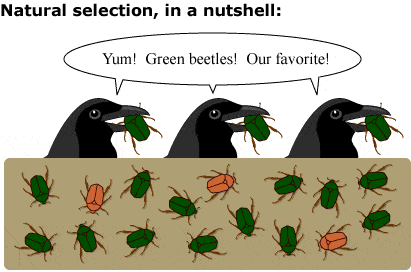
Which of the following is NOT an example of natural selection? 
a)
People selectively breeding hamsters.
b)
Insect populations developing resistance to certain pesticides.
c)
Bacteria becoming resistant to antibiotics.
d)
Male birds of certain species developing colorful feathers to attract female mates.
7.
Which term refers to the process by which individuals that are better suited to the environment survive and reproduce therefore passing down their genes to their offspring? 
a)
Evolution 
b)
Variation 
c)
Adaptation
d)
Natural Selection 
8.
The environment around Manchester, England, changed during the Industrial Revolution.  How did this change affect peppered moths living in the area?
a)
Natural selection favored moths with dark wings because predators could not see them on the soot-colored trees.
b)
Natural selection favored moths with white wings that were easy for predators to see.
c)
Natural selection favored moths with white wings because predators could not see them on the soot-colored trees.
d)
Natural selection caused moths with white wings to become extinct.
9.
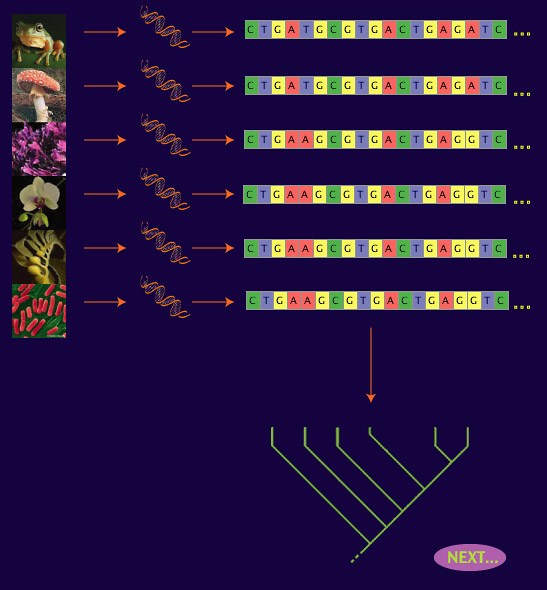
Two organisms that are closely related would have
a)
very similar DNA sequence
b)
exactly the same DNA sequences
c)
no proteins in common
d)
completely different DNA sequence
10.

Eyes that can see in the dark is a(an) _______ inherited by nocturnal animals.

a)

adaptation

b)

acquired trait

c)

learned ability

11.

Individuals undergo evolution.

a)

True

b)

False

12.

The forelimbs of mammals have similar anatomy because these groups descended from a recent common ancestor. Their bone structure is an example of a(n) ______________ structure.

a)

vestigial

b)

analogous

c)

homologous

13.
Change over time is
a)
evolution
b)
generation
c)
growth
d)
biogenesis
14.
Natural selection is
a)
survival of the fittest
b)
humans change
c)
two species are the same
d)
more animals survive
15.
Who was Charles Darwin?
a)
A naturalist who came up with the theory of evolution
b)
A scientist who studied plants
c)
A geologist who looked at rocks and fossils
d)
A paleontologist who studied dinosaurs
16.
Individuals that are well adapted to their environment will survive and produce
a)
better traits
b)
stronger genes
c)
more offspring
d)
fewer mutations
17.
The fossil record provides evidence that 
a)
Fossils cannot be dated.
b)
All species were formed during Earth’s formation and have changed little since then.
c)
The fossilized species have no connection to today’s species.
d)
Older species gave rise to more-recent species.
18.
Which of the following is a factor in natural selection?
a)
Individuals of species compete with one another to survive.
b)
All species are genetically diverse.
c)
Individuals better able to adapt to changes leave more offspring.
d)
All are correct 
19.
The surroundings and conditions in which an organism lives and operates.
a)
Evolution
b)
Population
c)
Environment
d)
Biological diversity
20.
What is binomial nomenclature?
a)
A two name naming system
b)
A two headed turtle
c)
A two grouped system to classify
d)
A two lensed microscope
21.
Which kingdom do humans belong to?
a)
Plantae
b)
Fungi
c)
Animalia
d)
Protista
22.
The 8 levels of classification, most broad to most specific.
a)
Domain, Genus, Family, Order, Class, Phylum, Kingdom, Species
b)
Domain, Species, Kingdom, Genus, Phylum, Family, Class, Order
c)
Domain, Kingdom, Phylum, Class, Order, Family, Genus, Species
d)
Order, Kingdom, Species, Domain, Phylum, Family, Class, Genus
23.
A dichotomous key for trees is provided. Hikers found a tree that has large brown cones and single sharp needles. What species of tree have the hikers found?
a)
Juniper
b)
Pine
c)
Spruce
d)
Fir
24.
A student discovers an arachnid with a segmented abdomen, long legs, and a tail with no stinger. The student uses the dichotomous key below to identify it. Which arachnid has the student found?
a)
Whip Scorpion
b)
Wind Scorpion
c)
Daddy long legs
d)
Scorpion
25.
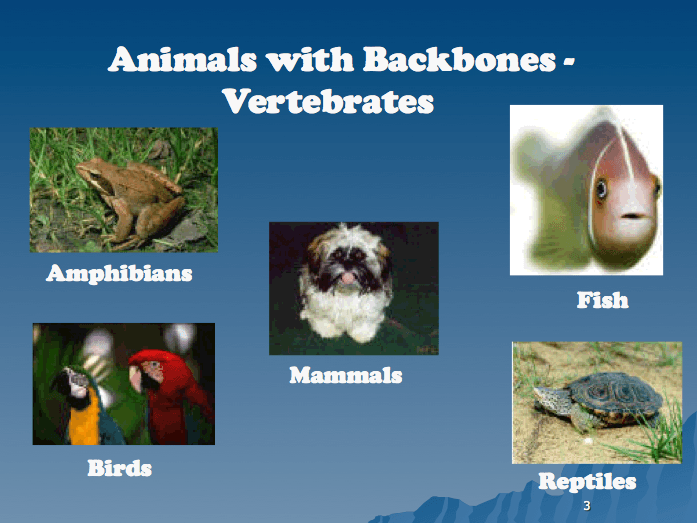
What are vertebrates?
a)
Animals with a backbone
b)
Animals without a backbone
26.

There are five categories of vertebrates. Which one is not a vertebrate?

a)

Mammals

b)

Birds

c)

Insects

d)

Reptiles

27.

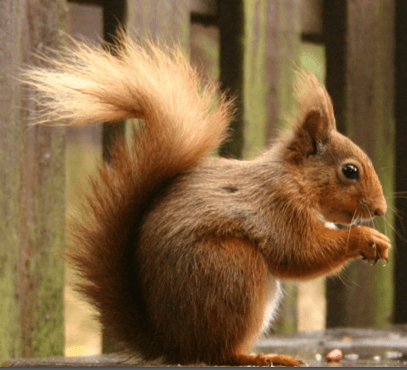
I have fur, I breathe with lungs, and I am warm blooded. What am I?

a)

Mammal

b)

Amphibian

c)

Bird

d)

Reptile

28.
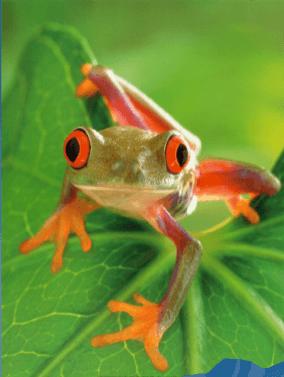
My body is moist and smooth, I lay eggs, and live in or near the water.  What am I?
a)
Amphibian
b)
Reptile
c)
Bird
d)
Fish
29.

My body is warm and covered in feathers. I lay eggs which hatch. What am I?

a)

Reptile

b)

Amphibian

c)

Mammal

d)

Bird

30.

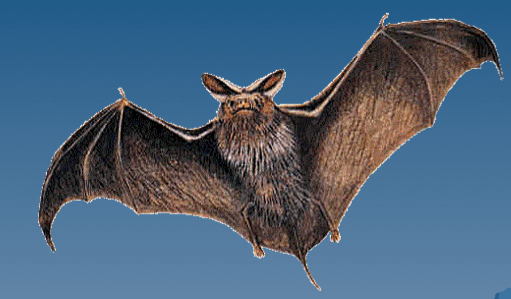
I have fur and I can fly. I feed my young on milk, and have live births. What am I?

a)

Reptile

b)

Bird

c)

Mammal

d)

Fish

31.
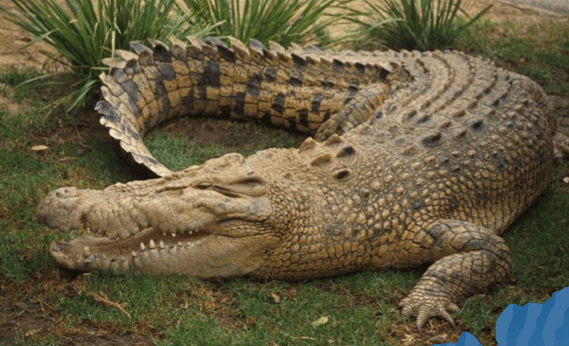
I am covered in dry scales and I lay eggs.  What am I?
a)
Mammal
b)
Fish
c)
Amphibian
d)
Reptile
32.

Animals that begin their life in the water and later live on land are called...

a)

Birds

b)

Amphibians

c)

Mammals

d)

Reptiles

33.

What class do you belong in?

a)

Birds

b)

Mammals

c)

Reptile

d)

Amphibian

34.

How do fish breathe?

a)

Through their gills

b)

Through their skin

c)

Through their fins

d)

Through their feathers

35.

An animal that is warm-blooded...

a)

can maintain a constant body temperature

b)

cannot maintain a constant body temperature

c)

is almost for sure a reptile

d)

always lays eggs

36.
The leaf's cuticle
a)
stores water
b)
reduces evaporation
c)
transports water in the leaf
d)
absorbs water for the leaf
37.
What happens in the phloem?
a)
water moves up from the roots
b)
food moves down from the leaves
c)
food moves up from the roots
d)
water moves down to the roots
38.
Gases pass in and out of a leaf through the 
a)
stomata
b)
phloem
c)
xylem
d)
cuticle
39.
The energy that powers photosynthesis comes from
a)
water
b)
chemicals
c)
oxygen
d)
the sun
40.
What part of a plant transports water and nutrients from the root to the plant's stem and leaves?
a)
root hairs
b)
phloem
c)
xylem
d)
cuticle
41.
All of the following is a root function, except
a)
water absorption
b)
food storage
c)
plant anchoring
d)
food production
42.

Seeds can move from one place to another by

a)

wind

b)

water

c)

animals

d)

wind, water, and animals

43.
WHERE does photosynthesis take place? 
a)
cell wall 
b)
chlorophyll 
c)
nucleus 
d)
chloroplast 
44.
What is the function of the petal on a flower? 
a)
to support the flower
b)
to carry pollen 
c)
to produce food 
d)
to attract pollinators 
45.
The female reproductive structure is called .... 
a)
stamen 
b)
style 
c)
pistil 
d)
filament 
46.
The male reproductive structure is called... 
a)
anther 
b)
filament 
c)
pistil 
d)
stamen 
47.

5. It contains food for baby plants.

a)

A) seed coat

b)

B) embryo

c)

C) cotyledon

48.

9.- What is Germination?

a)

A) the growth of roots of a young plant.

b)

B) the growth of new leaves of a young plant

c)

C) the overall growth of a seed into a young plant.

49.
DNA is found in the nucleus
a)
Prokaryote
b)
Eukaryote
50.

Name the Human species:

a)

Australophitecus.

b)

Homo Habilis.

c)

Homo Sapiens.

d)

Homo Neanderthalensis.