wayground logo

Free Printable Worksheets

NEW

Font size

S
M
L
XL
Worksheets

Changes in Climate

Total questions: 44

Worksheet time: 44mins

Name
Class
Date
1.

The volume of water moved by a stream is called

a)

discharge

b)

divide

c)

runoff

2.

Evaporation of water from soil and transpiration from plants is called

a)

evapotranspiration

b)

evaporation

c)

condensation

3.

Water found underground in the cracks and spaces in soil, sand and rock is called

a)

groundwater

b)

headwater

c)

watershed

4.
What does NOT produce carbon dioxide?
a)
Photosynthesis
b)
Burning Fossil Fuels
c)
Animal respiration
d)
Plants decaying
5.
TRUE or FALSE?
All of the carbon in existence is continually recycled in the carbon cycle.
a)
True
b)
False
6.
Organisms that do not decompose can be buried and become what?
a)
water
b)
nutrients
c)
air
d)
fossil fuels
7.
Carbon can be found in...
a)
The atmosphere
b)
Soil
c)
Fossil fuels
d)
All of the above
8.
Which of the following removes carbon from the atmosphere?
a)
Combustion
b)
Respiration
c)
Photosynthesis
d)
Death
9.
Respiration is the process by which animals take in _____ and release _____. 
a)
photosynthesis, air
b)
carbon, oxygen
c)
oxygen
d)
oxygen, carbon dioxide
10.
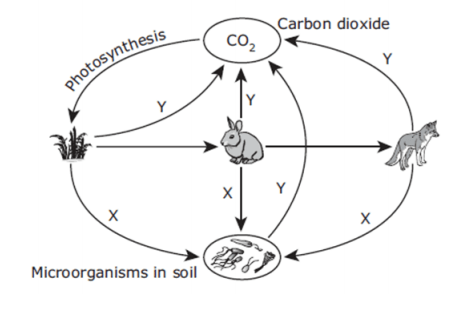
The diagram shows the flow of organic molecules through an ecosystem. What two processes are identified by the labels X and Y?
a)
X : Respiration
Y : Predation
b)
X : Adaptation
Y : Decomposition
c)
X : Fermentation
Y : Nitrogen Fixation
d)
X : Decomposition
Y : Respiration
11.
The average temperature of the surface of Earth has increased approximately 1°C in the past century. Which reason best explains this increase in temperature?
a)
lower levels of ozone in the atmosphere
b)
lower levels of nitrogen in the atmosphere
c)
higher levels of carbon dioxide and other greenhouse gases in the atmosphere
d)
higher levels of oxygen in the atmosphere
12.
When we discuss greenhouse gases what is the main one we discuss?
a)
Methane (CH4)
b)
Carbon Dioxide (CO2)
c)
Nitrous oxide (N2O)
d)
Flourinated gases
13.
T/F: Water vapor is a greenhouse gas
a)
True
b)
False
14.
T/F: Some greenhouse gases are naturally present in the Earth's atmosphere
a)
True
b)
False
15.
The warming of the atmosphere by the trapping of heat being radiated to space is called
a)
evaporation
b)
condensation
c)
the greenhouse effect
d)
radiation
16.
Consequences of climate change include:
a)
Stronger hurricanes
b)
Increased flooding
c)
Frequent droughts
d)
All of the above
17.

What results from livestock and other agricultural practices and by the decay of organic waste in municipal solid waste landfills?

a)

Carbon Dioxide

b)

Methane

c)

Water Vapor

d)

Fluorinated Gases

e)

Nitrous Oxide

18.
Without the Greenhouse Effect the Earth would be
a)
warm 
b)
cold
c)
dead
19.

Grooves or scratches cut into bedrock when clasts embedded in the moving glacier act like the teeth of a giant rasp

a)

Clast

b)

Erosion

c)

Glacial Striation

d)

Erratic

20.
Sustainable means
a)
using a lot of energy
b)
being able to last for a long time by creating as much as you use
c)
Being able to cause a stain
21.

Sustainability is making sure that the planet and its resources can continue to provide life.

a)

True

b)

False

22.

The main idea of sustainability is to act responsibly so that the resources on the planet will be able to _____________many generations to come.

a)

feed

b)

wipe out

c)

support

d)

clothe

23.

The reason we have seasons on our planet is because...

a)

we are closer to the sun during the winter and further during the winter.

b)

the tilt of Earth's axis allows for more direct sunlight in the summer and less direct sunlight in the winter.

c)

seasonal wind patterns carry warmer winds during the summer and colder winds during the winter.

d)

the Earth's orbit becomes more like an oval to give us different seasons.

24.

Ice cores can trap gases, like carbon dioxide. And increased concentration of carbon dioxide found in a layer of ice is one piece of evidence for ____________.

a)

climate change

b)

cell theory

25.

Both El Nino and La Nina have this in common

a)

Influence birds that migrate over the ocean

b)

Influence rainy / dry weather world wide

c)

The weather at the polar regions

d)

The directions that ships travel in the oceans

26.

How often do El Nino events occur?

a)

2-5 years

b)

2-7 years

c)

7-10 years

27.
El Nino occurs when the tropical ocean waters are warmer in which ocean?
a)
Atlantic
b)
Indian
c)
Pacific
d)
Arctic
28.

Why do the fisherman of Peru and South America not welcome a strong El Nino?

a)

El Nino poisons the fish

b)

El Nino causes strong winds and currents which move fish westward

c)

El Nino bring cold water to the surface which kills the base of the food chain

d)

El Nino shuts off upwelling and nutrients needed for the marine food chain do not rise to the surface

29.

What is climate?

a)

the condition of the atmosphere at any given time and place

b)

cloud cover and temperature

c)

precipitation and humidity at a given time and place

d)

weather conditions in an area over a long period of time

30.

Climate is affected by many factors including:

a)

latitude, elevation, and proximity to bodies of water

b)

tides and currents

c)

wind

d)

snow and sleet

31.

At which latitude would you expect to find the warmest air temperatures?

a)

23.5° S

b)

c)

66.5°N

d)

66.5°S

32.

These areas is located between 66.5°N and the North Pole and 66.5°S and the South Pole. It has low temperatures and very little precipitation.

a)

Polar Climate Zones

b)

Temperate Climate Zones

c)

Tropical Climate Zones

d)

The Arctic Climate Zones

33.

What is elevation?

a)

the depth of the ocean

b)

the height of the atmosphere

c)

the depth of a lake

d)

the height above sea level

34.

The areas located between 23.5°N and 66.5°N and 23.5°S and 66.5°S. These zones have hot summers and cold winters and usually have four seasons.

a)

Polar Climate Zones

b)

Temperate Climate Zones

c)

Tropical Climate Zones

d)

Oceanic Climate Zones

35.

What climate zone is located near the equator where the sun is directly overhead all year?

a)

polar

b)

tropical

c)

desert

d)

temperate

36.

Which city would you expect to have the overall colder climate?

a)

Atlanta, Georgia (elevation of 1,050 feet)

b)

Baton Rouge, Louisiana (elevation of 56 feet)

c)

Chicago, Illinois (elevation of 579 feet)

d)

Steamboat Springs, Colorado (6, 732 feet)
37.
What is the climate of the top of a mountain like as compared to the bottom of the mountain?
a)
warmer
b)
cooler
c)
drier
d)
wetter
38.
What is the difference between climate and weather?
a)
 Climate averages the weather conditions in a specific place over a long period of time, while weather describes the state of the atmosphere at a specific moment in time.
b)
 Weather averages the weather conditions in a specific place over a long period of time, while Climate describes the state of the atmosphere at a specific moment in time.
c)
Climate describes the weather conditions at night, while weather describes the conditions during the daytime.
d)
 There is not a difference between climate and weather.
39.
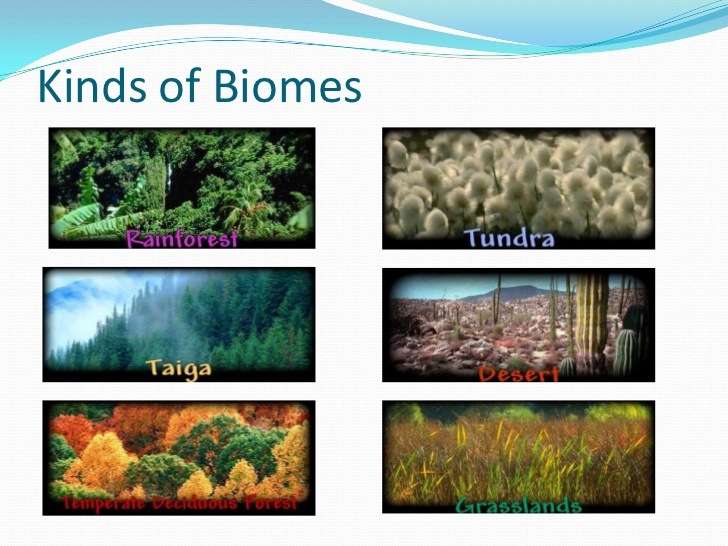
What is the main factor that separates the biomes?
a)
Land
b)
Water
c)
Climate
d)
Longitude
40.
Which biome is the driest?
a)
Desert
b)
Tundra
c)
Taiga
d)
Rainforest
41.
Which Biome has permafrost?
a)
Temperate Forest
b)
Rainforest
c)
Taiga
d)
Tundra
42.
Which biome has wide-open fields of grass?
a)
Taiga
b)
Grasslands
c)
Temperate Forest
d)
Rainforest
43.
Which biome has the most variety of plants and animals?
a)
Temperate Forest
b)
Rainforest
c)
Tundra
d)
Grasslands
44.
Which biome has coniferous trees (which don't lose their leaves)?
a)

Coniferous Forest

b)
Temperate Forest
c)
Tundra
d)
Grasslands