
 Worksheets
EOC 4 - Evolution
Total questions: 34
Worksheet time: 21mins
One sex competes over obtaining mates, and only those with specific traits are successful.
Male Competition
Female Choice
Evolution
Species
One sex chooses mates with a specific set of features
Female Choice
Male Competition
DNA Evidence
Natural Selection

The picture shows a male and female pheasant. What type of selection occurred for them to have these adaptations?
Natural Selection
Sexual Selection - Female Choice
Sexual Selection - Male Competition
Random Selection

Occurs when individuals at the extremes of the range of characteristic are selected against. This means that the "average" individuals are selected for.
Stabilizing Selection
Directional Selection
Disruptive Selection
all of the choises


Evolution can be defined as a ____________
change in the frequency of an allele in a population over time
change in the frequency of reproduction in a population
change in the frequency of an allele in an individual
What process leads to a new species and often begins by a portion of a population become physically or geographically isolated?
Speciation
Selective breeding
genetic change
resistance
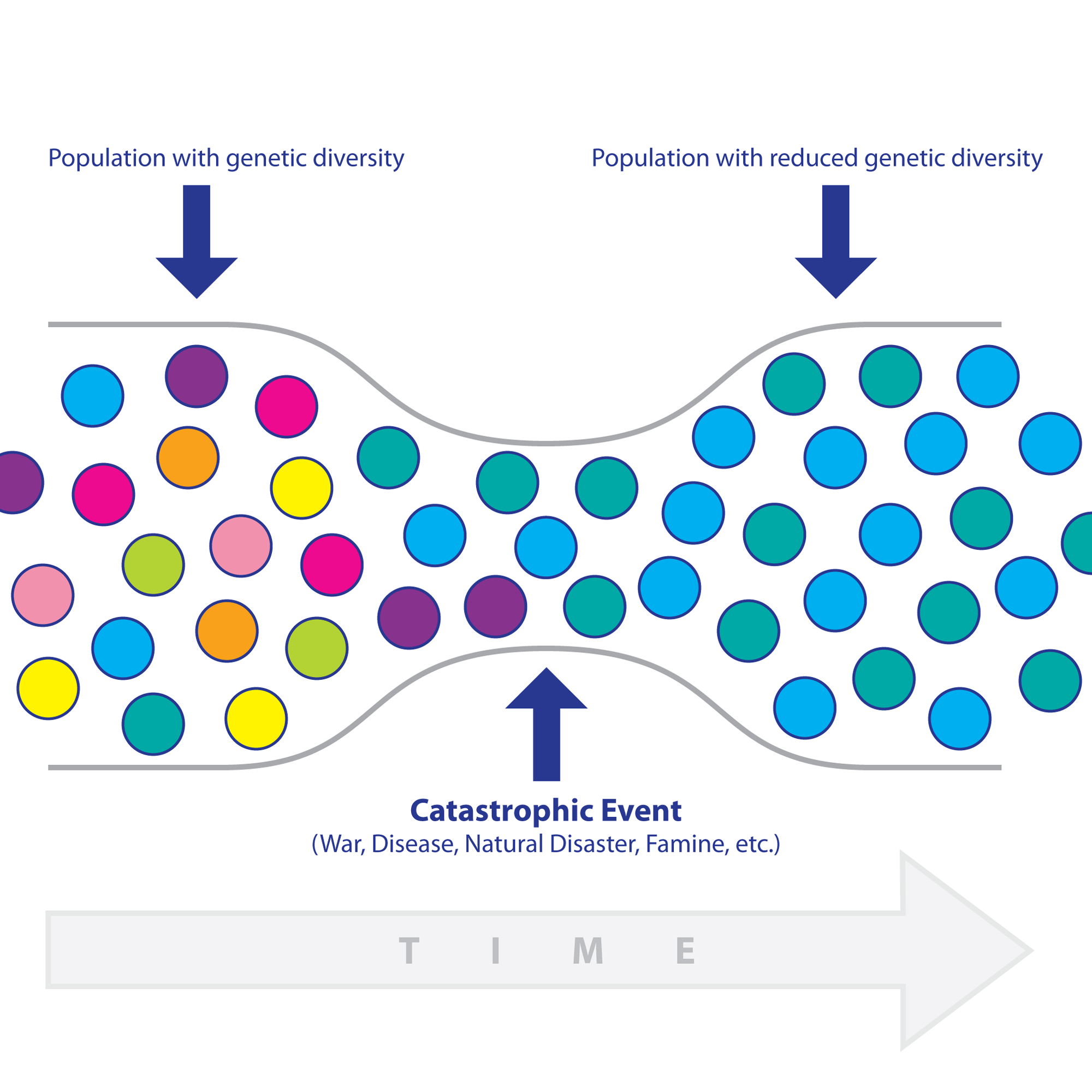
A drastic reduction in the size of a population that can change allele frequencies is called
the bottleneck effect
the founder effect
the gene flow effect
the Thanos effect
The Endosymbiotic Theory explains
the origin of prokaryotes
how bacteria lives
the origin of eukaryotes
how species develop

Two students are reading an article about the evidence of the endosymbiotic theory. As they are reading, they have drawn images of what they believe to be occurring on index cards. The two students are engaging in a discussion on how the index cards should be ordered to accurately show the evolution of eukaryotic cells.
Student A claims the order should be B, E, D, A, C. Their reasoning is that since the small circles without lines in the index cards represent chloroplasts, photosynthesizing organisms evolved before aerobic organisms.
Student B claims the order should be B, A, C, E, D. Their reasoning is that since the small ovals with lines in the index cards represent mitochondria, respiratory organisms evolved before photosynthesizing organisms
Use the diagram to answer the question. Which statement below is accurate about the discussion above?
student A has a correct ordering of index cards but incorrect reasoning.
student B has a correct ordering of index cards and correct reasoning.
Student A has a correct ordering of index cards and correct reasoning.
Student B has a correct ordering of index cards but incorrect reasoning.
_____ and _____ are organelles that arose from endosymbiosis
nucleus and cell membrane
mitochondria and chloroplasts
cell wall and chloroplasts
mitochondria and nucleus
Which of the following is evidence to support the endosymbiotic theory?
Mitochondria and chloroplasts have their own DNA, which is similar to prokaryotic DNA.
Fossil evidence shows that the first forms of life were prokaryotic cells.
All eukaryotic cells have a double-layered membrane composed of phosplipids and proteins.
Prokaryotes have the same number and types of enzymes as eukaryotes.

Images of the embryo and adult stages of three different organisms are shown.
Which of the following is the best conclusion that can be drawn from this evidence?
Having similar embryos indicates that these organisms eat the same types of food.
Having similar embryos indicates that these organisms live in a similar environment.
Having similar embryos indicates that these organisms share a recent common ancestor.
Having similar embryos indicates that a certain protein controls how many legs the adult organisms will have.
Why are advantageous traits more likely to be passed onto offspring?
Because they are more likely to survive and reproduce.
Because they come from dominant alleles.
Because they come from recessive alleles.
Because the organism knew it needed that trait, survives, and passes it on.
Why is competition important for natural selection?
It shows which variations are more successful, allowing the organisms with those variations to survive.
It causes organisms, regardless of which traits they have, to die out, reducing the population size.
It causes organisms to get stronger due to having to outcompete other species.
Competition is not important for natural selection.

Domesticated dogs are an example of:
natural selection
artificial selection
darwin selection
lamarck selection
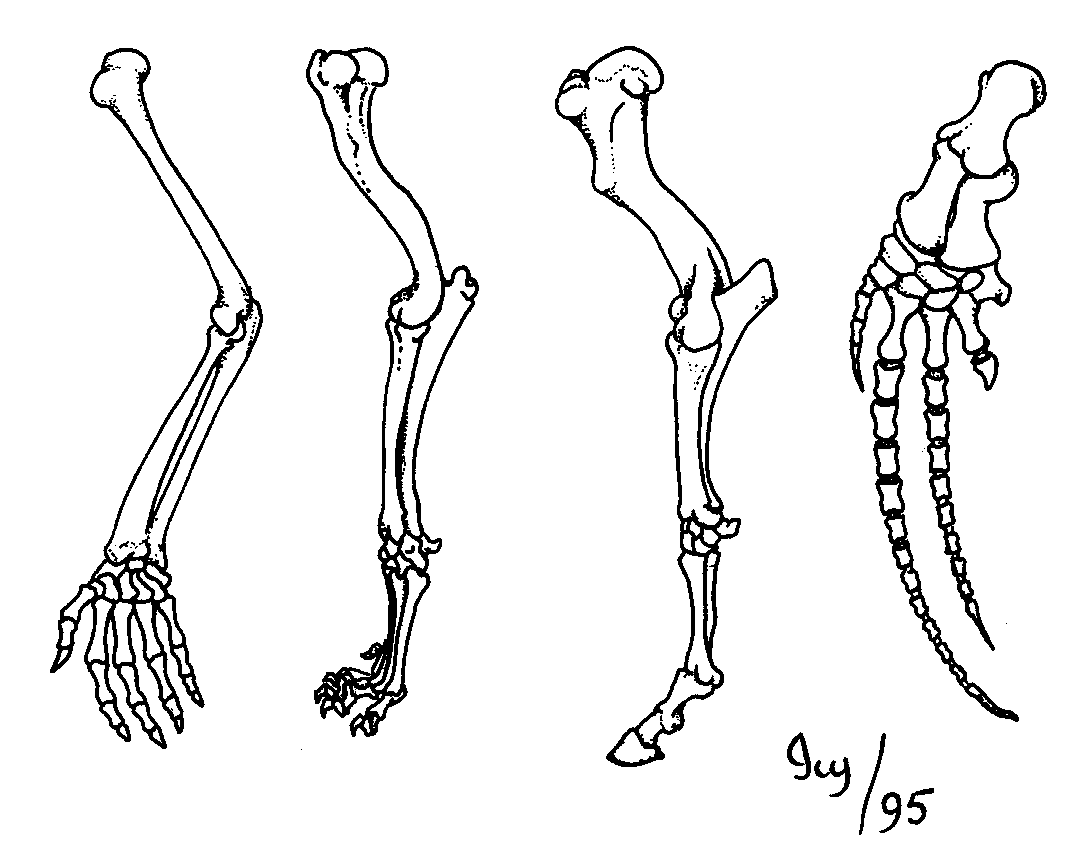
Evolved from the same ancestor, but have different functions
Homologous structures
Analogous structures
Vestigial structures
All of the above
Evolved from different ancestors, but due to living in similar environments have a similar function.
Homologous structures
Analogous structures
Vestigial structures
All of the above

The three species pictured do not share a common ancestor, yet have evolved to have a similar anatomy and life style. This is an example of ?
Homologous Structures
Divergent Evolution
Vestigial Organs
Convergent Evolution

The three species pictured share a common ancestor and have adapted so that each lives in a different environment. This is an example of
Law of Superposition
Evolutionary Arms Race
Divergent Evolution
Convergent Evolution

Broad spectrum antibiotics are bad because:
They kill many different pathogenic bacteria
They are really cheap to buy
They can increase the rate of development of antibiotic resistance
All of the above

