wayground logo

Free Printable Worksheets

Font size

S
M
L
XL
Worksheets

Year 7 Term 1 Review

Total questions: 76

Worksheet time: 1hrs 27mins

Name
Class
Date
1.

Each element is made up of its own kind of _______ .

a)

atoms

b)

block

2.
Something that takes up space and has mass.
a)
volume
b)
matter
c)
mass
d)
density
3.
I am the smallest whole particle of matter. 
a)
atom
b)
compound
c)
molecule
d)
mixture
4.
I am 2 or more elements chemically bonded.
a)
atom
b)
molecule
c)
compound
d)
mixture
5.
A pure substance that cannot be broken down into any other substance by chemical or physical means. There are about 100 of us shown in the Periodic Table
a)
compound
b)
mixture
c)
molecule
d)
element
6.
Type of matter made of two or more elements...
a)
element
b)
mixture
c)
compound
7.

This diagram represents...

a)

An element

b)

A molecule

c)

A compound

d)

A mixture of elements and compounds

8.
a)
element
b)
compound
c)
mixture of elements
d)
mixture of compounds
9.
a)
element
b)
compound
c)
mixture of elements
d)
mixture of compounds
10.
a)
element
b)
compound
c)
mixture of elements
d)
mixture of compounds and elements
11.
a)
element
b)
compound
c)
mixture of elements and compounds
d)
mixture of compounds
12.
a)
element
b)
compound
c)
mixture of elements
d)
mixture of compounds
13.
What is a mixture?
a)
elements chemically combined
b)
a combination of different things
c)
it is found on the Periodic Table 
d)
it is made of chemical
14.
Sand floating in water, but most of the sand is settled at the bottom this an example of which type of mixture?
a)
A solution
b)
A colloid
c)
A suspension
d)
A compound
15.

A salad is an example of a __________.

a)

homogenous mixture

b)

solution

c)

heterogeneous mixture

d)

homogenous solution

16.
What are the two types of Mixtures
a)
Elements and Subatomic Particles
b)
Protons and Electrons
c)
Atoms and Compounds
d)
Homogenous and Heterogeneous
17.
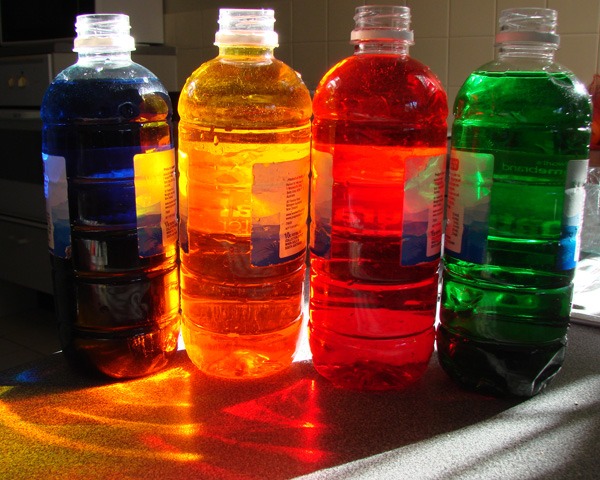
Coloured water is an example of a
a)
homogeneous mixture
b)
heterogeneous mixture
18.
What type of force is shown in the picture?
a)
The Cat force
b)
Star Wars Force
c)
Unbalanced force
d)
Balanced  force
19.
What is a Force?
a)
The distance
b)
Mass
c)
A push or pull
d)
Give me a  failing grade 
20.
An _______ force must act on an object for it to CHANGE it's motion
a)
balanced
b)
unbalanced
c)
gravitational
d)
electrical
21.

If the net force is equal to zero, the forces acting on the object are

a)

balanced

b)

unbalanced

22.
Balanced forces do not change the objects speed or 
a)
direction
b)
distance 
c)
time
d)
mass
23.
The unit of force is
a)
m/s
b)
m/s^2
c)
newton
d)
kg
24.
Forces that have a net force of zero ( the object is still).
a)
Balanced force
b)
Unbalanced force
25.
What is the net force?
a)
5000 N right
b)
4000 N right
c)
40 N left
d)
4000 N left
26.
Jonny and Patty are pushing against a basketball. Both of them push against theball on opposite sides with a force of 20 N to keep the ball still. What is the net force?
a)
400 N
b)
24 N
c)
0 N
d)
40 N
27.
What is the net force in this picture?
a)
50 Newtons to the right
b)
950 Newtons to the right
c)
950 Newtons to the left
d)
50 Newtons to the left
28.
What will cause an object to move?
a)
Applied forces
b)
Balanced forces
c)
Unbalanced forces
29.
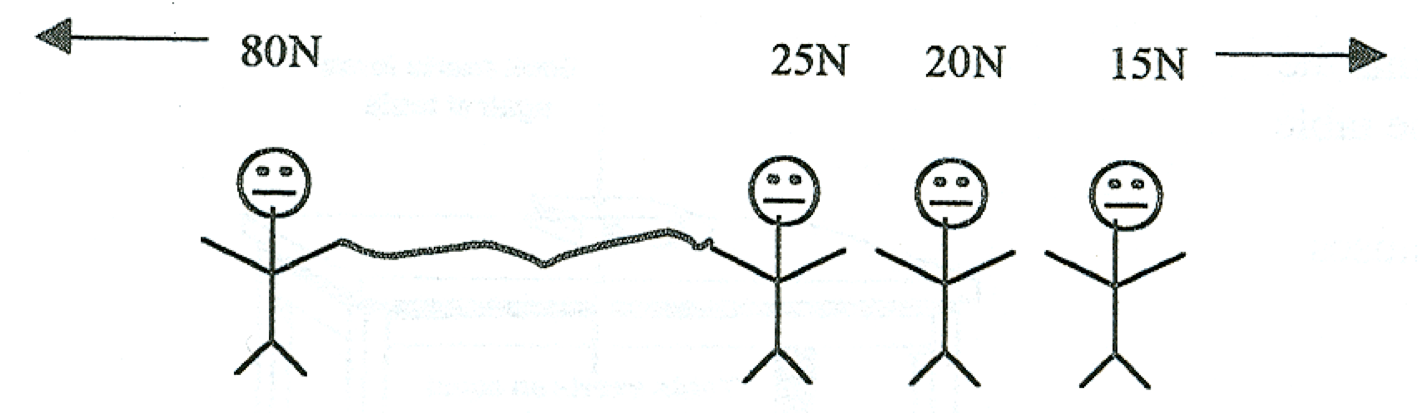
Who wins the tug of war with what net force?
a)
The person on the left with 20 N
b)
The person on the left with 80 N
c)
The people on the right with 20 N
d)
The people on the right with 100 N
30.

Two forces act on an object to the right at the same time. What force is required to bring the object into equilibrium?

a)

9 N to the right

b)

9 N to the left

c)

3 N to the left

d)

18 N to the left

31.
How does friction affect speed?
a)
more friction decreases speed
b)
more friction increases speed
c)
less friction decreases speed
d)
less friction doesn't affect speed
32.
Friction is a force that acts in an ___________ direction of movement.
a)
similar
b)
opposite
c)
parallel
d)
west
33.
A type of friction that occurs when air pushes against a moving object causing it to decelerate.
a)
surface area
b)
air resistance
c)
velocity
d)
gravity 
34.
Which of the following is an example of friction that is helpful?
a)
Brakes used on a bike
b)
Tires from a car on the road
c)
Tread on the bottom of your shoes
d)
All are examples that are helpful
35.
Which would NOT be a way of reducing friction?
a)
making the surfaces smoother
b)
using lubricants such as waxes, oils, or grease
c)
changing from sliding friction to rolling friction using ball bearings
d)
Using kitty litter on snow and ice to help your car gain traction
36.
What does friction produce?
a)
light
b)
sound
c)
heat
d)
gravity
37.

Which two of these forces act on parachutes?

a)

Air Resistance

b)

Gravity

c)

Thrust

d)

Kinetic Energy

38.

What causes an object to fall faster?

a)

Smaller surface area

b)

Larger surface area

c)

If it has a parachute

d)

If it is softer

39.

Another name for air resistance is...

a)

Buoyancy

b)

Streamline

c)

Gravity

d)

Drag

40.

The larger the surface area of the moving object, the ___________ air resistance there is.

a)

Less

b)

More

c)

Longer

d)

Quicker

41.
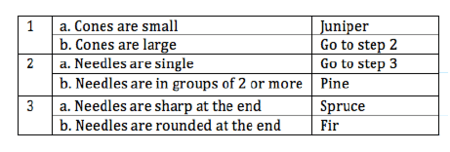
A dichotomous key for trees is provided. Hikers found a tree that has large brown cones and single sharp needles. What species of tree have the hikers found?
a)
Juniper
b)
Pine
c)
Spruce
d)
Fir
42.
A dichotomous key for insects is given. To what order does an insect with two pairs of scaly wings belong?
a)
Coleoptera
b)
Heteroptera
c)
Diptera
d)
Lepidoptera
43.
What step do we always start with when using dichotomous keys?
a)
1
b)
2
c)
3
d)
4
44.
When using a dichotomous key to identify organisms, what do we look at?
a)
physical features
b)
weather patterns
c)
environment
d)
diet
45.
A botanist discovers a new plant in the jungle. Which of the
following observations of the plant’s characteristics would be useful in determining its identity with a dichotomous key?
a)
It was discovered in the summertime
b)
It is wet from a recent rain storm.
c)
Its leaves curl up on the edges.
d)
It is eaten by native jungle ants.
46.

Which of the following characteristics would be useful in determining the identify of a tree in a dichotomous key?

a)

It provides shade

b)

It has a nest

c)

It has several birds in it

d)

Its leaves are long and narrow

47.
What should you do when typing a scientific name?
a)
Capitalize the first word
b)
Capitalize the first word and underline the whole thing
c)
Capitalize the first word and italicize the whole thing
d)
Nothing
48.
What is the purpose of a dichotomous key?
a)
to find a common ancestor
b)
to show the evolution of organisms
c)
to show relationships between organisms
d)
to identify organisms
49.
Term given to describe the 2 name naming system is:
a)
dichotmous key
b)
binomial nomenclature
c)
2 scientific names
d)
binomial key
50.
The first part of a scientific name is an organism's _______________ and the second part is its ________________.
a)
species, genus
b)
phylum, order
c)
class, spices
d)
genus, species
51.

What is binomial nomenclature?

a)

system of 3 names

b)

system of 2 names

c)

the names of the kingdoms

d)

the levels of classification

52.
Who first proposed binomial nomenclature as a way of classifying organisms?
a)
Carl Linnaeus
b)
Carl's Jr.
c)
Charles Darwin
d)
Henry Groseclose
53.
The science of describing, classifying, and naming living things is called:
a)
Geology
b)
Biology
c)
Taxonomy
d)
Chemistry
54.
Imaginary line that runs through the north & south poles of earth.
a)
axis
b)
equator
c)
latitude
d)
degrees
55.
The spinning of the earth on its axis.
a)
orbit
b)
revolution
c)
day
d)
rotation
56.
The orbiting of earth around the sun.
a)
orbit
b)
revolution
c)
year
d)
rotation
57.

What season is the northern hemisphere in at position D

a)

winter

b)

spring

c)

summer

d)

fall

58.

In what position would the northern hemisphere need to be at to be in winter?

a)

D

b)

V

c)

W

d)

X

59.

What causes a hemisphere to be in the summer season?

a)

It's closer to the sun.

b)

It's receiving the direct rays of the sun.

c)

It's tilted away from the sun.

d)

The axis is pointed towards the north star.

60.

How can it be summer & winter at the same time on the same planet?

a)

one hemisphere is closer to the sun

b)

one hemisphere is receiving the direct rays of the sun while the other is receiving indirect rays

c)

one hemisphere has a path of warm winds from the north

d)

the southern hemisphere balances out the temperatures for earth

61.

What is the main cause of the seasons?

a)

earth's tilted axis

b)

earth's distance from the sun

c)

earth's elliptical orbit

d)

earth's rotation on its axis

62.

Which happens when the Earth comes in between the Moon and the Sun?

a)

Lunar Eclipse

b)

Solar Eclipse

c)

Earth Eclipse

d)

Jupiter Eclipse

63.

Which eclipse happens when the Moon gets in between the Earth and the Sun?

a)

Neptune Eclipse

b)

Uranus Eclipse

c)

Solar Eclipse

d)

Lunar Eclipse

64.

Why can you not see a total solar eclipse from everywhere on the Earth?

a)

No, You can see a total solar eclipse anywhere on the Earth

b)

Because the Moon is smaller than the Sun and the Earth

c)

Because the Moon is bigger than the Sun and the Earth

d)

Because the Earth is tilted

65.

How long does it take to the moon to revolve around the Earth?

a)

23.7 days

b)

25.4 days

c)

27.3 days

d)

24 hours

66.
What is the result of the Earth’s rotation?
a)
Seasons
b)
Eclipses
c)
Moon Phases
d)
Day and Night
67.
How long does it take for the Earth to make one complete rotation?
a)
365 days/1 year
b)
1 week
c)
24 hours/1 day
68.

Identify the scientific equipment

a)

Beaker

b)

Conical Flask

c)

Filter Funnel

d)

Test Tube

69.

Identify the scientific equipment

a)

Beaker

b)

Flask

c)

Cup

d)

Conical Flask

70.

Identify the scientific equipment

a)

tube

b)

test tube

c)

beaker

d)

flask

71.

Identify the scientific equipment

a)

Funnel

b)

Filter Funnel

c)

Drip Tube

d)

flask

72.

Identify the scientific equipment

a)

burner

b)

fire maker

c)

bunsen

d)

bunsen burner

73.

Identify the scientific equipment

a)

heat mat

b)

wire mat

c)

gauze mat

d)

metal mat

74.

Identify the scientific equipment

a)

measuring cup

b)

measuring cylinder

c)

measuring device

d)

measuring tube

75.

Identify the scientific equipment

a)

retort stand

b)

stand

c)

holder

d)

standing device

76.

Identify the scientific equipment

a)

rack

b)

test tube holder

c)

wooden tube holder

d)

test tube rack