
 Worksheets
Optional gas laws quiz review
Total questions: 80
Worksheet time: 3hrs 29mins
If 3.25 mol of Ar occupies 100. L at a particular temp and pressure, what volume (in L) will 14.15 mol of Ar occupy under same condition?
Enter your answer with the correct number of significant figures.
(a)
What is the equation that relates moles and gas volume (Avogadro's Law)?
P1V1 = P2V2
T1V1=T2V2
n1V1=n2V2
PV = nRT
If 1.00 mol of He occupies 22.4 L at standard temperature and pressure (STP), what volume will 1.00 g of He occupy under the same conditions?
A balloon contains 0.504 moles of a gas at a volume of 2680 mL. When the number of moles changes to 0.423 moles, what is the new volume of the balloon?
Enter your answer with the correct number of significant figures.
(a)
A balloon containing 12.05 moles of a gas had an original volume of 265 L. If an additional 2.51 moles of the same gas are added at the same temperature and pressure, what is the new volume of the balloon?
0.662 L
55.2 L
320. L
1270 L
A balloon had an original volume of 12.05 L. Additional gas was added to the balloon. The new volume is 12.99 L when a total of 7.81 moles of gas are in the balloon. How many moles did the balloon originally contain?
20.04 mol
7.24 mol
1.53 mol
7.00 mol
A balloon contains 1.99 moles of a gas and has a volume of 12.2 L.
How many moles of this gas would occupy a volume of 15.6 L at the same conditions?
9.52 mol
2.55 mol
2.40 mol
7.41 mol
If a beach ball has a volume of 261 L at a temperature of 502 K, what will be the new temperature of the balloon if the volume decreases to 176 L and the pressure remain constant?
744 K
0.0030 K
339 K
512 K
The pressure remains constant over a sample of helium gas occupying a volume of 638 mL. The temperature is increased to 471 K and the volume is now 953 mL. What was the original temperature?
315 K
1291 K
704 K
133 K
The volume of a gas at 25ο C is 3.80 L. What will be the volume of that gas at
57 ο C if the pressure is held constant?
Which of the following correctly predicts how the gas pressure inside a hairspray can would be affected if a hairspray can is heated?
The pressure will increase
The pressure will decrease
The pressure will remain constant
The pressure will equalize
Which of the following correctly predicts how the gas pressure inside a hairspray can would be affected if a hairspray can is heated?
The pressure will increase
The pressure will decrease
The pressure will remain constant
The pressure will equalize
In order to convert to Kelvin, you add ______ to the Celsius measurement.
372.00
273.15
237
732
Which of the following would increase the (gas) pressure of a system?
Increase the temperature
Pump in more gas
Decrease the volume
All of these
Pressure is
defined as the mass that an object exerts when at rest.
not a measurable in gases.
defined as the number of moles of substance divided by the mass of the substance.
created by the force of the gas particles impacting the walls of the container.
A student measures the pressure and volume of a balloon to be 1.4 atm and 2.3 L She then decreases the pressure to 0.65 atm while keeping the temperature constant. What is the new volume?
2.1 L
5.0 L
8.2 L
3.9 L
What is the pressure of a car tire that had an initial pressure of 1.8 atm but was heated from 38°C to 123°C?
0.9 atm
2.1 atm
1.6 atm
3.4 atm

If the pressure on a gas is increased, the temperature will ___________, when the volume is held constant.
increase
decrease
remain the same
If 6.00 L of gas at 293K is compressed to 4.00L at constant pressure, what is the new temperature?
195K
440.K
0.0820K
12.2K
A gas at a pressure of 928 kpa and a temperature of 129 oC occupies a volume of 569 L. Calculate the volume at 319 kpa and 32 oC.
410.61 L
418.18 L
1255 L
1400 L
5.7 liters of gas in a piston at a pressure of 1.5 atm is compressed to a volume of 4.8 L at constant temperature. Calculate the new pressure inside the piston.
18 atm
1.8 atm
1.3 atm
1.29 atm
What is the volume of a balloon that contains 3.7 moles of helium at 75°C and 5.1 atm?
37 L
13 L
45 L
21 L
You are holding four identical balloons, each containing 10.0 g of a different gas. The balloon containing which gas is has the largest volume?
H2
He
Ne
O2
All have the same volume.
Which of the following correctly shows the relationship between gas pressure and temperature?


Which of the following graphs correctly depicts the relationship between gas volume and gas pressure?


A sample of sulfur dioxide occupies a volume of 652 mL at 313 K and 150 kPa. What volume will the sulfur dioxide occupy at STP?
STP = 273 K, 101.3 kPa
1682.6 mL
20.7 mL
492.3 mL
842.1 mL

A quantity of gas has a volume of 250 L, at 290 K and 303.98 kPa of pressure. What volume must the gas be for the gas to be at 273 K and 101.33 kPa?
78.4 L
88.5 L
706 L
771 L

What volume of methane gas at 273 K and 101.33 kPa do you have when the volume is decreased to 0.50 L, with a temperature of 300 K and a pressure of 151.99 kPa.
0.68 L
0.82 L
0.50 L
0.37 L

If 3.0 L of helium at 293 K with a pressure of 200 kPa is allowed to expand to 4.4 L with the pressure staying constant. What is the new temperature?
702 K
430 K
157 K
0 K

A gas is heated from 263K to 298K. The volume is increased from 24.0L to 35.0L. If the original pressure was 101.33 kPa, what is the new pressure?
78.7 kPa
167.2 kPa
129.7 kPa
61.8 kPa

A weather balloon has a volume of 105 L at 98.3 kPa when the temperature is 318 K. What is the volume at 293 K and 106.4 kPa?
89.4 L
0.32 L
93.8 L
3.13 L
Oxygen gas is at a temperature of 40oC when it occupies a volume of 2.3 liters. To what temperature should it be raised to occupy a volume of 6.5 liters, assuming constant pressure?
610oC
610 K
113 K
880 oC
110 oC
Hydrogen gas was cooled from 150oC to 50oC. Its new volume is 75 mL. What was its original volume?
98 mL
98 K
98oC
98 L
A rigid plastic container holds 1.00 L methane gas at 0.90 atm pressure when the temperature is 22.0°C. What is the new pressure the gas exert if the temperature is raised to 44.6°C, assuming constant volume?
0.97 atm
1.82 atm
0.97oC
1.82oC
What is STP?
1 Degrees Celsius and 0 ATM
0 Degrees Celsius and 1 ATM
0 Kevin and 10 ATM
273 Celsius and 273 ATM
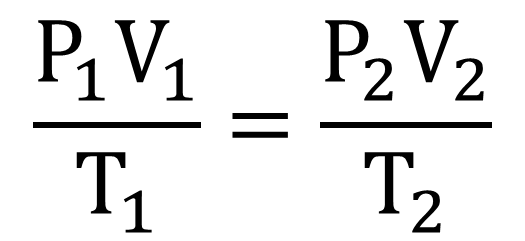
10.oC
If 10.0 L of O2 at 273K and 1.0 atm is compressed to a 7.0L container at 250K, what is the new pressure?
1.3 atm
9.2 atm
A 1.11 L sample of neon gas at 18 oC and 0.799 atm is heated to 49 oC. The new gas pressure is 1.11 atm. What is the change in volume of the neon gas?
.30L
0.884L
.28L
1.2L
If I initially have 4.0 L of a gas at a pressure of 1.1 atm, what will the volume be if I increase the pressure to 3.4 atm?
1.29 L
12.36 L
1.29 atm
12.36 atm
If I have 5.6 liters of gas in a piston at a pressure of 1.5 atm and compress the gas until its volume is 4.8 L, what will the new pressure inside the piston be?
1.8 atm
3.27 atm
1.8 L
3.27 atm
A sample of nitrogen occupies a volume of 250 mL at 25oC. What volume will it occupy at 95oC?
308.70 mL
456.1 mL
308.70oC
456.1oC
A weather balloon has a volume of 105L at 0.97 atm when the temperature is 318K. What is the volume at 293K and 1.05 atm?
89.4 L
0.32 L
93.8 L
3.13 L
What is the pressure of a car tire that had an initial pressure of 1.8 atm but was heated from 38°C to 123°C?
0.9 atm
2.1 atm
1.6 atm
3.4 atm

The pressure of the gas in the balloon in the ice water will be:
Greater than that of the balloon in the boiling water.
Less than that of the balloon in the boiling water.
The same as that of the balloon in the boiling water.
Not enough information to answer the statement.
If 15L of neon at 300. K and 3.0 atm is allowed to heat to 350K, what is the new pressure, assuming volume stays constant?
3.5 atm
2.6 atm
16.7 atm
0.86 atm
A sample of gas containing 9.2 moles is transferred from an 13 L tank to a 23 L tank. What is the new number of moles that can be stored in the tank?
10.2 mol
13.7 mol
19.1 mol
16.3 mol
A 28.965 L sample of Kr experiences a change in pressure from 358.34 kPa to 729.71 kPa. What is the resulting volume in liters? Express answer with correct number of sig figs.
(a)
A 68.966 L sample of methane experiences a change in pressure from 977.47 kPa to 560.28 kPa. What is the resulting volume in liters? Express answer with the correct number of sig figs.
(a)
A sample of Ar experiences a change in volume from 39.801 L to 53.449 L. If its new pressure is 804.79 kPa, what was its original pressure in kilopascals?
(a)
A sample of carbon monoxide at 466.1 kPa experiences a change in volume from 6.481 L to 3.396 L. What is the resulting pressure in kilopascals?
(a)
A sample of SF6 experiences a change in pressure from 655.08 kPa to 88.28 kPa. If its new volume is 31.106 L, what was its original volume in liters?
(a)
A sample of carbon dioxide experiences a change in volume from 54.16 L to 22.323 L. If its new pressure is 554.05 kPa, what was its original pressure in kilopascals?
(a)
A 43.361 L sample of hydrogen gas experiences a change in pressure from 252.68 kPa to 30.35 kPa. What is the resulting volume in liters?
(a)
A sample of radon experiences a change in pressure from 578.78 kPa to 931.88 kPa. If its new volume is 36.387 L, what was its original volume in liters?
(a)
A gas with a volume of 400 L at 120K is heated until its volume is 700 L. What is the new temperature ( in degree Celsius) of the gas if the pressure is constant?
483K
688 K
210. K
68.57K
210 K
A gas at a volume of 4 liters is at a pressure of 2 atm. The volume is changed to 16 Liters. The new pressure of the gas is (a)
A 25.0 L balloon that contains 3.55 moles of a gas loses gas (it leaked). If we know that we were able to trap 1.55 moles of gas, what would the new volume of the balloon be?
57.3 L
4.54 L
7.48 L
10.9 L
If a balloon contains 1.99 moles of a gas and has a volume of 12.2 L, how many moles (mol) would another balloon have if it contained 15.6 L of the same type of gas?
9.52 mol
2.55 mol
2.40 mol
7.41 mol
A 600 mL sample of nitrogen is heated from 27 °C to 77 °C at constant pressure. What is the final volume?
800 ml
700 ml
600 ml
500 ml
The initial and final temperature of neon is 289 K and 323 K. Find the initial volume if the final volume is 2.3 L?
2.0 L
2.1 L
2.4 L
2.5 L
A gas occupies a volume of 400. cm3 at 0°C and 780 mm Hg. What volume (in litres) will it occupy at 80°C and 780 mm Hg?
0.663L
0.517L
1.05L
1.301L
The pressure exerted by a gas is (a) related to its temperature and (b) related to the pressure.
Why does the air pressure inside the tires of a car increase when the car is driven?
Some of the air has leaked out.
The air particles collide with the tire after the car is in motion.
The air particles inside the tire increase their average speed because their temperatures rise.
The atmosphere compresses the tire.
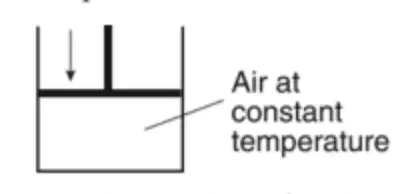
The diagram shows a sample of air in a cylinder with a movable piston. As the piston is moved down, the number of gas molecules (a)
Which of the following graphs correctly represents the relationship between the absolute temperature of a confined gas and its pressure, when volume is held constant?


Which of the following graphs correctly shows the relationship between volume and absolute temperature of a confined gas, at constant pressure?


As temperature rises ___________.
an atom's kinetic energy decreases
an atom's kinetic energy increases
an atom's kinetic energy stays the same
A gas occupies a volume of 5.0 L under a pressure of 1.2 atm. If the volume is changed to 3.0 L and the temperature remains constant, the new pressure of the gas is (a) atm.
A 2.0 liter container of nitrogen had a pressure of 3.2 atm. What volume would be necessary to decrease the pressure to 1.0 atm?
Enter your numerical value with the appropriate number of significant figures; do not include units
(a)
What is the pressure of a car tire that had an initial pressure of 1.8 atm but was heated from 38°C to 123°C?
0.9 atm
2.1 atm
1.6 atm
3.4 atm

