
 Worksheets
HBS 4.2 quiz review
Total questions: 52
Worksheet time: 27mins
A sarcomere is
a nonfunctional unit of skeletal muscle
a repeating structural unit of skeletal muscle
the area between two intercalated discs
the wavy lines on the muscle seen in the microscope.
Which of the following are composed of myosin?
thick filaments
thin filaments
Z discs
all myofilaments
Which of the following surrounds the individual muscle cell?
perimysium
endomysium
epimysium
fascicle
Which of the following muscle type is not striated?
smooth muscle
skeletal muscle
cardiac muscle
none of above
The bundle of collagen fibers at the end of a skeletal muscle that attaches the muscle to bone is called a(n)
fascicle
tendon
ligament
myofibril
Rigor mortis occurs because
the cells are dead
sodium ions leak out of the muscle
ATP is required to release the attached
actin and myosin molecules
proteins are beginning to break down, thus preventing the flow of calcium ions.
Where is cardiac muscle found?
In the walls of hollow organs
In the walls of the heart
Around the skeleton
In between ribs
What is the function of skeletal muscle?
Movement of the body
Moving food toward the stomach
Pumping blood through the heart
Moving the lungs during breathing
The place where neurons meet muscles cells is called the
point of joint origin.
site of insertion.
neuromuscular junction.
fiber that covers the muscle.
What are the three types of muscle?
Open, closed and striated
Smooth, rough and striated
Cardiac, skeletal and closed
Smooth, cardiac and skeletal
A syndrome that affects the median nerve in the wrist is called:
ATP
rigor mortis
carpal tunnel
deletion


What is another name #1?
Skeletal muscle
Cardiac muscle
Smooth muscle
Myofiber
What is another name #2? (Hint: It is a muscle layer)
Skeletal muscle
Epimysium
Perimysium
Endomysium
What is another name #5? (Hint: It is a muscle layer)
Skeletal muscle
Epimysium
Perimysium
Endomysium
What is another name #6? (Hint: It is a muscle layer)
Skeletal muscle
Epimysium
Perimysium
Endomysium
What is the name of #3?
Skeletal muscle
Myofibril
Myofiber
Tendon
What number covers a fascicle?
#6
#5l
#4
#10
What is another name for #9 (cell membrane)?
Sarcomere
Sarcolemma
Myofibril
Myofiber
What is another name for #10?
Sarcomere
Sarcolemma
Myofibril
Myofiber
What is another name for a muscle cell?
Sarcomere
Sarcolemma
Myofibril
Myofiber
What is a bundle of muscle fibers called?
fascia
fascicle
epimysium
endomysium
What is a tendon?
The covering of the whole muscle
The covering of a fascicle
It connects bone to bone
It connects muscle to bone
What is a myofibril?
A subunit of a muscle fiber
The covering of a muscle fiber
The covering of a whole muscle
The smallest contractile unit of a muscle.
Which type of muscle tissue is involuntary?
Skeletal muscle
Cardiac muscle
Smooth muscle
This structure stores calcium in the muscle cell
Sarcolemma
Sarcoplasmic reticulum
Sarcomere
The A band contains which type of filaments?
Only thick
Only thin
Both thick and thin

The arrow is pointing to
The Z disc
The I band
The thin filament
The H zone
These organelles store the neurotransmitter ACh
Vesicles
Sarcoplasmic reticulum
Golgi body
Lysosomes
Which combo of chemicals are essential for a muscle contraction?
Potassium, ADP, Phosphorous
Calcium, Potassium, Phosphorous
Sodium, Potassium, Glucose
Calcium, ATP, Sodium
What is not a function of the muscular system?
Maintaining posture
Generating heat
Movement
Storing red blood cells
What is listed from smallest to largest correctly?
Sarcomere, fascicle, muscle fiber
Myofibril, sarcomere, fascicle
Sarcomere, myofibril, muscle fiber
Myofibril, fascicle, sarcomere
What is the name of the neurotransmitter that is released from the neuron to the sarcolemma?
Acetylcholine
Acetone
ATP
Calcium
Which of these occurs last during a muscle contraction?
The nerve signal reaches the neuromuscular junction
Ach is released and opens Na ion channels
The sarcomere shortens
The myosin binds to the actin
Which of these occurs first during a muscle contraction?
The nerve signal reaches the neuromuscular junction
Ach is released and opens Na ion channels
The sarcomere shortens
The myosin binds to the actin

The green arrows are pointing at the border between sarcomeres called the.....
M Line
H Line
Z disk
I Line

Identify letter 'G'
Sarcolemma
Sarcoplasmic Reticulum
T-tubules
Mitochondria
Where is smooth muscle tissue located?
in hollow organs and blood vessels
in the heart
on the surface of the body
attached to bone
Which muscle tissue type(s) are involuntary?
cardiac
smooth
cardiac and smooth
skeletal
cardiac, smooth, and skeletal
Which muscle tissue type(s) are voluntary?
cardiac
smooth
cardiac and smooth
skeletal
cardiac, smooth, and skeletal

Which muscle tissue type is shown in the picture?
cardiac muscle tissue
smooth muscle tissue
skeletal muscle tissue
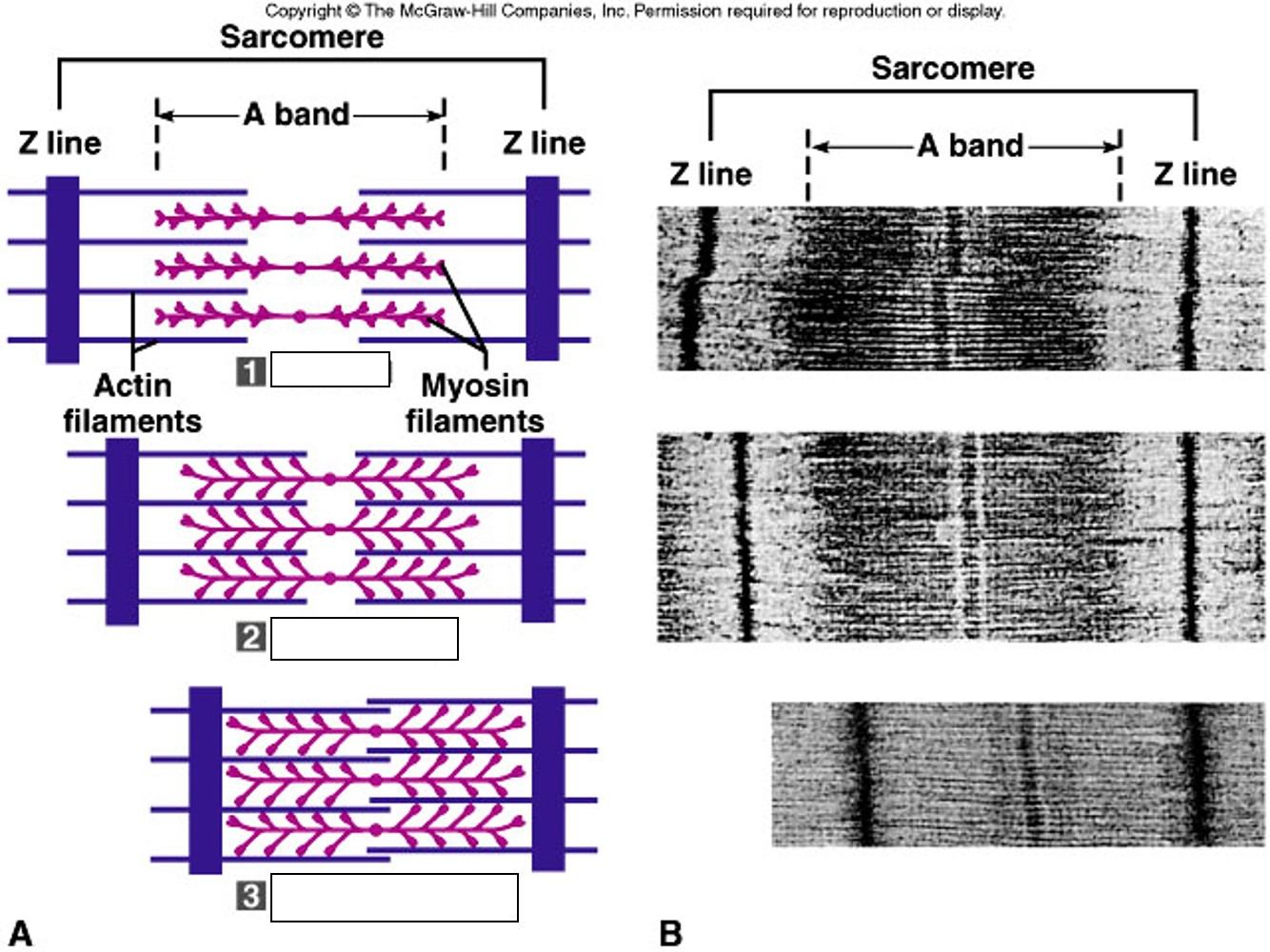
Sliding filament theory states that
Actin and myosin filaments shorten and slide past each other
When myofilaments slide past each other , shortening of actin filaments occur
When myofilaments slide past each other , shortening of myosin filaments occur
Actin and myosin filaments do not shorten , they only slide past each other

____________ attaches to actin to form the cross bridge.
Troponin
Tropomyosin
Myosin
Calcium

What muscle is the arrow pointing to?
Pectoralis (Pecs)
Biceps
Triceps
Lats
This muscle is located on the upper chest and function in adduction and flexion of the arm/shoulder
latissimus dorsi
brachialis
deltoid
pectoralis major
What is the origin of the brachioradialis?
scapula
distal half of humerus
lateral ridge of humerus
head of scapula

