Wayground logo

Free Printable Worksheets

Font size

S
M
L
XL
Worksheets

2S Easter Revision Quiz

Total questions: 80

Worksheet time: 3hrs 0mins
Name
Class
Date
1.
Name that shape.
a)
quadrilateral, parallelogram
b)
quadrilateral
c)
quadrilateral, kite.
d)

quadrilateral, trapezium

2.

What can we call any quadrilateral that has opposite sides that are parallel and all of its sides are the same length?

a)
Rhombus
b)

Trapezium

c)
Rectangle
d)
Square
3.
Name that shape. 
a)
quadrilateral, parallelogram, rectangle, rhombus, square
b)
square
c)
quadrilateral, parallelogram, square
d)
quadrilateral, parallelogram, rhombus, square
4.

Can a polygon have curved sides?

a)

yes

b)

no

5.
What is the sum of the exterior angles?
a)
90 degrees
b)
180 degrees
c)
540 degrees
d)
360 degrees
6.

The shape is a regular polygon. Determine the angle x.

a)
x =72 degrees
b)
x = 45 degrees
c)
x = 360 degrees
d)
x = 540 degrees
7.

Find the sum of the interior angles of this polygon.

a)

A

b)

B

c)

C

d)

D

8.

Find the sum of the interior angles for this polygon.

a)

A

b)

B

c)

C

d)

D

9.

Find angle x

a)

247o

b)

67o

c)

157o

d)

203o

10.

Find angle x

a)

127o

b)

217o

c)

37o

d)

63o

11.

Find the size of angle x

a)

108o

b)

120o

c)

90o

d)

144o

12.

How do you calculate the area of a triangle?

a)

base x height

b)

take half of the base times the height

c)

add up all of the sides

13.

Calculate the area of the triangle.

a)

84 cm2

b)

42 cm2

c)

21 cm2

d)

168 cm2

14.

Calculate the area of the triangle.

a)

32 cm2

b)

16 cm2

c)

20 cm2

d)

10 cm2

15.

Calculate the area of the parallelogram.

a)

36 cm2

b)

30 cm2

c)

60 cm2

d)

45 cm2

16.
Find the area of the trapezium.
a)
16 cm2
b)
30 cm2
c)
32 cm2
d)
60 cm2
17.
Find the height of the trapezium, given that its area is 150 cm2.
a)
12 cm
b)
21.4 cm
c)
1.95 cm
d)
6 cm
18.

Find the area of the trapezium

a)

38cm2

b)

49.5cm2

c)

76cm2

d)

36cm2

19.

What is the error?

a)

Area requires to divide by the base.

b)

Do not multiply area by 1/2.

c)

The base is not 14 units.

d)

The height is not 11 units.

20.

Find the missing yellow length

a)

2 cm

b)

6 cm

c)

9 cm

d)

4 cm

21.

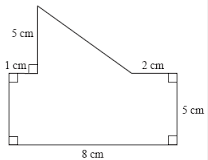
Work out the AREA of this compound shape.

(just the number. No units)

(a)  

22.
What is the area of the shaded region?
a)
14 m2
b)
120 m2
c)
106 m2
d)
134 m2
23.
What is the area of the composite figure?
a)
80 cm2
b)
16 cm2
c)
96 cm2
d)
32 cm2
24.
What is the base and the height of the triangle in this composite shape?
a)
base: 8cm
height: 5 cm
b)
base: 5 cm
height: 8 cm
c)
base: 5 cm
height: 5 cm
d)
base: 1 cm
height: 2 cm
25.
If the dotted figure is the image, the original figure was reflected over the ...
a)
x-axis
b)
y-axis
26.
State the line of reflection.
a)
Reflection across y-axis
b)
Reflection across x-axis
c)
Reflection across x = 1
d)
Reflection across y = 1
27.

What is the mirror line for this reflection?

a)

y=4

b)

x=-3

c)

y=x

d)

y= -x

28.

Does the mirror line y=x map shape A onto shape E?

a)

Yes

b)

No

29.

What type of rotation does this represent (from red to blue)?

a)

270⁰ clockwise

b)

180⁰

c)

90⁰ clockwise

30.

Triangle A is rotated 270° clockwise with the origin as the center of rotation to create a new figure. Which triangle shows the new location?

a)

A

b)

B

c)

C

d)

D

31.
The image C'D'E' is a rotation of CDE.
a)
True
b)
False
32.

How was the triangle ABC translated to triangle A'B'C'?

a)

3 up , 8 left

b)

9 down , 4 right

c)

8 down , 4 right

d)

2 up , 3 left

33.

a)

8 left and none up or down

b)

8 up and non left or right

c)

8 down and non left or right

d)

8 right and none up or down

34.

Find the scale factor of the enlargement from A to C

a)

2

b)

0.5

c)

3

d)

4

35.

Find the scale factor of the enlargement from B to F

a)

1/2

b)

3

c)

2

d)

1/4

36.

Describe the transformation that takes the blue shape to the pink shape...

a)

Enlargement

Scale Factor: 2

Centre: (0,0)

b)

Enlargement

Scale Factor: 1/2

Centre: (0,0)

c)

Enlargement

Scale Factor: -2

Centre: (0,0)

d)

Enlargement

Scale Factor: -2

Centre: (2,0)

37.

Find the scale factor of the enlargement from R to T

a)

2

b)

1

c)

3

d)

0.5

38.
What is a possible sequence of transformations for the given figures? 
a)
Reflect over the x-axis, translate (x+8,y)
b)
Reflect over the x-axis then translate (x+6, y)
c)
Reflect over the y-axis then (x+1, y+1)
d)
Translate down 4 (y-4) and to the right 5 (x+5)
39.

Which of the following describes the sequence of transformations shown?

a)

Reflect across the x-axis and then rotate 90 degrees counterclockwise around the origin

b)

Rotate 90 degrees clockwise around the origin and then translate down 8.

c)

Reflect across the x-axis and then reflect across the y-axis.

d)

Translate up 8 and then rotate 90 degrees counterclockwise about the origin.

40.

The definition of a circle is

a)

the set of all points in a plain that are the same distance from a point called the centre

b)

the distance around a square

c)

a curved figure

d)

a shape with no vertices

41.

The definition of radius is

a)

distance from one point to another point

b)

distance around the circle

c)

distance from the center to any point on the circle

d)

distance across the circle through the center

42.

The definition of diameter is

a)

distance from the center of any point on the circle

b)

distance across the circle through the center

c)

distance from one point to another

d)

distance around the circle

43.

The definition of circumference is

a)

distance from the center of any point on the circle

b)

distance from one point to another

c)

distance around the circle

d)

distance from the center of any point on the circle

44.

what is the formula for finding circumference


select ALL that apply

a)

c = π d

b)

c = 2 π r

c)

d = 2 r

d)

r = d/2

45.

which segment above represents the diameter

a)

BC

b)

AC

c)

BD

d)

LM

46.

what is the formula for finding area of a circle

a)

C = π r2

b)

A = π r2

c)

A = π r2 / 2

d)

C = 2 π r

47.
If you are given the diameter, how can you calculate the radius?
a)
Multiply the diameter by 2
b)
Divide the diameter by 2
c)
Add 2 to the diameter
d)
Subtract 2 from the diameter
48.
A cruise ship has a large, circular window. It has a diameter of 6 meters. What is the window's approximate circumference?
a)
3 m 
b)
9.42 m
c)
12 m
d)
18.84 m
49.
Find the circumference of a circle with diameter = 10 ft
a)
3.14 ft
b)
31.4 ft
c)
314.1 ft
d)
62.8 ft
50.
Find the arc length.  Leave your answer in terms of π.
a)
7/4π
b)
7/2π
c)
1/8π
d)
45π
51.
FIND THE ARC LENGTH OF THE BOLDED ARC
a)
A
b)
B
c)
C
d)
D
52.

A area between/bounded by two radii of the circle and the arc where the radii meet the circle.

a)

triangle

b)

arc length of a circle

c)

sector of a circle

d)

segment of a circle

53.

What is the radius of a circle with an area of 49π?

a)

49

b)

10

c)

7

d)

14

54.
FIND THE SECTOR AREA OUTLINED IN BOLD
a)
A
b)
B
c)
C
d)
D
55.
FIND THE SECTOR AREA OUTLINED IN BOLD
a)
A
b)
B
c)
C
d)
D
56.
What kind of triangles does the Pythagorean Theorem work with?
a)
Right
b)
Left
c)
Isosceles
d)
Equilateral
57.
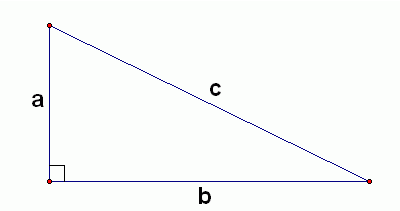
What is the formula used to solve for the hypotenuse?
a)
a2+b2=c2
b)
a+b=c
c)
a2-b2=c2
d)
c-a=c
58.
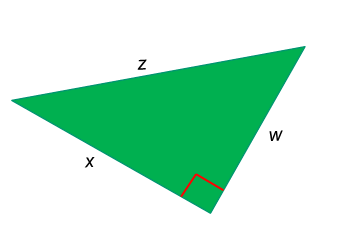
Identify the hypotenuse.
a)
x
b)
z
c)
w
59.
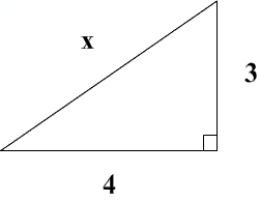
What is the length of x?
a)
5
b)
7
c)
8
d)
25
60.
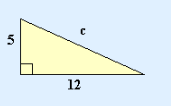
solve for c
a)
7
b)
9
c)
4
d)
13
61.
Use Pythagoras' Theorem to find c in this triangle:
a)
5.29
b)
10
c)
28
d)
100
62.
The foot of a ladder is placed 6 feet from a wall. If the top of the ladder rests 8 feet up on the wall, how long is the ladder? 
a)
10 ft
b)
14 ft
c)
17 ft
d)
100 ft
63.
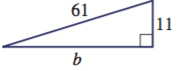
Find the length of b in this triangle.
a)
31
b)
36
c)
60
d)
62
64.
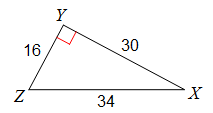
What is the length of the hypotenuse?
a)
16
b)
30
c)
34
65.
What is the gradient of the line
y = 2x - 3?
a)
2
b)
-3
c)
3
d)
2x
66.
Which of these lines would be the steepest?
a)
y = 2x + 9
b)
y = 7x + 3
c)
y = 5x - 3
d)
y = 7
67.
Which of these lines will intercept the y-axis at 5?
a)
y = 5x
b)
y = x - 5
c)
5y = 5x + 5
d)
y = x + 5
68.
What is the y-intercept of the line
y = 4x - 6?
a)
4
b)
4x
c)
6
d)
-6
69.
Which of these lines has a negative gradient?
a)
The orange one
b)
The red one
c)
The blue one
d)
The green one
70.
What is the gradient of this line?
a)
2
b)
½
c)
-½
d)
-3
71.
What is the y-intercept of this line?
a)
2
b)
3
c)
-3y
d)
-3
72.
Which of these lines is
y = 5?
a)
The orange one
b)
The red one
c)
The blue one
d)
The green one
73.
Which of these lines has a gradient of ½?
a)
The orange one
b)
The red one
c)
The blue one
d)
The green one
74.
Which of these
co-ordinates lie on the line
y = 3x - 8?
a)
(5, 8)
b)
(0, 8)
c)
(2, -2)
d)
(1, 5)
75.
Which of these lines passes through the point (3, 7)?
a)
y = 2x + 4
b)
y = x + 5
c)
y = x + 10
d)
y = 3x - 2
76.
Which of these lines will intercept the y-axis at 5?
a)
y = 5x
b)
y = x - 5
c)
5y = 5x + 5
d)
y = x + 5
77.

The table of values for the equation, y = x + 2 are:

a)
b)
c)
d)
78.

The table of values for the equation, y = 4 - x are:

a)
b)
c)
d)
79.

State whether the values given for x and y make the equation true or false

a)

True

b)

False

80.

State whether the values given for x and y make the equation true or false

a)

True

b)

False