
 Worksheets
Practice - Earth Science
Total questions: 65
Worksheet time: 55mins

What type of weathering is it when acid rain breaks down and changes the rock.
Chemical weathering
Mechanical weathering
Astronomical weathering
Physiological weathering

Freezing water is expanding, causing the crack in the rock to widen (frost action). What kind of weathering is this?
Chemical weathering
Mechanical weathering

What is weathering?
occurs when the eroded materials are dropped or laid down
fragments of weathering rocks
the process by which rock materials are broken down by the action of physical and chemical process
the process by which wind, water, ice or gravity transport weathered materials from one location to another
In the pictures below, choose each picture that shows different types of physical weathering.


What type of chemical weathering is in the picture shown?
oxidation
mosses and lichens
acid precipitation

What is erosion?
When sediment is transported from one place to another
When eroded materials are dropped or laid down.
when sediment or rocks are broken down
when rocks react with oxygen and water

1. What happens to the sediment when a river slows down at a curve?
the river picks up larger pieces of sediment
the river loses energy and drops sediment
the river gains energy and picks up large boulders
the river stops all erosion at this point

What geologic process happens when a delta forms as a river is emptied into the ocean?
the sediment's composition is being changed by oxidation
the sediment is being eroded by the river and deposited into the ocean
the sediment has experienced frost wedging


A fan-shaped area where a river meets the ocean is called a ____________. This is formed when sediment and rock is deposited at the end of the river.
dune
delta
weathering
sediment

A ______________ is a hill of sand created by the wind.
dune
delta
sediment
Which best describes the surface of the earth over billions of years?
High mountains gradually wear down until most of the earth is at sea level
High mountains stay side by side for billions of years with little change
Flat surface is gradually pushed up into higher and higher mountains until the earth is covered with mountains
High mountains gradually wear down as new mountains are continuously being formed, over and over again
Sediment is deposited in a river delta because the
speed of the river decreases
force of gravity decreases
volume of the river increases
angle of the river increases
Why are sinkholes common in Florida?
Florida is a peninsula. Sinkholes are commonly formed on peninsulas because a peninsula is surrounded by water.
Florida has a lot of swamps with animals that burrow into the sandy soil making holes and tunnels that collapse.
Florida's underlying rock is limestone. Limestone dissolves easily, forming caverns which can then collapse and form a sinkhole.
Florida has a lot of oil underground. When the oil is removed, there is nothing left to hold up the soil
Earth's surface is constantly changing and new landforms are constantly taking shape due to natural processes. Which landform is most likely caused by deposition?
caves
deltas
lakes
valleys
The earth is built up and torn down in many ways. Physical and chemical weathering are processes which are very important in making soil. Which statement accurately describes an example of chemical weathering?
Tree roots break apart a rock.
Sinkholes are formed in central Florida as seeping water dissolves underground limestone rocks.
In Alaska, rocks are broken due to continuous freezing and thawing of water sitting in cracks.
Blowing sand has created beautiful and strange rock formations in the Western United States.

This landform is formed by
water erosion
wind erosion
deposition
glaciers
What is the correct order of the earth's layers from inside to outside?
inner core, mantle, outer core, crust
outer core, inner core, mantle, crust
crust, mantle, outer core, inner core
inner core, outer core, mantle, crust
Select ALL layers that are solid.
crust
mantle
outer core
inner core
Select ALL layers that are liquid/molten rock.
crust
mantle
outer core
inner core

Interactions between layers of Earth cause convection currents to move crustal plates.
In which layer of Earth are the convection currents that directly result in tectonic plate motion found?
1
2
3
4
Imagine you could travel in a straight line through Earth from a point on one side and come out on the other side.
What compositional layer would you travel through in the exact center of Earth?
Mesosphere
Core
Crust
Lithosphere

The diagram shows the collision of two tectonic plates in Asia.
What is a result of this collision?
Volcanoes erupt periodically.
The Tibetan Plateau slowly sinks.
Glaciers on the Tibetan Plateau melt.
The Himalayas increase in height each year.

What is the dropping of sediment is called?
weathering
erosion
deposition
transportation

What is a major factor that affects wind erosion and deposition?
presence of plants and vegetation
water
abrasion
humidity

Which probably experiences more runoff when it rains, a desert or a rain forest?
desert
rain forest

What is the flat, wide area along a river called?
flood plain
meander
delta
tributary

When the oceanic crust sinks beneath the less dense continental crust, like a cookie in milk, this is called:
lithosphere
asthenosphere
subduction

True or false.
The asthenosphere is located below the mantle. Due to extreme heat and pressure. The solid rocks can flow like liquid.
True
False

True or false.
Lithosphere is just another term for the rock that makes up the crust and some of the mantle, forming tectonic plates.
True
False
This layer of the earth:
Is a solid ball of metal, is composed mostly of iron and spins faster than the Earth and is as hot as the sun.
Crust
Mantle
Outer Core
Inner Core
Which layer is made of liquid metal (Fe and Ni)?
crust
mantle
outer core
inner core
Fossils of the fern-like, tropical plant, Glossopteris have been found on the continents of Africa, South America, and Antarctica. How have scientists explained this observation?
The wind blew the plant's seed across the ocean from continent to continent.
The fern developed on each continent.
The continents were once joined together and later moved apart.
The fern had adaptations to survive in different climates.
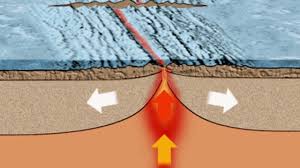
In sea-floor spreading, molten material rises from the mantle and erupts
along the edges of all the continents.
along mid-ocean ridges.
in deep-ocean trenches.
at the north and south poles.

Most geologists think that the movement of Earth’s plates is caused by _______
convection.
continental drift.
subduction.
conduction.
The geological theory of _______ states that pieces of Earth’s lithosphere are in constant, slow motion.
subduction
plate tectonics
deep-ocean trenches
sea-floor spreading
A place where two plates slip past each other, moving in opposite directions, is known as a _______
transform boundary
divergent boundary.
convergent boundary.
rift valley.

The place where two plates come together is known as a _______
transform boundary.
divergent boundary.
convergent boundary.
rift valley.

Below is a picture of sea-floor spreading. How are the ocean crusts moving?
Converging
Diverging
Sliding
No movement
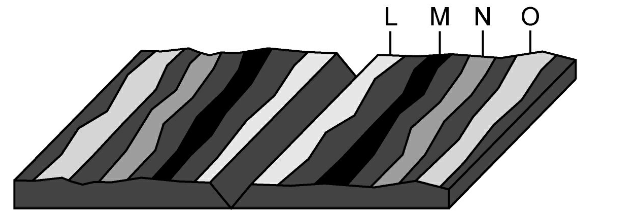

divergent boundary
convergent boundary
transform boundary

divergent boundary
convergent boundary
transform boundary

divergent boundary
convergent boundary
transform boundary
This type of boundary can be found along the San Andreas fault in California....
divergent
convergent
transform
New crust is formed at this type of boundary
divergent
convergent
transform

This area is called the....
Arc of Volcanoes
Ring of Fire
Horseshoe of Magma

Which of the following orders the rock layers accurately from oldest to youngest?
1, 2, 3, 4, 5
5, 4, 3, 2, 1
2, 3, 4, 5, 1
1, 2, 3, 5, 4


Which of the following rock layers is older than than C?
F
E
D
A
Which of the following rock layers is younger than D?
A
B
C
E


Which of the following lists the steps an igneous rock undergoes in order to become a sedimentary rock, in the correct order?
Deposition, erosion, melting, cooling
Erosion, weathering, eruption, cooling
Dissolving, deposition, cooling, fracture
Weathering, erosion, deposition, cementation
What type of rock might contain evidence of past life?
Sedimentary Rock
Igneous Rock
Metamorphic Rock
Limestone is a sedimentary rock. During the rock cycle, limestone is changed into marble, a metamorphic rock. The processes that act on limestone and change it into marble are
weather and erosion
heat and pressure
compacting and cementing
melting, cooling, and hardening

Which of the following CAN be inferred from the diagram?
Rocks can change over time
Metamorphic rock can form from any other type of rock.
Different types of rock will be made of different minerals.
New rocks can be formed from older rocks of different ages.
Which of these actions must take place in order for sedimentary rock to change into igneous rock ?
The sedimentary rock melted and became magma.
Sedimentary minerals dissolved in water to form igneous rock
The sedimentary rock broke down into smaller pieces and then was melted into igneous rock
The sedimentary rock was exposed to extreme heat and pressure.
The forces that create metamorphic rock are related to which of the following?
The breaking of rock into smaller particles over long periods of time
extreme heat and pressures
The cooling of magma above Earth’s surface after a volcanic eruption
The transportation of Earth materials by moving water
Select all of the following that are an example of mechanical weathering?
a tree's roots growing in a cracked rock
a gopher burrowing in the ground and loosening rock/soil
iron oxide weakening and breaking down a rock
ice expanding cracks in a rock

