
 Worksheets
Topic 7: Mid-Topic Review
Total questions: 80
Worksheet time: 3hrs 43mins
The probability of rolling a 7 on a 6-sided number cube labeled 1 through 6 is...
Impossible
Unlikely
Likely
Certain
When flipping a coin, the probability of landing on a heads is 1/2.
True
False
A probability of 0 means:
Impossible
Certain
Likely
Unlikely
A probability of 1 means:
Impossible
Certain
Unlikely
Likely
An unlikely probability means MORE than 1/2.
True
False
A likely probability means MORE than 1/2.
True
False
The theoretical probability of an event is what you would expect to happen.
True
False
A single outcome or group of outcomes is a(an) _____________.
outcome
probability
event
ratio

Red is the _____________________.
probability
outcome
event
ratio
Relative frequency is the ratio of the number of times an event occurs to the _____________________________.
remaining trials
outstanding trials
total trials
to 1
Another name for relative frequency is ______________________.
theoretical probability
experimental probability
sample space
trial
A probability model consists of which of the following?
CHOOSE ALL THAT APPLY.
sample space
events within the sample space and their probabilities
events without their probabilities
dice and coins
A sample space is _____________________________________.
the set of all possible outcomes
the ratio of outcomes to total
the probability
certain, likely, impossible or unlikely

If Mariana spins this spinner, she will MOST likely land on –
orange
blue
red
yellow
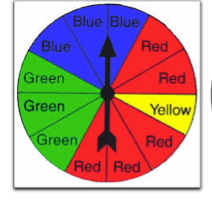
What is the probability of spinning yellow?
P(Y) = 1/11
P(Y) = 1/12
P(Y) = 1/4
P(Y) = 3/4
P(8) = 0
P(8) = 8/6
P(8) = 4/3
P(8) = 1/2
What will happen
What I think happens
John knows that he should roll a 5 on a number cube one out of six times. When he actually rolled the number cube 6 times, he rolled a 5 three times. Which explanation describes this reasoning?
Theoretical probability is 1/6; experimental probability was 1/6
Theoretical probability is 1/6; experimental probability was 1/3
Theoretical probability is 1/6; experimental probability was 1/2
Theoretical probability is 1/6; experimental probability was 5/6
Katrina will roll a fair number cube 57 times during one of her math stations. The sides of the cube are numbered 1 to 6. How many times could Katrina predict rolling a 2 or a 6?
2 times
6 times
19 times
29 times

In the Science Lab, Mrs. Campbell’s class experimented with rolling a number cube. The number cube is labeled 1 through 6. They rolled the number cube 20 times. The data is shown in the table above. What was the experimental probability of rolling a 6 on the number cube?


A board game uses the spinner above. What is the probability that a player will not move an odd number of spaces on their first spin?


What is the theoretical probability of rolling a 4?
P(4) = 3/6
P(4) = 1/6
P(4) = 1/2
P(4) = 4/6

What is the theoretical probability of getting yellow?
P(Yellow) = 2/8
P(Yellow) = 3/8
P(Yellow) = 2/3
P(Yellow) = 1/4

What is the theoretical probability of getting green or red?
P(G or R) = 2/6
P(G or R) = 1/5
P(G or R) = 2/5
P(G or R) = 1/5

What is the theoretical probability of getting an even number?
P(Even) = 1/3
P(Even) = 1/2
P(Even) = 3/6
P(Even) = 2/6

What is the theoretical probability of getting a king?
P(King) = 2/8
P(King) = 1/8
P(King) = 3/8
P(King) = 1/4

What is the theoretical probability of getting an orange Starburst?
P(orange) = 2/9
P(orange) = 1/4
P(orange) = 3/12
P(orange) = 3/10

What is the theoretical probability of getting a blue or yellow cake pop?
P(B or Y) = 4/6
P(B or Y) = 2/5
P(B or Y) = 2/3
P(B or Y) = 1/2

What is the theoretical probability of getting an odd number?
P(Odd) = 2/3
P(Odd) = 4/9
P(Odd) = 7/10
P(Odd) = 1/2

What is the theoretical probability of getting a heart?
P(Heart) = 13/40
P(Heart) = 13/52
P(Heart) = 4/52
P(Heart) = 3/4

What is the theoretical probability of getting a red or blue marble?
P(R or B) = 7/15
P(R or B) = 10/20
P(R or B) = 1/2
P(R or B) = 4/5

What is the theoretical probability of rolling a 2 or higher?
P(2 or higher) = 3/4
P(2 or higher) = 2/3
P(2 or higher) = 4/6
P(2 or higher) = 5/6

What is the theoretical probability of NOT getting a green Starburst?
P(Not Green) = 9/12
P(Not Green) = 1/4
P(Not Green) = 3/4
P(Not Green) = 3/12

What is the theoretical probability of getting a Snickers or Kit Kat?
P(Snickers or Kit Kat) = 1/3
P(Snickers or Kit Kat) = 2/3
P(Snickers or Kit Kat) = 4/9
P(Snickers or Kit Kat) = 3/9

What is the theoretical probability of getting green, yellow or black?
P(G, Y, or B) = 4/3
P(G, Y, or B) = 6/8
P(G, Y, or B) = 2/3
P(G, Y, or B) = 3/4

What is the theoretical probability of rolling a 1 or 5?
P(1 or 5) = 4/5
P(1 or 5) = 1/2
P(1 or 5) = 2/6
P(1 or 5) = 1/3
Probability can be written as...
A fraction
A decimal
A percent
All of the above

A bag has 3 red, 2 blue, 4 green, and 1 yellow marbles.
What is the theoretical probability off pulling a red?
P(red) = 3/10
P(red) = 3/9
P(red) = 1/9
P(red) = 1/3

A bag has 3 red, 2 blue, 4 green, and 1 yellow marbles.
What is the theoretical probability off pulling a green?
P(green) = 1/5
P(green) = 6/10
P(green) = 2/5
P(green) = 4/10
The probability of it snowing today is 30%. What is the probability that it will NOT snow?
P(Not snow) = 30%
P(Not snow) = 70%
P(Not snow) = 100%
P(Not snow) = 0%
There is not enough information!

The chart below represents the number of marbles in a jar. Find the experimental probability of getting a green marble.
P(Green) = 5/19
P(Green) = 10/28
P(Green) = 5/14
Find the experimental probability of rolling a 1 using the data below.
Roll dice: 1, 3, 3, 4, 4
P(1) = 3/5
P(1) = 1/6
P(1) = 2/5
P(1) = 1/5
What is the theoretical probability of spinning green?
P(Green) = 0%
P(Green) = 25%
P(Green) = 50%
P(Green) = 75%
The letters that form the word ALGEBRA are placed in a bowl. What is the probability of choosing a letter other than “A”?
P(letter other than A) = 2/7
P(letter other than A) = 1/6
P(letter other than A) = 5/7
P(letter other than A) = 25/26
The letters that form the word MATHEMATICS are placed in a bowl. What is the probability of choosing a letter that is a vowel?
P(vowel) = 7/11
P(vowel) = 4/11
P(vowel) = 2/11
P(vowel) = 5/26
P(R or B) = 5/6
P(R or B) = 1/2
P(R or B) = 1/3
P(R or B) = 1/6
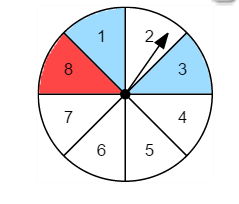
The spinner is divided into eight equal parts. Find the theoretical probability of landing on the white section of the spinner.
P(white) = 12.5%
P(white) = 62.5%
P(white) = 87.5%
P(white) ≈ 43%

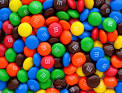
If you choose from the following M & M colors, what is the theoretical probability that you choose a blue M & M?
5 green
6 yellow
8 blue
7 brown
P(Blue) = 25%
P(Blue) ≈ 31%
P(Blue) = 32%
P(Blue) ≈ 33%

Ben has a basket of 5 red balls, 3 yellow balls, and 2 green balls. What is the probability that he randomly chooses a red ball?
P(red) = 1/2
P(red) = 1/5
P(red) = 1/10
P(red) = 5/8

Which of the following statements is true about the probability of spinning a blue?

Which statement best describes the experimental probability and theoretical probability of the arrow landing on the section labeled Q?
A bag of marbles has 8 red marbles and 6 purple marbles. Jennifer will randomly select 1 marble from the bag. What is the theoretical probability that she will select a purple marble?
P(Purple) = 6/8
P(Purple) = 3/4
P(Purple) = 6/14
P(Purple) = 3/7
P(Skittles or Reese's) = 3/4
P(Skittles or Reese's) = 1/4
P(Skittles or Reese's) = 3/8
P(Skittles or Reese's) = 1/8

A boy is playing darts with his friends. What is the probability that his dart will land in an unshaded square?
P(Unshaded) = 12/25
P(Unshaded) = 13/25
P(Unshaded) = 10/25
P(Unshaded) = 11/25
When calculating experimental probability, as more trials are conducted, the experimental probability generally gets closer to the theoretical probability. Eventually, the experimental probability may equal the theoretical probability.

23 students
25 students
35 students
50 students
Jillian rolled a 6-sixed number cube 360 times. About how many times do you expect her to roll a 2?
20 times
180 times
60 times
120 times
Josefina pulled 3 red marbles, 5 green marbles, 8 pink marbles, and 12 yellow marbles out of a bag. If she repeats this experiment 200 times, about how many pink marbles should she expect to pull from the bag?
P(lemon) = 3
P(lemon) = 1/10
P(lemon) = 3/10
P(lemon) = 30%
If I flip a coin 10 times, how many times can I expect to get heads?
1 time
10 times
3 times
5 times
If the probability of an event is 0.9, which of the following best describes the event?
The event will never occur
There is a small chance that the event will occur
The event is likely to occur
The event will definitely occur
The experimental probability that an SUV will pass by Ariel's store is 2/5. If 500 cars pass by Ariel's store, how many can she expect to be SUVs?
200
100
20
150
Rylee is on a weekend fishing trip with her family. So far she has caught 4 trout, 10 catfish, and 13 bluegill. What is the probability that the next fish that Rylee catches will be a catfish?
P(catfish) ≈ 37%
P(catfish) ≈ 15%
P(catfish) ≈ 48%
P(catfish) = 43%
Rachel is setting up tables for a party. Four of the tables are covered with red tablecloths and eight tables are covered with white tablecloths. Guests will be randomly seated at the tables as they arrive.
What is the probability that the first guest to arrive will be seated at a table with a red tablecloth?
P(red tablecloth) = 1/2
P(red tablecloth) = 1/8
P(red tablecloth) = 1/4
P(red tablecloth) = 1/3
A standard coin has two sides. One side is heads and one side is tails. A coin is tossed 80 times. The coin lands on tails 38 times. Which statements about theoretical and experimental probability are true? SELECT ALL THAT APPLY.
The more times the coin is tossed, the closer the experimental probability will get to the theoretical probability.
The theoretical probability is less than the experimental probability of landing on tails.
The theoretical probability of landing on tails is 1/2 and the experimental probability of landing on tails is 19/40.
The theoretical probability is the same as the experimental probability of landing on tails.
IIs it more likely, less likely, certain or impossible to select a red marble from a box of 12 red marbles?
More Likely
Less Likely
Certain
Impossible
Is it less likely, more likely, equally likely or impossible to roll an even number on a standard 6-sided die?
Less Likely
More Likely
Equally Likely
Impossible
The probability of winning a certain game is 5/8. If the game is played 1,600 times, about how many times would someone be expected to lose?
100
600
1,000
400
A bag contains several marbles. Each marble is purple, white or blue. The probability of choosing a purple marble is 1/6 and the probability of choosing a white marble is 2/3. What is the probability of choosing a blue marble?
1/6
5/8
3/8
5/6
Which of the following numbers could NOT be a probability?
1/5
0
1
8/7
The probability of a particular event is 5/14. What is the probability that the event will not happen?
9/14
1/2
1
9
Which vocabulary word describes a number between 0 and 1 that describes the likelihood that an outcome will occur?
Outcome
Equally Likely
Probability
Favorable Outcome
Jeff rolls a 12-sided game piece with faces labeled 1 through 12. What is the probability that Jeff will roll a number less than 13?
P(less than 13) = 1
P(less than 13) = 0
P(less than 13) = 1/2
P(less than 13) = 1/12
Jeff rolls a 12-sided game piece with faces labeled 1 through 12. What is the probability that Jeff will roll an odd number?
P(odd number) = 1
P(odd number) = 0
P(odd number) = 1/2
P(odd number) = 1/12
The probability model based on experimental probability for randomly selecting a marble from a bag is P(green) = 8/25, P(blue) = 14/25 and P(white) = 3/25 . About how many white marbles are in the bag if there are 40 total marbles?
13 white marbles
22 white marbles
4 white marbles
5 white marbles

What is the sample space when rolling a regular number cube?
1
2, 4, 6
1, 2, 3, 4, 5, 6
6

What is the sample space for the jar of marbles?
red
red, yellow, green, blue
red and yellow
red and green

What is the sample space for the spinner shown?
{yellow}
{yellow and blue}
{red and green}
{yellow, blue, green, red}

