wayground logo

Free Printable Worksheets

NEW

Font size

S
M
L
XL
Worksheets

Water and Carbon Cycles

Total questions: 42

Worksheet time: 22mins

Name
Class
Date
1.

A student draws a model to represent the precesses involved in the water cycle, as shown. To which process is the formation of clouds related?

a)

Condensation

b)

Evaporation

c)

Freezing

d)

Melting

2.

What is the energy source that drives the water cycle?

a)

The moon

b)

The heat from our home in the winter all around the world

c)

The sun

d)

The heat generated solely from the core of the earth

3.

Water in its gas form is called ____________________,

a)

water vapor

b)

precipitation

c)

ice

d)

air

4.

What are formed when water vapor condenses?

a)

Clouds

b)

Mountains

c)

Transpiration

d)

Valleys

5.

If groundwater reaches earth's surface, how does it reenter the water cycle?

a)

by transpiration

b)

by evaporation

c)

by accumulation

d)

it can't

6.

The image shows various stages in the water cycle. During which stage does water flow back towards the sea as runoff?

a)

W

b)

X

c)

Y

d)

Z

7.

Condensation occurs when water vapor_____________.

a)

heats up and becomes liquid water

b)

cools off and becomes liquid water

c)

freezes and becomes ice

d)

rains on the land

8.

The Earth can make new water, we just have to wait long enough for the cycle to be over.

a)

True

b)

False

9.

What is another name or synonym for the water cycle?

a)

Geologic cycle

b)

Hydrologic cycle

c)

Geosphere

d)

Carbon cycle

10.

As a part of the water cycle, water from Earth's surface enters the clouds and finally falls back to the ground in the form of rain. What is the correct sequence of processes water undergoes?

a)

Evaporation, Condensation, Precipitation

b)

Precipitation, Condensation, Evaporation

c)

Condensation, Evaporation, Precipitation

d)

Evaporation, Precipitation, Condensation

11.

What would happen if the Sun is removed from the water cycle?

a)

The water cycle would not include precipitation but would continue with groundwater flow.

b)

The water cycle would no longer occur because the Sun provides the energy for evaporation and transpiration.

c)

The water cycle would no longer occur because the Sun provides energy for the formation of clouds.

d)

The water cycle would not include evaporation and transpiration but would continue with condensation.

12.
Which is the opposite of condensation?
a)
runoff
b)
evaporation
c)
precipitation
d)
transpiration
13.
What is the process during which water cools and turns from a gas to a liquid?
a)
Codensation
b)
Runoff
c)
Precipitation
d)
Evaporation
14.
The ________ is the driving force of the earth's surface.
a)
sun
b)
moon 
c)
stars
15.

Precipitation might contribute to the addition of pollutants to rivers, lakes, and oceans because...

a)

it carries pollutants from the atmosphere into bodies of water

b)

it collects any pollutants that are in or on the ground in the water supply

16.

Runoff might contribute to the addition of pollutants to rivers, lakes, and oceans because...

a)

it carries pollutants from the atmosphere into bodies of water

b)

it collects any pollutants that are in or on the ground in the water supply

17.
Freshwater that is stored in the form of snow and ice.
a)
Frozen Water
b)
Aquifer
c)
Atmosphere
d)
Snowmelt
18.
The flow of excess water on Earth’s surface due to too much meltwater or stormwater. 
a)
Surface runoff
b)
Infiltration
c)
Water Cycle
d)
Glacier
19.
The process where plants absorb water through the roots and then give off water vapor through their leaves.
a)
Transpiration
b)
Respiration
c)
Oxygen
d)
Infiltration
20.
What does NOT produce carbon dioxide?
a)
Photosynthesis
b)
Burning Fossil Fuels
c)
Animal respiration
d)
Plants decaying
21.
Combustion is another word for __________.
a)
Transportation
b)
Respiration
c)
Fossil Fuels
d)
Burning
22.
Carbon can be found in...
a)
The atmosphere
b)
Soil
c)
Fossil fuels
d)
All of the above
23.
Which of the following removes carbon from the atmosphere?
a)
Combustion
b)
Respiration
c)
Photosynthesis
d)
Death
24.
What process occurs when coal (fossil fuel) is used for energy?
a)
Decomposition
b)
Combustion
c)
Pressurization 
d)
Respiration 
25.
Respiration is the process by which animals take in _____ and release _____. 
a)
photosynthesis, air
b)
carbon, oxygen
c)
oxygen
d)
oxygen, carbon dioxide
26.

The main human activity that releases greenhouse gases is

a)

using public transportation and there by reduce the affects of greenhouse gases.

b)

burning fossil fuels

c)

texting on cellphones

d)

eating meat

27.
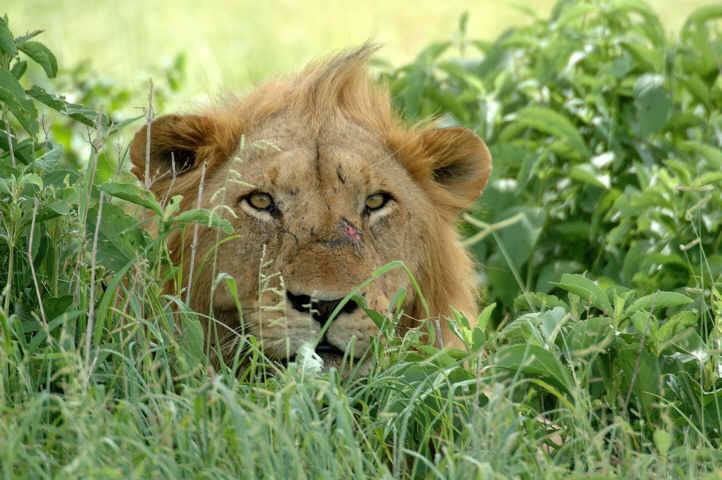
How does the carbon in grass become part of a lion?
a)
The lion eats the grass
b)
Carbon from grass doesn't end up in a lion. 
c)
The carbon ends up in the lion's food chain. 
d)
The lion breathes in carbon given out by the plant
28.
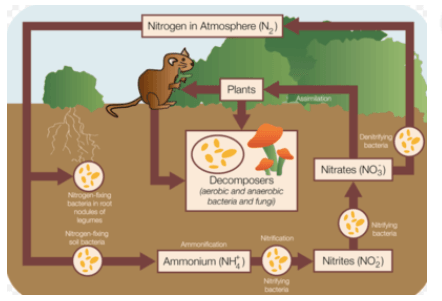
What is the process of combining nitrogen gas with other elements to make nitrogen into usable compounds?
a)
nitrogen composition
b)
ammonia 
c)
nitrogen fixation
d)
denitrification
29.
How much of the atmosphere is composed of nitrogen gas?
a)
87%
b)
38%
c)
78%
d)
21%
30.
Organisms that break down dead plants & animals and release nitrogen back into atmosphere...
a)
bacteria
b)
plants
c)
animals
d)
producers
31.
Organisms that need nitrogen to survive
a)
only plants
b)
only animals
c)
only bacteria
d)
all living organisms
32.
If the atmosphere is 78% N2, why can't we just get our nitrogen by breathing?
a)
We have no mechanism to break the triple bond of nitrogen between the atoms.
b)
Our lungs would be damaged by the N2.
c)
We need Oxygen for cellular respiration.
d)
The legumes take it up first.
33.
Plants and animals cannot use nitrogen directly from the air.
a)
True
b)
False
34.
What happens when organisms die and decay? 
a)
Their bodies are lifted up
b)
Their nitrogen returns to the soil
c)
they keep their nitrogen
d)
They stay on earth forever
35.
Nitrification happens in the ______
a)
Air 
b)
Soil 
c)
Ground Water 
d)
Plants 
36.

Which nitrogen cycle process is occurring when bacteria convert ammonium to nitrite and then into nitrate?

a)

nitrogen fixation

b)

nitrification

c)

denitrification

d)

ammonification

e)

assimilation

37.

What converts nitrogen gas into a usable form for plants and animals?

a)

bacteria

b)

rain

c)

fungi

d)

car exhaust

38.
How nitrogen is "fixed" into useable form for plants...
a)
through action of bacteria only
b)
through lightning only
c)
through action of bacteria & lightning
d)
through photosynthesis
39.

Which plant is an example of a legume?

a)

strawberries

b)

carrots

c)

peanuts

d)

corn

40.
Organisms require nitrogen to make which of the following?
a)
glucose and starch
b)
lipids and nucleic acids
c)
proteins and nucleic acids
d)
carbohydrates and proteins
41.

A correct path that nitrogen could take would be

a)

air -> animals -> plants -> bacteria

b)

animals -> air -> bacteria -> plants

c)

bacteria -> air -> plants -> animals

d)

air -> bacteria -> plants -> animals

42.

Which process makes nitrites from ammonia?

a)

ammonification

b)

denitrification

c)

nitrification

d)

nitrogen fixation