
 Worksheets
Plate Tectonics-The Basics
Total questions: 50
Worksheet time: 37mins
The lithosphere is is made of dense solid material while the asthenosphere is made of liquid molten metal
The lithosphere is a mixture of gasses while the asthenosphere is made of rigid, solid rock
The lithosphere is molten rock that moves while the asthenosphere is rigid and thin
The lithosphere is made of rigid, solid rock while the asthenosphere is a softer hot rock that flows.

What happens to temperature and density as you go deeper in the Earth?


Which type of crust is more dense?
________________ currents drive Earth's plate movement.
ocean
atmosphere
wind
convection

divergent boundary
convergent boundary
transform boundary

divergent boundary
convergent boundary
transform boundary
Which layer contains the convection currents that move Earth's plates?
Asthenosphere
Lithosphere
Mesosphere
Volcanoes found away from plate boundaries and in the middle of plates, such as Hawaii, are known as
hot spots
calderas
trenches
mid-ocean ridges
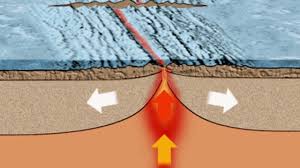
In sea-floor spreading, molten material rises from the mantle and erupts
along the edges of all the continents.
along mid-ocean ridges.
in deep-ocean trenches.
at the north and south poles.

The process by which the ocean floor sinks beneath a deep-ocean trench and back into the mantle is known as _______
convection.
continental drift.
subduction.
conduction.
What are the two types of crust?
When two continental plates converge, this landform is made:
Mountain (non volcanic)
Rift Valley
Trench and Volcanic Mountains
Fracture Zone
When an oceanic plate and a continental plate converge, what landform(s) is created?
Mountain (non-volcanic)
Trench and Volcanic Islands
Trench and volcanic mountains
Mid Ocean ridge
When two oceanic plates diverge, what landform is created
Rift Valley
Trench and volcanic islands
Mid ocean ridge
fracture zone
When two plates diverge on land, what landform is created?
mid ocean ridge
fracture zone
rift valley
Trench
When an oceanic plate converges with an oceanic plate, what landform(s) is created?
Trench and volcanic islands
trench and volcanic mountains
mid ocean ridge
fracture zone
When two plates slide past each other, what landform is created?
Mid ocean ridge
fracture zone
trench
rift valley

The first type of seismic wave to arrive after an earthquake. Travels through solids and liquids
P-Waves
S-Waves
The second type of seismic wave to arrive after an earthquake. Travels through solids only
P-Waves
S-Waves
Which layer is described as plastic-like and slowly flowing?
lithosphere
asthenosphere
crust
inner crust
Process by which new ocean crust forms.
Seafloor spreading
Continental drift
Mid-ocean ridge
Rift
Each layer of earth is the same density
True
False
Each layer of Earth is a uniform temperature
True
False

The most dense physical layer of Earth is:
Inner Core
Outer Core
Mesosphere
Asthenosphere
Lithosphere
Check which feature is NOT a cause of seismic activity
Landslide
Earthquakes
Glacial deposits
Avalanche
Faults
Which of the following is a source of heat in Earth's interior?
Earthquakes
Solar radiation
Seismic Waves
Radioactive decay
An earthquake occurs along a fault when:
Stress in the rock along the fault does not change for a long period of time
Stress in the rock along the fault causes the rock to melt
Enough stress builds up in the rock along the fault to cause the rock to break or slip
When density increases...
material rises
material sinks
When density decreases...
material rises
material sinks
As material heats up...
Its density increases
Its density decreases
As material cools down...
Its density increases
Its density decreases
Undersea earthquakes have the potential to cause which natural phenomena?
Hurricanes
Tsunamis
Tornadoes
Monsoons

Rock layers shown in the picture have been folded at a convergent boundary. Which occurred first?
The layers
The folding


What is the last event to happen?
Deposition of Breccia
Igneous Intrusion
Faulting
Deposition of Limestone

