
 Worksheets
AU7 Part 2 Test Intervention
Total questions: 135
Worksheet time: 8hrs 47mins
x2 - 4x + 4 = 20,
what goes in the blank?
(x - __ )2 = 20
x2 + 6x = 5
x2+ 6x - 4 = 36
x2 +12x = 5
Solve by Factoring using the X-Box Method:
3x² + 5x - 12 = 0
x = -4/3, x = 3
x = 4/3, x = -3
x = -1, x = 4
x = 1, x = -4


(x + 2)(x - 3) = 0

Solve by factoring
-4, 2
-2, 4
-16
-4
Solve using the Quadratic Formula:
2x2 + 2x − 12 = 0
x = −2, 3
x = 2, 3
x = 2, −3
x = −2, −3
3x2 + 18x +15
Solve by factoring: x2 = 7x + 18
-7 and -18
9 and 2
9 and -2
2 and 7
x2 + 4x - 40 = -8
Solve by the Extraction of Roots method: -5x2 = -50
± 5
± 10
± √10
-10
Solve by the Extraction of Roots method: (x - 2) 2 = 49
9 or -5
± 9
± 5
± 7
x2 – 8x + ___
7x2=6x−1
Given this quadratic equation, what could be the values a, b, and c to use in the quadratic formula?
a = 7, b = −6, c = 1
a = 1, b = 6, c = −7
a = −7, b = 6, c = 1
a = 6, b = 7, c = 1
x2−7x=0
Solve by the method of your choice.
x = 7 only
x = 0 only
x = 0 and 7
There is no real answer for this equation.

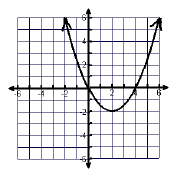
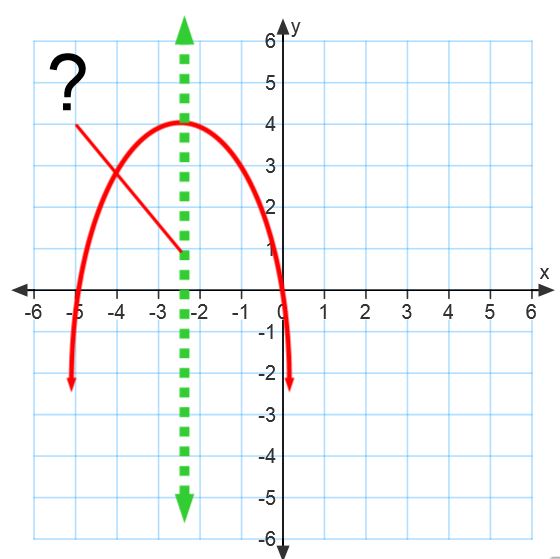
What is the axis of symmetry for this graph?
x=−8
y=−8
y=−1

Solve 2x² - 7x + 6 = 0 by factoring
x = -3/2 and x = -2
x = -3 and x = -2
x = 3 and x = 2
x = 3/2 and x = 2
Solve: 12x2−4x=0
{4, 1/3 }
{0, 4}
{ 0, 3 }
{ 0, 1/3 }
Solve:
5b2 - 4 = 41
b = 9, b = -9
b = 3, b = -3
b = 8, b = -8
no real solution

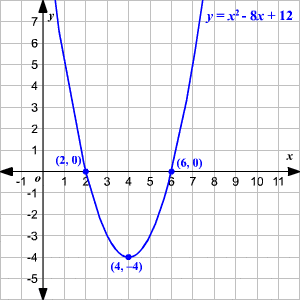
What is the significance of the ordered pair (2, -4) to the graph?
It is the vertex
It is an x-intercept
It is the y-intercept
It is the axis of symmetry
Quadratic equations take the shape of a _______ when graphed.
parabola
straight line
snaked line
elliptical

When did the ball reach its maximum height? Choose the key feature and the answer.
y-intercept, 3 secs
x-value of the vertex, 4 secs
y-value of the vertex, 5 secs
y-intercept, 0 secs

What was the maximum height of the ball? Choose the key feature and the answer choice.
y-intercept, 3 feet
y-intercept, 0 feet
x-value of the vertex, 4 feet
y-value of the vertex, 5 feet

How high was the ball when it was thrown? Choose the key feature and the answer.
y-intercept, 0 feet
y-intercept, 3 feet
x-value of the vertex, 4
y-value of the vertex 5

Approximately how long did it take the water from the fountain to hit the pool below?
about 1.85 second
about 2.85 seconds
about 3.85 seconds
about 4.85 seconds

When did the water reach its maximum height? Choose the key feature and the answer.
x-value of vertex, 2 seconds
y-value of vertex, 9 seconds
y-intercept, 0 seconds
x-intercept, 3.8 seconds

Approximately when did the ball hit the ground?
3.25 seconds
4.25 seconds
8.25 seconds
10.25 seconds

Does this scenario have a max or a min?
Max
Min

Which point is the vertex?
(-8, 0)
(-5, -9)
(-2, 0)
(-9, -5)

An object in launched directly upward at 64 feet per second (ft/s) from a platform 80 feet high. Its height is represented by the equation
s(t) = –16t2 + 64t + 80
What will be the object's maximum height?
2 ft
80 ft
144 ft
64 ft
You jump off a 24 foot high cliff and your fall is modeled by the function:
h(t) = -16t2 + 8t + 24
How long would it take you to hit the water?
8 seconds
1 second
1.5 seconds
1/4 second
The profit from selling local ballet tickets depends on the ticket price. Using past receipts, we find that the profit can be modeled by the function:
p= -15x2 +600x +60
What is the maximum profit you can make from selling tickets?
$6060
$20
$600
$10,250
Heather dropped a water balloon over the side of her school building from a height of 80 feet. The approximate height of the balloon at any point during its fall can be represented by the following quadratic equation:
h = -16t2 + 80
About how long did it take for the balloon to hit the ground?
1.73 seconds
2.24 seconds
2.45 seconds
2.83 seconds
The length of a rectangle is 1 m longer than 3 times its width. The area is 80 m2 . Find the dimensions of this rectangle.
4m by 13m
5m by 16m
6m by 19m
7m by 22m

What is the Vertex of the graph?
(-4, -4)
(0, 0)
(-8, 0)
(-2, -3)

The height of an object thrown into the air can be modeled by the formula h(t) = -16t2 + 70t + 95, where h(t) is in feet after t seconds.
What is the height of the object after 5 seconds?
Hint: f(5)=?
95 feet
45 feet
70 feet
171.56 feet
A ball is thrown into the air with an upward velocity. Its height, h, after t seconds is given by the function below.
h=−16t2+64t+960
How many seconds did it take for the ball to reach its maximum height?
Hint: look at the vertex and remember that x=seconds and y=height.
10 seconds
64 seconds
960 seconds
2 seconds
A ball is thrown into the air with an upward velocity. Its height, h, after t seconds is given by the function below.
h=−16t2+64t+960
How many seconds did it take for the ball to reach its maximum height?
Hint: look at the vertex and remember that x=seconds and y=height.
1024 meters
64 meters
960 meters
2 meters

A
B
C
D

Hint: Must make equation = 0 first, then type into Desmos
-3
0.4
2.5
4

Hint: type into Desmos and look at x-intercepts
0
9
-3
3

Hint: make equation =0, then put equation into Demos.
-4
2
-1
3

A
B
C
D

which of the following show the quadratic formula being used properly?
2(1)−7±(7)2−4(1)(−10)
2(1)7±(7)2−4(1)(−10)
2(1)−10±(−10)2−4(1)(7)
2(1)10±(−10)2−4(1)(7)
5b2 - 4 = 41
The pathway of an arrow can be represented by the equation h = -16t2 + 80t + 25, where h is the height in feet and t is the time in seconds. What is the maximum height?
h = 125 feet
h = 80 feet
h = 95 feet
h = 140 feet
A rock is dropped from a bridge 320 feet above a river. The pathway that the rock takes can be modeled by the equation h = -16t2 + 320. How long will it take the rock to reach the river (ground)?
4.5 seconds
2.5 seconds
3.8 seconds
3.5 seconds
Joe Mauer hits a fly ball. You can track the height of the ball using the equation: h(t) = -16t2 + 140t + 2. What is the starting height of the ball?
-16 feet
140 feet
2 feet
0 feet

What is the initial height of the parabola?
h = 0.563
h = 10.063
h = 5
h = 1.356
y=−16x2+88x
Henry launched a model rocket from the ground. Its height after x seconds can be modeled by the function above. When will the rocket be 40 feet high?
0.5 sec, 5 seconds
0.5 seconds
5 seconds
never
Jason jumped off of a cliff into the ocean in Acapulco while vacationing with some friends. His height as a function of time could be modeled by the function h(t) = –16t2 + 16t + 480, where t is the time in seconds and h is the height in feet. How long does it take Jason to hit the water?
-16 seconds
-6 seconds
0 seconds
5 seconds
The length of a rectangle is 4 cm more than its width. The area of the rectangle is 96 sq. cm. Find its dimensions.
4 cm by 8 cm
6 cm by 10 cm
8 cm by 12 cm
10 cm by 14 cm
Solve: m2+7=88
undefined
No solution
undefined
undefined
Solve:x2−1=24
undefined
undefined
undefined
No solution
Solve:5x2−45=0
undefined
undefined
undefined and undefined
undefined , undefined , and undefined
x2 + 12x + ____
(2x - 1)2 = 49
x2 +12x = 5
Solve by Factoring using the X-Box Method:
3x² + 5x - 12 = 0
x = -4/3, x = 3
x = 4/3, x = -3
x = -1, x = 4
x = 1, x = -4
Multiply the following binomials:
(X+4)(X+5)
x2+20x+9
x2+9x+20
x2+20x+20
x2+20
(2x3−4x2+3)+(x3−3x2+1)
2x3−7x2+4
2x6−10x5+12x4+5x3−13x2+3
3x3−7x2+4
3x6−7x4+4
Multiply the binomial by the monomial: −3x2(x2+3x)
−3x4−9x3
−3x4−9x2
−2x2+9x2
−2x2−3x2+3x
Multiply the binomials: (4x+3)(x-7)
4x2−84x−21
4x2−21
5x−4
4x2−25x−21
(5n2−7)−(2n2+n−3)
10n4+5n3−29n2−7n+21
10n4−70n3−7n+21
3n2−n−4
3n2+n−10
3x(x2−5x−3)
3x3−15x2−9x
x2−2x−3
3x2−15x−9
3x3+15x2+9x
(5x−3)(4x+2)
20x2−6
9x−1
20x2−120x−6
20x2−2x−6
(3x3+7x2)+(x2−2x3)
x3+8x2
4x5+5x
7x4−11x5−6x6
−6x6−42x5+7x4
(3x−1)(2x2−5x+1)
6x2−15x−1
2x2−2x
6x3−17x2+8x−1
6x3+60x2+15x−1
(2x−13x2+3)−(2x2+8x)
−26x4−512x3−192x2
−15x2−6x+3
−15x2+6x+3
−15x2+10x+3
(x−9)(x+9)
x2−81
x2−81x−81
2x
x2−18x−81
8x3−12x2+4x Factor this polynomial using the GCF.
2x(4x2−6x+2)
4(2x3−3x2+1)
4x(2x2−3x+x)
4x(2x2−3x+1)
x3−5x2 Factor using the GCF:
x2(x−5)
x(x2−5x)
Prime
x2(x−5x)
16m3−8m2+12m Factor using the GCF:
4m(4m2−2m+3)
4m(4m2−2m+3m)
2m(8m2−4m+6)
4(4m3−2m2+3m)
6y4+9y3−27y2 Factor using the GCF:
3y2(2y2+3y−9)
3y(2y3+3y2−9y)
3(2y4+3y3−9y2)
y2(6y2+9y−27)
Y = -3x2 +7x - 2
What is the "b" value in the equation
4x2 = 76 ?
4
76
0
-76
What is the "c" value in the equation
4x2 = 76 ?
4
76
0
-76
What is "b" in the equation 3x2 −7 = 0 ?
3
7
0
10
a, b, and c for
the quadratic equation:
4x2 – 8x = 3
What is the value of "c" in the equation
2x2 − 6x = 0 ?
2
−6
0
6
x2−6x+4=0
3±5
26±20
3±20
3±i13
What should you do first in solving this equation?
x2 + 6x - 13 = 3
Factor
Write down: a = 1, b = 6, c = -13
Subtract 3 from both sides.
Add 3 to both sides.
Solve using the quadratic formula...
9x2 = 4 + 7x


No solution
What are the zeros of
f(x)=x2+7x−18 ?
x=−2, −9
x=2, −9
x=−2, 9
x=2, 9

What is the vertex?
(-2,0)
(0,0)
(0,-4)
(2,0)
Select the answer that has a, b, and c correctly labeled:
a= 1, b= 2, c= -9
a= 2, b= -1, c= 9
a= -9, b= 2, c= -1
a= -1, b= 2, c= -9

What is the equation of the line of symmetry for this quadratic function?
x = -3
x= .5
x = 4
x = -12
Which direction will this parabola open?
upwards
downwards

(x-5)2 = 25
x2 + 44 = -15x
{-8, 2}
{-7, 5}
{-11, -4}
{-11}
(4a + 3)(4a - 3) = 0

Solve the equation by factoring.
{3, −5}
{−3, 2}
{−5, −3}
{3, −4}

Solve the equation by factoring.
{2, −1}
{−5, 5}
{−4, 1}
{−8, 6}
Solve by factoring. z2 + 81 = 18z
Heather dropped a water balloon over the side of her school building from a height of 80 feet. The approximate height of the balloon at any point during its fall can be represented by the following quadratic equation:
h = -16t2 + 80
About how long did it take for the balloon to hit the ground?
1.73 seconds
2.24 seconds
2.45 seconds
2.83 seconds
A ball is thrown into the air with an upward velocity of 40ft/s. Its height h in feet after t seconds is given by the function :
h(t) = -16t2 + 40t + 10
How many seconds does it take the ball to reach its maximum height?
1.25 seconds
1.4 seconds
2.5 seconds
2 seconds
Rafael drops a ball from a third-story window. This equation represents the approximate height, h, in meters, of the ball above the ground after it falls for t seconds.
h = -5t2 + 45
When is the ball at ground level?
only at t = 0 seconds
only at t = 3 seconds
only at t = 9 seconds
at both t = 0 seconds and t = 3 seconds
Jason launched a rocket for a physics experiment. This equation can be used to find the height (h), in feet, of the rocket after t seconds.
h = -16t2 + 288t + 8
How many seconds will it take for the rocket to reach a height of 1,304 feet?
9.0 seconds
9.6 seconds
81.0 seconds
82.0 seconds


y = -2x2
have a maximum or minimum value?

Which graph is a parabola?



