
 Worksheets
Natural Selection Unit 5
Total questions: 38
Worksheet time: 20mins
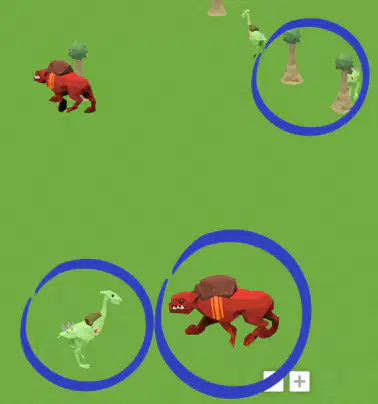
Which of the following was NOT part of our Amplify Natural Selection Simulation?
Thorn Palm
Carnithon
Tawny Owl
Ostrilope

Histograms: the first histogram displays the starting population of a species of lizards. The lizards display a wide range of tail lengths that have equal numbers. The second histogram displays the lizard population after 50 years. Choose the explanation that best describes what has occurred to the second population.
Something in the environment favored the short tail length which allowed them to survive and reproduce.
Something in the environment favored none of the tail lengths which caused the population to go extinct.
Something in the environment favored the long tail length which allowed them to survive and reproduce.
Something in the environment favored the medium tail length which allowed them to survive and reproduce.
Something in the environment favored both short and long tail length, but not medium, which allowed them to survive and reproduce.
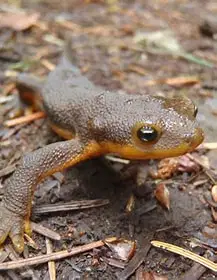
Which claim about the rough-skinned newt and its poison ended up being true in our investigations?
The newts became more poisonous because they wanted to be able to survive.
Something in the environment pressured the newts to become more poisonous.
The newts became more poisonous because they were infected by the predators.
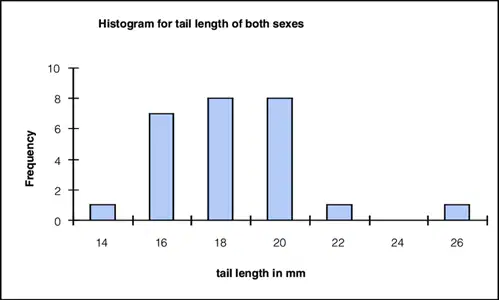
What word would one use to describe the fact that there seems to be 8 individuals in the 18 and 20 range, 7 individuals in the 16 range, and 1 individual in the 14, 22, and 26 ranges?
generation
variation
adaptation
distribution
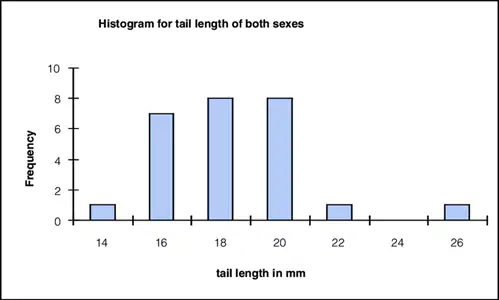
What word would one use to describe the fact that there seem to be six different types of tail length genes?
generation
variation
adaptation
distribution
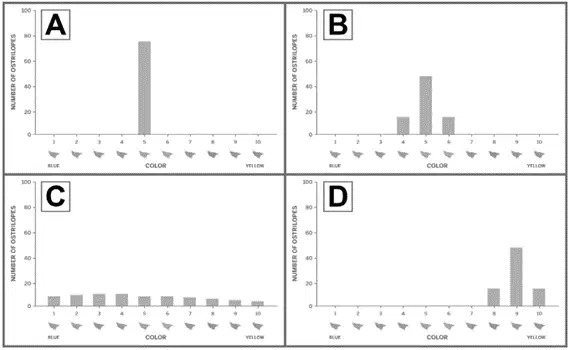
Which choice above is in an environment that favors the survival of yellow organisms... probably due to providing camouflage from predators?
A
B
C
D
Which choice above would seem to indicate that the color of the organism did NOT provide an advantage for survival and reproduction?
A
B
C
D
Which choice above displays the least amount of variation?
A
B
C
D
Which choice above would display almost entirely organisms with a few shades of green color?
A
B
C
D
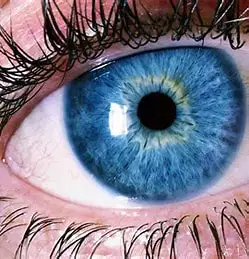
Approximately 10,000 years ago the human genome experienced a mutation that produced blue eyes. The eye color did not provide any advantage or disadvantage for survival and reproduction. What type of trait would this be considered?
adaptive
neutral
non-adaptive
maladaptive
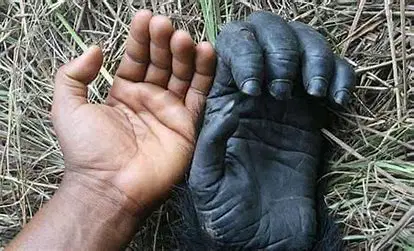
Approximately 2 million years ago our ancestor's genome experienced a mutation that produced an opposable thumb (great for gripping tools). The trait provided a major advantage for survival and reproduction. What type of trait would it be considered?
adaptive
neutral
non-adaptive
maladaptive
In the Natural Selection Simulation we watched as generations of ostrilope passed with a yellow 7 grass color and carnithons as predators. The yellow 7 ostrilope did best out of all of the 10 color variants. What do you believe would happen if we removed predation by getting rid of the carnithons?
The yellow 7 color variant would go extinct and blue and green would survive and reproduce.
All of the color variants would slowly change into the yellow 7 variant.
None of the color variants would be favored and the distribution would be more even.
The yellow 7 color variant would evolve into a predator.
_____ are instructions for making _____, and those molecules are what ultimately determines an organism's traits.
genes
environment
mutation
proteins
survive and reproduce
Genetic copies are not always perfect, and when there is a change, we call it a(n) _____.
genes
environment
mutation
proteins
survive and reproduce
Traits are not always automatically either adaptive or non-adaptive... it truly depends on the nature of the organism's _____.
genes
environment
needs
proteins
If a mutation is adaptive, it allows the organism to _____.
be stronger
survive
move faster
be larger
reproduce

Which type of natural selection is displayed by the illustration?
stabilizing
disruptive
selectional
directional

Which type of natural selection is displayed by the illustration?
stabilizing
disruptive
selectional
directional

Which type of natural selection is displayed by the illustration?
stabilizing
disruptive
selectional
directional
In a lab exercise, we tested beak mutations with 3 variations. Each team used the "beaks" to scoop rice into a cup. The amount of "food" for each was then weighed and recorded on a chart. Each 10 milligrams of food represented one offspring produced for that breeding season. After the trials, a graph was produced to display what type of selection was possible. Which was NOT a beak type?
2 tine fork
1/2 spoon
4 tine fork
spoon
In the bird beak selection lab exercise, which of the following changes would NOT have effected the outcome of the lab?
Recording data from previous years' trials and adding this year's data to it.
Using salt instead of rice as a representation of bird food.
Using two different digital scales to get measurements of the food weight.
Allowing each student to take a turn scooping rice with the beak varieties.

Consult the chart on penguin population. Which statement best describes what happened to the penguin population between year 1 and year 2 of the study?
there was a dramatic increase that stabilized near the end of the period
there was an increase followed by a slight decrease followed by a slight increase
there was a gradual slight decrease in population followed by a very minor increase
there was a dramatic decrease in the population
The presence of natural differences in traits within a species is called genetic __.
variation
sublimation
distillation
selection
In most populations, many versions of a gene exist. These versions of genes, called __.
wild types
mutations
zygotes
alleles
All organisms are constantly working to survive. Populations are involved in all of the following except...
finding food
attracting a mate
attracting predators
finding and defending territory
caring for young
A friend states that evolution occurs in individual organisms. The best way to gently correct them is to state that evolution occurs...
in the fittest organisms.
in populations.
randomly and nothing influences it.
only over millions of years.
Which foot illustrated above is best adapted for organisms that need to run across rocky or hard ground for long distances?


The extinction of which of the following organisms would probably decimate the population of the honeybee?
grizzly bears
honey badgers
flowering plants
butterflies
The evolutionary history of humans (palmaris longus, tailbone, opposable thumb) displays that we were most definitely at one point...
carnivore (meat-eater)
herbivore (plant-eater)
diurnal (daytime hunter)
nocturnal (nighttime hunter)
arboreal (tree-dweller)

What adaptation has allowed this insect to survive and reproduce?
poisonous bite
ability to fly
camouflage from predators
ability to jump long distances
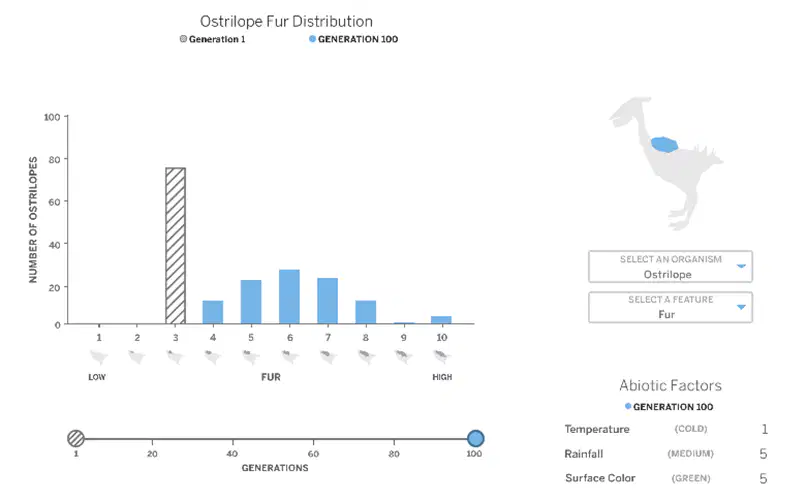
In the above histogram, the temperature was reduced to cold level 1, ostrilope fur level was placed at 3 with no variation, and the mutations button was turned on. The simulation was allowed to run for 100 generations.
Describe the variation that resulted.
Variation increased due to non-adaptive mutations until 5 variants existed after 100 generations.
Variation decreased due to adaptive mutations until 8 variants existed after 100 generations.
Variation decreased due to non-adaptive mutations until 4 variants existed after 100 generations.
Variation increased due to adaptive mutations until 7 variants existed after 100 generations.
In the above histogram, the temperature was reduced to cold level 1, ostrilope fur level was placed at 3 with no variation, and the mutations button was turned on. The simulation was allowed to run for 100 generations.
Describe the distribution that resulted.
Distribution shifted from one variant to multiple variants... predominantly fur levels 5, 6, and 7.
Distribution shifted from one variant to multiple variants... predominantly fur levels 3, 4, and 5.
Distribution shifted from two variants to multiple variants... predominantly fur levels 6, 7, and 8.
Distribution shifted from seven variants to one variant... predominantly fur level 3.
In the above histogram, the temperature was reduced to cold level 1, ostrilope fur level was placed at 3 with no variation, and the mutations button was turned on. The simulation was allowed to run for 100 generations.
Do you suppose that there were mutations that led to variants 1 and 2 despite the fact that none are present at generation 100?
No, such mutations would not be beneficial and so would not exist.
No, the ostrilopes did not need them for survival so they did not occur.
Yes, but they were non-adaptive and died.
Yes, but they mutated into the higher fur level variant.
In the above histogram, the temperature was reduced to cold level 1, ostrilope fur level was placed at 3 with no variation, and the mutations button was turned on. The simulation was allowed to run for 100 generations.
If allowed to run for 250 generations, what do you suppose the histogram distribution would look like?
The distribution would favor the lowest fur levels and decrease as the levels increased.
The distribution would favor the highest fur levels and decrease as the levels decreased.
The distribution would favor none of the variants and be basically level all the way across.
The distribution would be completely random.

Humans have 23 pair of these.
chromosome
DNA
gene
protein
A section that codes for a trait.
chromosome
DNA
gene
protein
An instruction molecule.
chromosome
DNA
gene
protein
The molecule that is built from the instruction molecule.
chromosome
DNA
gene
protein

