
 Worksheets
Evolution
Total questions: 50
Worksheet time: 45mins
What characteristic did Darwin observe about the finches on the Galapagos Islands?
Their feathers
Genotypes
Their beaks
Their body sizes
The separation of a group of individuals from the rest of the population is referred to as
genetic drift
natural selection
geographic isolation
survival of the fittest
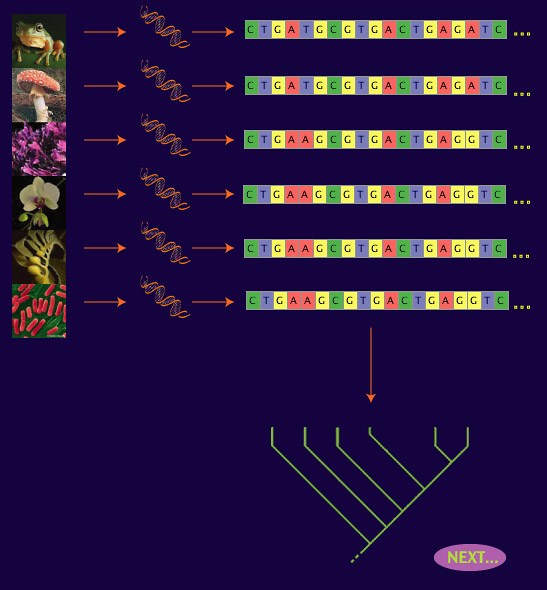
Two organisms that are closely related would have
very similar DNA sequence
exactly the same DNA sequences
no proteins in common
completely different DNA sequence
Eyes that can see in the dark is a(an) _______ inherited by nocturnal animals.
adaptation
acquired trait
learned ability
How does a species change over time?
by adapting to the environment
changes in the gene frequencies in a population
acquiring new traits
they do not change

The pelvic bone of whales is not needed for movement within the water. This is an example of a(n) ______________ structure.
vestigial
analogous
homologous

The forelimbs of mammals have similar anatomy because these groups descended from a recent common ancestor. Their bone structure is an example of a(n) ______________ structure.
vestigial
analogous
homologous

Many different groups of organisms have wings, even though they do not share a recent common ancestor. This is because they evolved in environments with similar selective pressures. Wings are an example of a(n) ______________ structure.
vestigial
analogous
homologous
Which does NOT cause genetic variation?
crossing over in meiosis
mutations
acquired traits

Vertebrate embryos pass through similar stages of development is evidence for
use and disuse
homologous structures
common ancestry
acquired characteristics
Mistakes or changes that occur in the DNA sequence are called....
adaptations
Darwinism
mutations
natural selection

What does this picture model?
DNA structure of the horse
Evolution of the horse
Extinction of the horse
Singular trait of the horse
What most likely caused the finches on the Galapagos Islands to have beaks that were different from the finches living on the South American mainland?
They were different types of food available on the island.
The finches on the islands had to drink salt water.
There were different types of predators living on the island.
The finches on the mainland built different types of nests.
Which beneficial variation would be most helpful in a desert environment?
white fur
claws for burrowing
green and black camouflage
flippers
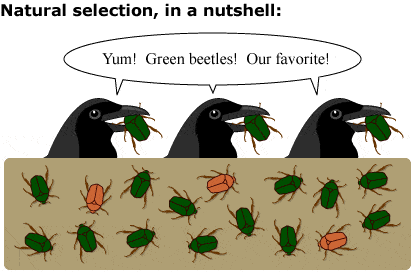
Which of the following is a factor in natural selection?
Individuals of species compete with one another to survive.
All species are genetically diverse.
Individuals better able to adapt to changes leave more offspring.
All are correct

The fossil record provides evidence that
Fossils cannot be dated.
All species were formed during Earth’s formation and have changed little since then.
The fossilized species have no connection to today’s species.
Older species gave rise to more-recent species.
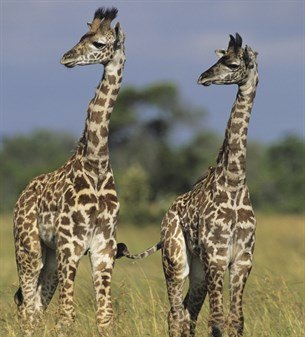
Individuals that are better able to cope with the challenges of their environment tend to
Decrease in population over time.
Leave more offspring than those less suited to the environment.
Leave fewer offspring than those less suited to the environment.

Members of different subspecies
Are considered to be entirely different species.
Can no longer interbreed successfully.
Differ genetically because of adaptations for different living conditions.
Will never diverge to become different species.

Starting in 1954, commercial fishers in the northwest Pacific were paid by weight, rather than by the individual fish, for pink salmon. The fishers increased the use of a type of net that selectively catches larger fish. Which of the following effects did this change in fishing technique most likely have on the salmon population over the next 20 years?
The average body size of the salmon population decreased significantly.
The average body size of the salmon population increased significantly.
The average body size of the males in the salmon population increased, and the females stayed the same.

European rabbits were introduced to Australia in 1859. The rabbits reproduced rapidly in their new habitat, displaced other animals, and overgrazed vegetation. In an attempt to reduce the rabbit population, a virus was introduced in 1951. This virus is usually deadly to European rabbits. When the virus was first introduced, the rabbits died in large numbers, but the death rate decreased over time. Which of the following best explains the decrease in the rabbit death rate?
Young rabbits learned to avoid being infected with the virus.
The lifespan of the virus was too short to affect rabbits over a long period of time.
Natural selection favored rabbits that were resistant to the virus.
No correct choices.

The Asian shore crab invaded parts of the eastern coast of the United States about 15 years ago. The Asian shore crab preys on blue mussels. In the time since the Asian shore crab arrived, the average shell thickness of the blue mussel population has increased. Which of the following is the most likely reason that this increase in shell thickness has occurred?
Blue mussels with thick shells attract more crabs than mussels without thick shells.
Blue mussels with thick shells grow in larger colonies than mussels without thick shells.
Blue mussels with thick shells catch more food per day than mussels without thick shells.
Blue mussels with thick shells survive and reproduce more successfully than mussels without thick shells.

Structures with no function that are remnants of an organism’s evolutionary past are
Not visible organisms.
Vestigial
Young in origin
Useful to the organism

Which of the following statements best reflects the evolutionary importance of the figures pictured?
New genetic instructions have been disregarded in the evolution of vertebrates.
Early in development, vertebrate embryos show no evidence of common ancestry.
All adult vertebrates retain pharyngeal pouches (gills).
The evolutionary history of organisms is seen in the way embryos develop.
What is the advantage of having different shaped beaks?
To look different from other species.
To be able to eat the food readily available in the environment.
To protect itself against predators.
To protect itself against prey.
Why are advantageous traits more likely to be passed onto offspring?
Because they are more likely to survive and reproduce.
Because they come from dominant alleles.
Because they come from recessive alleles.
Because the trait is an acquired phenotype.
Genetic differences between organisms of the same species
Variation
Adaptation
Behavior
Environment
A fossil of an extinct dinosaur is found and the anatomy of the fossil shows similarities to that of a bird. What could this mean?
This is purely by chance and isn't significant
The extinct dinosaur and modern bird share a common ancestor
All dinosaurs evolved into birds and that's why there aren't any dinosaurs alive today
Dinosaurs choose to fly, and evolved into birds to escape predation and capture food
Which of the following are examples of evidence for evolution?
Fossils and Cellular Structure
Biological Structures
Genetics/DNA
All of the Above

Hibernation is an example of which type of adaptation?
Behavioral Adaptation
Physical Adaptation

Beak shape, camouflage, and webbed feet are all examples of which type of adaptation?
Behavioral Adaptation
Physical Adaptation
__________ characters are similar characteristics that have evolved separately in two unrelated organisms.
analogous
homologous
cladistic
phylogenic
_________ characters may or may not be similar between two organisms but they developed from a common ancestor.
homologous
analogous
cladistic
phylogenic
________ structures are reduced in size or function.
vestigial
homologous
cladistic
phylogenic
Mutations are important because they bring about genetic variation needed for a population to evolve
death of the organism in which they develop
genetic variation needed for a population to evolve
benefits for the individual, not for the population
Hardy-Weinberg equilibrium within a population


What is the significance of the Galapagos finches in the study of evolution?
They demonstrate that isolation can lead to the extinction of species.
They provide evidence that different environments can lead to speciation through adaptive radiation.
They show that all bird species originated from a common ancestor.
They prove that climate change has no effect on the evolution of species.
What does it mean when two species share a common ancestor?
The two species are actually the same species.
Both species are descended from a species that lived in the past.
One of the species evolved into the other species.
Environmental changes may lead to the evolution of a species. Polar bears live in the Arctic. Ice in the Arctic is melting fast, reducing the range where the polar bear can live. If polar bears do not have adaptations that allow them to survive environmental changes, what may happen to
them?
they may become another species
they may overpopulate
they may become extinct
Some lizards have an adaptation that allows their tails to break off with minimal damage to bones, nerves, blood vessels, and muscles. This type of lizard can then regrow the missing portion of the tail.
Which of the following statements best explains why the adaptation for regrowing a tail is a favorable trait for some lizards?
Lizards with this adaptation can camouflage themselves more easily in vegetation.
Lizards with this adaptation are more likely to escape from predators.
Lizards with this adaptation can use their tails as lures to attract more food.
Habitats are constantly changing and evolving, and the animals living within them must constantly adapt to changes large and small.
Which of the following is the best example of an adaptation that helps organisms survive in their environment?
green coloring in lizards living on gray rocks
a white rabbit in the snowy mountains
thick fur on animals that live in the desert
Which of these scenarios is an example of natural selection that Darwin described?
Farmers crossbreed two types of cows to produce a breed of cow that has high-quality
beef and can tolerate a hot climate.
Giraffes that have longer necks survive a dry season by eating leaves from the tops of
trees. Those giraffes breed more successfully that year.
Dogs of the same breed that have a desirable coat color are bred with one another to
produce more puppies with that same coat color.
A tree frog population lives in the canopy of a tropical rainforest. In this tree frog population, a mutation occurs that results in a new genetic variation for skin coloration causing stripes on their legs.
Which of the following factors has the greatest effect on whether leg stripes will become more common in the tree frog population?
If the reproduction rate of the tree frog population remains constant over time.
If the new genetic variation for stripes is presented more in females in the tree frog
population.
If the new genetic variation for stripes increases the survival of the tree frogs in their
environment.
When Darwin observed finches on islands in the Pacific, he noted that the beaks of the birds on islands with lots of seeds were different from the beaks of the birds on islands with lots of insects. How did their beaks come to match the food in their environments so well?
The food supply on the islands changed to match the birds’ beaks.
The predators on the islands eliminated the birds with the “wrong” beaks.
The birds with the “right” beaks for the food supply had more young.
What can scientists infer from finding coral fragments at the deepest layer (20-30 m) and mammal bones at the shallowest layer (0-10 m) at the Ocala site?
The area was always a mountain region.
Mammals lived before corals in this area.
The environment changed from ocean to land over time.
Corals lived on land after mammals.
Why is the fossil record of Archaeopteryx important for understanding evolutionary relationships?
It shows that all animals evolved at the same time.
It provides evidence of shared traits between ancient reptiles and modern birds.
It proves that evolution does not occur.
It shows that fossils cannot provide information about evolution.

