
 Worksheets
Light & Reflection
Total questions: 46
Worksheet time: 2hrs 18mins
which of the following is not a property of the image formed by a [lane mirror?
virtual and erect
Object size = image size
object distance = image distance
Real and inverted

Four students A, B, C and D performed the experiment to determine the focal length of a concave mirror by obtaining the image of a distant tree on a screen. They measured the distances between the screen and the mirror as shown in the above figure.
The correct way of measuring accurate focal length of the mirror is
A
B
C
D

which of the following ray diagrams is correct for the ray of light incident on a concave mirror as shown in the figure 10.6?
A
B
C
D
Convex mirror is also called as
converging mirror
diverging mirror
plane mirror
silver mirror
The relation between focal length and radius of curvature is
R = 2f
1/f = 2R
f = R/2
R = 2/f
The focal length of a plane mirror is ........
infinite
zero
1m
100m
A convex mirror has a focal length 12 cm. Then its radius of curvature is ........ cm
24
12
6
1.2
When the object is in between the centre of curvature (C) and focus (F) of a concave mirror, then the position of the image is ...........
At focus
At the centre of curvature
at infinity
beyond the centre of curvature
Which of the following characteristic of an image formed for a convex mirror?
Enlarged size
virtual image
Real image
inverted image

Which mirror is shown in the figure?
convex mirror
concave mirror
plane mirror
silver mirror

Mirror formula is defined as ........
A
B
C
D
When the object is at infinity, a point sized image is formed at ................ by the convex mirror
focus behind the mirror
focus in front of the mirror
radius of curvature
principal axis
According to laws of reflection,
angle of incidence > angle of reflection
angle of incidence < angle of reflection
angle of incidence = angle of reflection
both 1 and 2
Where will be the images of the Sun or the moon are formed by a concave mirror?
Focus
Pole
centre of curvature
beyond centre of curvature
What is the size of the image formed when an object is kept at the focus in front of concave mirror?
enlarged
diminished
highly enlarged
highly diminished

Images in a plane mirror are
real
larger
same size
smaller

What is an image called that forms when light rays actually converge
virtual image
real image
imaginary image
Spectral
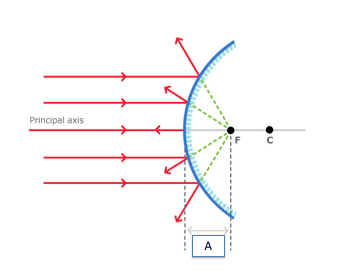
In the image, all the rays meet at F, What is F
focal length
focal point
center of curvature
reflection
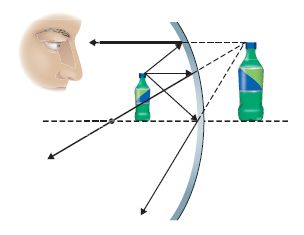
When distance of object from a mirror is gradually increased then image formed by it becomes inverted which was erect in the beginning. Which type of mirror is this ?
Plane mirror
Concave mirror
Convex mirror
none of the above
Which mirror is used as a make-up mirror ?
Convex mirror
plane mirror
concave mirror
plano-concave

What shall be the position of image , if an object is place in-front of a concave mirror as shown ?
At C
between F & C
between F & P
at F
An object is placed 20 cm from a concave mirror with a focal point of 15 cm. Where will the image be located.
15 cm
20 cm`
60 cm
-8.6 cm
An object is placed 20 cm from a convex mirror with a focal point of 15 cm. Where will the image be located.
-15 cm
-20 cm`
60 cm
-8.6 cm
An image is formed upside down in front of mirror and seems bigger by 2 times from the actual size. What might be the type of mirror uses?
concave mirror
convex mirror
plane mirror
concave lens

Who was the first to develop reflecting telescopes?
Nicolaus Copernicus
Isaac Newton
Galileo Galilei
Hubble
Modern telescopes are reflecting because: (Choose all that apply)
Lenses are difficult to manufacture
Lenses are heavy and fragile
lenses reflect light that passes through them
Lenses require only 1 perfect surface
What particles make up light?
Photons
Neutrons
Protons
Lumitrons
Light behaves like both a particle and a ______.
Mass
Wave
Current
Proton

Which color has the lowest frequency?
yellow
green
blue
indigo

Which of the following has the longest wavelength?
Infrared
The color Indigo
gamma rays
TV

Which of the following has the shortest wavelength?
Gamma rays
The color blue
AM radio
Infrared

Which of the following has the highest frequency?
TV
Microwaves
the color indigo
ultraviolet rays
What do radio waves, microwaves, X-rays, and gamma rays all have in common?
They all have the same wavelength.
They are electromagnetic waves.
They are detected in the same way.
They store the same amount of energy.
A wave has a frequency of 2.5 hz and a wavelength of 20 m. What is the velocity of the wave?
50 m/s
8 m/s
40 m/s
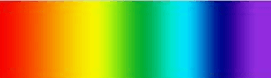
A beam of light has a wavelength of 600 nm in air. What is the frequency of the light (c = 3x10⁸ m/s)?
5 x 10¹⁴ Hz
2 x 10¹⁴ Hz
3 x 10¹⁴ Hz
6 x 10¹⁴ Hz
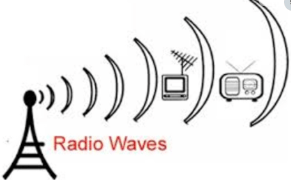
Find the distance a radio wave will travel in 0.250 s.
7.50 × 10⁷ m
5.60 × 10⁷ m
1.20 × 10⁹ m
1.35 × 10⁹ m

