wayground logo

Free Printable Worksheets

Font size

S
M
L
XL
Worksheets

Practice Gas Laws

Total questions: 123

Worksheet time: 4hrs 40mins
Name
Class
Date
1.
What does Boyle's law relate to?
a)
Temperature and Volume
b)
Volume and Pressure
c)
Temperature and Pressure
2.
When the temperature of matter increases the particles...
a)
speed up and move closer
b)
speed up and move farther apart
c)
slow down and move closer together
d)
slow down and move farther apart
3.
How do gas molecules move? 
a)
in an orderly fashion 
b)
constantly and randomly
c)
in straight line paths
d)
in a circular motion
4.
In Charles' Law the pressure remains constant.
a)
True
b)
False
5.
What does Boyle's law relate to?
a)
Temperature and Volume
b)
Volume and Pressure
c)
Temperature and Pressure
6.
When the temperature of matter increases the particles...
a)
speed up and move closer
b)
speed up and move farther apart
c)
slow down and move closer together
d)
slow down and move farther apart
7.
How do gas molecules move? 
a)
in an orderly fashion 
b)
constantly and randomly
c)
in straight line paths
d)
in a circular motion
8.
In Charles' Law the pressure remains constant.
a)
True
b)
False
9.
What type of relationship is Charles' Law?
a)
Inverse
b)
Direct
c)
Not enough information
d)
#goals
10.
True or False: Gases can be compressed. 
a)
True
b)
False
11.
What is the formula for Boyle's Law?
a)
P1V1=P2V2
b)
P1V1/P2V2
c)
P1V2=P2V1
d)
P1/V1=P2/V2
12.
When Pressure increases then the Volume must...
a)
Increase
b)
decrease
13.
When Volume increases then Pressure must...
a)
Increase
b)
Decrease
14.
What type of relationship to pressure and volume have?
a)
direct
b)
inverse
c)
no relationship
d)
I don't know
15.
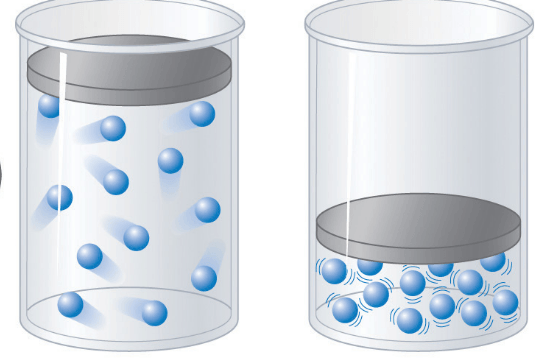
Which container will have a lower pressure?
a)
left
b)
right
c)
they both have the same pressure
d)
I don't know
16.
What causes pressure?
a)
The walls of the container
b)
The vacuum in the container
c)
The collisions of the particles
d)
Atmospheric pressure acting on the outside walls
17.
The relationship of which two variables are compared in Boyle's Law?
a)
pressure & volume
b)
volume & temperature
c)
temperature & pressure
d)
volume & moles (amount of gas)
18.
Boyle's law : When _______ is held constant, the pressure and volume of a gas are ________  proportional
a)
temperature,  equally
b)
mass, inversely
c)
temperature, inversely
d)
mass, equally
19.
What type of relationship is Charles' Law?
a)
Inverse
b)
Direct
c)
Not enough information
d)
#goals
20.
What is the formula Charles' Law?
a)
V = T
b)
VT = VT
c)
T1 / V1 = T2 / V2
d)
V1 / T1 = V2 / T2
21.
This variable in an experiment is the one being deliberately changed by the scientist. 
a)
dependent variable
b)
independent variable
c)
data
d)
control group
22.
Should experiments be repeated over and over to see if the results are the same each time?
a)
yes
b)
no
23.
A series of steps used by scientists to solve a problem or answer a question
a)
scientific method
b)
recipe
c)
data collection
d)
metric system
24.
TRUE/ FALSE: Science is a continually ongoing process.
a)
True
b)
False
25.
A gas that has a pressure of 2 atm and a volume of 10 L.  What would be the new volume if the pressure was changed to 1 atm?
a)
P1/T1 = P2/T2
b)
P1V1 = P2V2
c)
V1/n1 = V2/n2
d)
PV = nRT
26.
A sample of a gas has a volume of 852 mL at 298 K. What temperature is necessary for the gas to have a volume of 945 mL?
a)
Pt = P1 + P2 + P3 + ...
b)
P1V1 = P2V2
c)
V1/T1 = V2/T2
d)
P1V1/T1 = P2V2/T2
27.
If a nitrogen gas occupies a volume of 500 ml at a pressure of 0.971atm. What volume will the gas occupy at a pressure of 1.50 atm?  
a)
P1V1 = P2V2
b)
PV = nRT
c)
P1/T1 = P2/T2
d)
V1/n1 = V2/n2
28.
Determine the number of moles in a container of gas at STP with a volume of 99.2 L. 
a)
V1/n1 = V2/n2
b)
PV = nRT
c)
P1/T1 = P2/T2
d)
V1/T1 = V2/T2
29.
A container is filled with H2, and H2O. What is the partial pressure of H2 when the pressure of water is 17 kPa. The total pressure of the gases is 750 kPa.
a)
P1V1 = P2V2
b)
Pt = P1 + P2 + P3 +...
c)
P1/T1 = P2/T2
d)
V1/n1 = V2/ n2
30.
A sample of gas with a volume of 30.0 mL at 25.0oC is heated to 50.0oC.  What is the new volume of the gas?
a)
P1V1 = P2V2
b)
P1/T1 + P2/T2
c)
PV = nRT
d)
V1/T1 = V2/T2
31.
If the pressure exerted by a gas at 298 K in a volume of 0.044 L is 3.81 atm, how many moles of gas are present?
a)
P1/T1 = P2/T2
b)
PV = nRT
c)
V1/n1 = V2/n2
d)
P1V1 = P2V2
32.
A gas fills a balloon at a temperature of 27 oC and 1 atm of pressure. What will the pressure of the balloon be if the gas is heated to 127 oC?
a)
P1V1 = P2V2
b)
PV = nRT
c)
P1/T1 = P2/T2
d)
V1/T1 = V2/T2
33.
A 220.0 mL sample of helium gas is in a cylinder at 105 kPa and 275 K. The piston is pushed in until the sample has a new temperature of 310 K and new pressure of 150 kPa. What is the new volume of the gas? 
a)
P1V1/T1 = P2V2/T2
b)
PV = nRT
c)
P1V1 = P2V2
d)
Pt = P1 + P2 + P3 + ...
34.
A gas is at a pressure of 12 atm, a volume of 23 L, and a temperature of 200K. If the pressure is raised to 14 atm,  and the temperature is increased to 300K. What is the new volume of the gas?
a)
P1V1/T1 + P2V2/T2
b)
PV = nRT
c)
P1V1 = P2V2
d)
P1/T1 = P2/T2
35.
The gas in the container is at a pressure of 3.00 atm at 298 K.  What would be the pressure in the container at 325 K?
a)
P1/T1 = P2/T2
b)
P1V1 = P2V2
c)
V1/T1 = V2/T2
d)
PV = nRT
36.
A container has 0.504 moles of a gas at a volume of 2680 mL.  When the number of moles changes to 0.423 moles, what is the new volume?
a)
PV = nRT
b)
V1/n1 = V2/n2
c)
P1V1/T1 = P2V2/T2
d)
P1V1 = P2V2
37.
If the total pressure is 0.99 atm, and the partial pressure of carbon dioxide and hydrogen sulfide is 0.05 atm and 0.02 atm respectively.  What will be the partial pressure of the remaining air?
a)
P1V1 = P2V2
b)
Pt = P1 + P2 + P3 + ...
c)
PV = nRT
d)
P1/T1 = P2/T2
38.
A 1.25 L volume of gas contains 4.5 moles.  How many moles will be in 0.75 L?
a)
PV = nRT
b)
P1V1 = P2V2
c)
P1V1/T1 = P2V2/T2
d)
V1/n1 = V2/n2
39.
According to Boyle's law of PV, at constant temperature, as the pressure of a given sample of gas is increased, the volume will –
a)
Increase
b)
Decrease
c)
Remains the same
40.

If you lower the pressure of a metal container, what will happen to its temperature?

a)

Increase

b)

Decrease

c)

Stay the Same

41.

If you increase the temperature of a balloon, what will happen to its volume?

a)

Increase

b)

Decrease

c)

Stay the Same

42.

If you decrease the volume of a container, what will happen to it’s pressure?

a)

Increase

b)

Decrease

c)

Stay the Same

43.

If you increase the amount of molecules in a container, what will happen to the volume?

a)

Increase

b)

Decrease

c)

Stay the Same

44.
In order to convert to Kelvin, you add ______ to the Celsius measurement.
a)
372
b)
273
c)
237
d)
732
45.
In order to convert to Kelvin, you add ______ to the Celsius measurement.
a)
372
b)
273
c)
237
d)
732
46.
In order to convert to Kelvin, you add ______ to the Celsius measurement.
a)
372
b)
273
c)
237
d)
732
47.
What is 50 C in Kelvin?
a)
223
b)
323
c)
100
d)
50
48.
100 degrees Celsius is equal to _______ Kelvin. 
a)
0 K
b)
273 K
c)
173 K
d)
373 K
49.
If a balloon is cooled what will happen to the volume?
a)
Volume will increase
b)
Volume will decrease
c)
Volume will not change
50.
Which of the following would increase the (gas) pressure of a system?
a)
Increase the Temperature
b)
Pump in more gas
c)
Decrease the volume
d)
All of these
51.
The following graph shows ____ relationship. 
a)
Direct
b)
Inverse
52.
Boyle's law :  The pressure and volume of a gas show a _____ relationship. 
a)
Inverse 
b)
Direct 
53.
In the ideal gas law, which variable represents the gas constant?
a)
n
b)
R
c)
T
d)
V
54.
Calculate the volume that a 0.323-mol sample of a gas will occupy at 265 K and a pressure of 0.900 atm (make sure you use the correct R value).
a)
7.18 L 
b)
7.81 L
c)
4.63 L
d)
4.36 L
55.
You have a gas that has a pressure of 2 ATM and a volume of 10L.  What would be the new volume if the pressure was changed to 1 ATM?
a)
5 L
b)
20 L
c)
It would stay at 10L
d)
1 L
56.
A sample of gas with a volume of 30.0 mL at 25.0oC is heated to 50.0oC.  What is the new volume of the gas?
a)
60.0 mL
b)
15.0 mL
c)
27.5 mL
d)
32.5 mL
57.
A sample of oxygen gas has a volume of 150.0 mL when its pressure is .947 atm. What will the volume of the gas be if it is lowered to a pressure of 0.658 atm and the temperature remains constant?
a)
72 mL
b)
144 mL
c)
216 mL
d)
288 mL
58.
Determine the Kelvin temperature required for 0.0470 mol of gas to fill a balloon to 1.20 L under .998 atm pressure. 
a)
0 K 
b)
107 K 
c)
207 K 
d)
307 K 
59.
Three gases, Ar, N2 and H2 are mixed in a sealed container. Ar has a pressure of 255 torr, N2 has a pressure of 228torr and H2 has pressure of 752torr. What is the total pressure in the container?
a)
483torr
b)
270torr
c)
1235torr
60.
A container is filled with H2, and H2O. Calculate the partial pressure of H2 when the pressure of water is 17torr. The total pressure of the gases is 750torr.
a)
767.5torr
b)
732torr
c)
42.86torr
61.
Determine the number of moles in a container of gas at STP with a volume of 99.2 L. 
a)
2222.08 moles
b)
4.43 moles
c)
22.4 moles 
d)
76.8 moles
62.
Determine the initial temperature of a random gas when the initial volume is 2.2 L and it is cooled to 88K with a volume of 0.85 L. 
a)
0.029 K
b)
0.021 K
c)
227.76 K
d)
34 K
63.
If the temperature of a gas increase, the pressure...
a)
Decreases
b)
Increases
c)
Does not change
64.
If a balloon is cooled what will happen to the volume?
a)
Volume will increase
b)
Volume will decrease
c)
Volume will not change
65.
Which container will have lower pressure?
a)
left
b)
right
c)
they both have the same pressure
66.
What is standard temperature?
a)
0K
b)
0oC
c)
173 K
d)
173.15 K
67.
Which of the following is NOT a value for standard pressure?
a)
101.3 kPa
b)
760 mm Hg
c)
1 atm
d)
1 torr
68.

What describes the motion of a Gas Molecule?

a)

Molecules are far apart

b)

Move in constant, random motion

c)

It will travel in a straight path

d)

All of the above

69.
Charles' Law States...
a)
As Pressure goes up volume goes down
b)
As Pressure goes up temperature goes up
c)
As Volume goes up temperature goes up 
d)
As Pressure goes down volume goes down 
70.

If a hairspray can is heated, what can be expected of the pressure of the gas inside the can?

a)

The pressure will increase

b)

The pressure will decrease

c)

The pressure will remain constant

d)

The pressure will equalize

71.
In order to convert to Kelvin, you add ______ to the Celsius measurement.
a)
372
b)
273
c)
237
d)
732
72.
What is 50 °C in Kelvin?
a)
223
b)
323
c)
100
d)
50
73.

Pressure is

a)

defined as the mass that an object exerts when at rest.

b)

not a measurable in gases.

c)

defined as the number of moles of substance divided by the mass of the substance.

d)

created by the force of the gas particles impacting the walls of the container.

74.

Absolute zero is

a)

0 K

b)

where there is no molecular movement

c)

the coldest temperature possible

d)

all of these

75.

A student inflates a balloon with helium then places it in the freezer. The student should expect

a)

the balloon's volume to increase

b)

the balloon's volume to decrease

c)

the balloon's moles to increase

d)

the balloon's moles to decrease

76.
Which of the following would increase the (gas) pressure of a system?
a)
Increase the Temperature
b)
Pump in more gas
c)
Decrease the volume
d)
All of these
77.
The following graph shows ____ relationship. 
a)
Direct
b)
Inverse
78.
Boyle's law :  The pressure and volume of a gas show a _____ relationship. 
a)
Inverse 
b)
Direct 
79.

When a sample of liquid is freezing , its phase energy

a)

increases

b)

decreases

c)

stays the same

d)

reduces to zero

80.
How many nitrogen atoms does NH3 have?
a)
1
b)
2
c)
3
d)
4
81.
Bob puts 200 grams of ice into a pitcher with 900 grams of water. He gets distracted and comes back later to find that the ice has melted in the water. How many grams of water does Bob now have in the pitcher?
a)
200 g
b)
700 g
c)
1,100 g
82.
24 g of magnesium reacts with 38 g of fluorine to produce _____ g magnesium fluoride
a)
62 
b)
38
c)
24
d)
14
83.

A gas that has a pressure of 2 atm and a volume of 10 L. What would be the new volume if the pressure was changed to 4 atm?

a)

2 L

b)

4 L

c)

8 L

d)

5 L

84.
Determine the Celsius temperature of 2.49 moles of gas contained in a 1.00-L vessel at a pressure of 143 kPa. 
a)
-266 degrees C
b)
-622 degrees C
c)
622 degrees C 
d)
266 degrees C
85.
In the ideal gas law, which variable represents the gas constant?
a)
n
b)
R
c)
T
d)
V
86.
Determine the number of moles in a container of gas at STP with a volume of 99.2 L. 
a)
2222.08 moles
b)
4.43 moles
c)
22.4 moles 
d)
76.8 moles
87.
What about gasses can be measured?
a)
Pressure and Volume
b)
Temperature, Volume, and Pressure
c)
Volume and Temperature
d)
Pressure, Temperature, Volume, and Moles
88.
If the pressure exerted by a gas at 25 degrees C in a volume of 0.044 L is 3.81 atm, how many moles of gas are present?
a)
.002766 mole
b)
.0069 mol
c)
2.766 mol
d)
9.887 mol
89.
In order to solve gas law calculations, temperature must be measured in:
a)
Fahrenheit
b)
Celsius
c)
Kelvin
d)
It doesn't matter 
90.
As number of moles goes up, volume 
a)
goes down.
b)
goes up.
c)
stays the same
91.
At STP, what is pressure in atmospheres?
a)
1 atm
b)
10 atm
c)
0 atm
d)
100 atm
92.
Calculate the volume that a 0.323-mol sample of a gas will occupy at 265 K and a pressure of 0.900 atm.
a)
7.18 L 
b)
7.81 L
c)
4.63 L
d)
4.36 L
93.
Determine the Kelvin temperature required for 0.0470 mol of gas to fill a balloon to 1.20 L under .998 atm pressure. 
a)
0 K 
b)
107 K 
c)
207 K 
d)
307 K 
94.

The average kinetic energy of the molecules is determined only by the absolute temperature of the gas.

a)

TRUE

b)

FALSE

95.

In which of the following gas mixtures of N2(g) and He(g) is the partial pressure of He(g) the greatest?

a)

2 moles N2(g) and 3 mole He(g)

b)

3 moles N2(g) and 1 mole He(g)

c)

4 moles N2(g) and 2 mole He(g)

d)

5 moles N2(g) and 5 mole He(g)

96.

Bottle A contains ammonia gas, NH3 (M = 17) which has a pungent odor


Bottle B contains hydrogen sulfide, H2S (M = 34) which has an odor like that of a rotten egg.


Which odor will they sense first?

a)

Bottle A

b)

Bottle B

c)

Neither of the two will be perceived.

d)

Insufficient data.

97.

It is the process by which a gas under pressure escapes from one compartment of a container to another by passing through a small opening.

a)

Gas diffusion

b)

Gas effusion

98.

Calculate the speed of H2 gas at 300K.


Use R = 8.314 J/K·mol.

Molar mass H2 = 2.016 x 10⁻³ Kg/mol


Express your answer in 4SF and correct units of measurement.

(a)  

99.

Use Graham’s Law to calculate fast O2 gas will effuse compared to Cl2. SHOW YOUR WORK ON PAPER

a)

O2 effuses 1.5 times faster than Cl2

b)

O2 effuses 0.67 times as fast as Cl2

c)

O2 effuses 2.2 times faster than Cl2

d)

O2 effuses 0.45 times as fast as Cl2

100.

Which will travel faster: oxygen gas or helium gas?

a)

O2

b)

He

101.

Which travels faster? CO2 or Ar?

a)

CO2

b)

Ar

102.

How much faster will He(g) travel than O2(g)?

a)

4 times faster

b)

2.8 times faster

c)

0.35 times faster

d)

0.125 times faster

103.

your answer to the problem you wrote down from the previous slide?

a)

1.1 g/mol

b)

2 g/mol

c)

0.15 g/mol

d)

0.45 g/mol

104.

Usuing Graham's Law: If you had 2 identical balloons filled with Nitrogen gas (N2) and Helium gas (He), which balloon will deflate the fastest?

a)

Helium balloon

b)

nitrogen balloon

c)

they will both deflate at the same rate

d)

the balloons will both pop

105.

What is the chemical formula for the white solid "cloud" made in the reaction you just saw?

a)

ammonia

b)

hydrochloric acid

c)

ammonium chloride

106.

Did the ammonium chloride cloud form closer to the NH3 side or the HCl side of the tube?

a)

NH3

b)

HCl

107.

Using Graham's Law: Explain why the cloud of ammonium chloride formed closer to the ammonia side of the tube than the hydrochloric acid side of the tube.

4 lines
108.
The rate of effusion is _______________ proportional to the square root of its' molar mass. 
a)
Directly
b)
Inversely 
109.
Lighter gases have a ________________ rate of effusion.
a)
faster 
b)
slower
c)
rate of effusion does not depend on mass.
110.
Which of the following would have a faster rate of effusion: 15g of Kr or 15g of N2?
a)
Kyrpton
b)
Nitrogen
c)
Both would have the same rate of effusion
111.
Effusion is
a)
used to describe the combustibility of a gas.
b)
ability of a gas to escape through a tiny opening
c)
what occurs after diffusion.
d)
the ability of a gas to mix with other gases.
112.
The rate of effusion of water vapor is 0.391 and the rate of effusion of propane is 0.251 at the same temperature and pressure.  What is the molar mass of propane? (write the formula and show your work)
a)
44.0 g/mol
b)
6.63 g/mol
c)
0.37 g/mol
d)
28.2 g/mol
113.

Identify the factor that determines rates of diffusion and effusion for different molecules at a given temperature.

a)

Size of the molecules

b)

Polarity of the molecules

c)

Temperature of the gas

d)

Molar mass of the gas

114.

Effusion and diffusion rates are inversely proportional to the square root of the molar mass of the gas.

a)

True

b)

False

115.

Grahams law refers specifically to

a)

the rate of diffusion

b)

the rate of effusion

c)

the temperature of gases

d)

the partial and total pressures of gases in a sample.

116.
why would O2 effuse faster than CO2 in the same room
a)
because it has more energy
b)
because it has a greater molar mass
c)
because oxygen has a higher temperature
d)
they will effuse the same because the temperature is fixed
117.
Which of the following gases will effuse most slowly under the same physical conditions?
Don't forget to check for diatomics!
a)
Hydrogen
b)
Chlorine
c)
Ammonia (NH3)
d)
Bromine
118.
Use Graham’s Law to calculate fast O2 gas will effuse compared to Cl2
a)
O2 effuses 1.5x faster than Cl2
b)
O2 effuses 0.11x as fast as Cl2
c)
O2 effuses 1.1x faster than Cl2
d)
O2 effuses 0.15x as fast as Cl2
119.
An unknown gas diffuses 0.25 times as fast as helium gas (He). What is the molecular mass of the unknown gas? 
a)
64 g/mol
b)
16 g/mol
c)
32 g/mol
d)
4 g/mol
120.
Which is the correct equation for Dalton's law representing a mixture o three gases
a)
PT = P1 - P2 - P3
b)
PT = P+ P2 - P3
c)
P1 = PT - P2 - P3
121.
Dalton's Law states...
a)
that at a constant temperature the volume of a confined ideal gas varies inversely with its pressure.
b)
that the total pressure exerted by the mixture of non-reactive gases is equal to the sum of the partial pressures of individual gases
c)
how gases tend to expand when heated
d)
that the density of an ideal gas at constant pressure varies inversely with the absolute temperature of the gas.
122.
A container holds three gases: oxygen, carbon dioxide, and helium. The partial pressures of the three gases are 2.00 atm, 3.00 atm, and 4.00 atm, respectively. What is the total pressure inside the container?
a)
2 atm
b)
4 atm
c)
3 atm
d)
9 atm
123.
A mixture of hydrogen, nitrogen, and water vapor has a total pressure of 864 mmHg. The partial pressure of hydrogen is 220 mmHg and that of nitrogen is 410 mmHg. What is the partial pressure of water vapor?
a)
234 mmHg
b)
1.37 mmHg
c)
2.64 mmHg
d)
1, 494 mmHg