wayground logo

Free Printable Worksheets

Font size

S
M
L
XL
Worksheets

Fall Final Practice Test

Total questions: 125

Worksheet time: 5hrs 21mins

Name
Class
Date
1.
How many electrons should Oxygen have around its Lewis dot model?
a)
5
b)
6
c)
7
d)
8
2.
Three pairs of electrons are shared in a
a)
Single bond
b)
Double bond
c)
Triple bond
3.

tetra

a)

six

b)

Four

c)

Five

d)

seven

4.
In CO2, how many UNSHARED pairs of electrons does each oxygen have?
a)
2
b)
1
c)
4
d)
6
5.
How strongly an atom attracts electrons is called....................
a)
Ionization energy
b)
Electronegativity
c)
Electricity
d)
Nuclear force
6.
How did Mendeleev arrange the elements?
a)

alphabetical 

b)

density

c)

melting point

d)

atomic mass

7.
The horizontal row on the periodic table is called a
a)

group

b)

family

c)

period

d)

atomic number

8.
The number at the bottom of each square on the periodic table is the ...
a)
atomic number
b)
atomic mass
c)
chemical symbol
d)
element name
9.
The atoms along the staircase are called 
a)

metals

b)

nonmetals

c)

metalloids

d)

noble gases

10.
Which is a halogen?
a)
Helium
b)
Chlorine
c)
Oxygen
d)
Neptune
11.
Which is an alkali metal?
a)
Magnesium
b)
Iron
c)
Sodium
d)
Europium
12.
Elements in a ..................have similar chemical properties.  
a)
period
b)
group
c)
row
13.
ammonium chloride
a)
NH3Cl2
b)
NH4Cl
c)
NH4ClO3
d)
NH4Cl2
14.
calcium phosphate
a)
CaPO4
b)
Ca2(PO4)3
c)
Ca3PO4
d)
Ca3(PO4)2
15.
phosphorus trichloride
a)
KCl3
b)
PCl3
c)
K3Cl
d)
P3Cl
16.
barium hydroxide
a)
Ba(OH)2
b)
Ba2OH
c)
BaOH
d)
Ba2OH
17.
CaCO3
a)
calcium monocarbon trioxide
b)
calcium carbide
c)
calcium carbonite
d)
calcium carbonate
18.
AlBr3
a)
aluminum bromide
b)
aluminum tribromide
c)
aluminum bromine
d)
monoaluminum tribromide
19.
K2SO3
a)
potassium sulfide
b)
potassium sulfite
c)
potassium sulfate
d)
dipotassium monosulfur trioxide
20.
SiCl4
a)
silicon tetrachloride
b)
silicon quadchloride
c)
monosilicon tetrachloride
d)
silicon chloride
21.
Carbon dioxide
a)
C2O2
b)
C20
c)
CO
d)
CO2
22.
Bromine monoflouride
a)
Br1F1
b)
BrF
c)
Br2F
d)
BrF2
23.
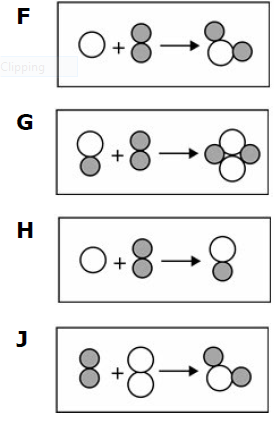
Which of the following models best demonstrates a balanced chemical equation?
a)
F
b)
G
c)
H
d)
J
24.
Which of these formulas contain equal numbers of nitrogen atoms?
a)
Formulas I and III
b)
Formulas I and IV
c)
Formulas II and III
d)
Formulas I, II, and V
25.
All of the following reactions are correctly balanced except-
a)
A
b)
B
c)
C
d)
D
26.
4Si + S8 --> 2Si2S4
a)
Synthesis
b)
Decomposition
c)
Single displacement
d)
Double displacement
27.
3Ca + 2AlCl3 --> 3CaCl2 + 2Al
a)
Synthesis
b)
Decomposition
c)
Single diplacement
d)
Double displacement
28.
3KOH + H3PO4 --> K3PO4 + 3H2O
a)
Synthesis 
b)
Decomposition
c)
Single displacement
d)
Double displacement
29.
2Pb(NO3)2 --> 2PbO + 4NO2 + O2
a)
Synthesis 
b)
Decomposition
c)
Single displacement
d)
Combustion
30.
What type of chemical reaction is this one?
C2H2 + O2 --> CO2 + H2O
a)
Decomposition
b)
Combustion
c)
Synthesis
d)
Single Replacement 
31.
What is the small number that you CANNOT CHANGE in a chemical equation? 
a)
Subscript
b)
Coefficient
c)
Product
d)
Reactant 
32.
What is the "large" number that you CAN CHANGE in a chemical equation? 
a)
Subscript 
b)
Coefficient
c)
Product
d)
Reactant 
33.
Predict the products (right side) of this reaction reaction,  
Ca + 2HCl --> ?
a)
 4CaCl+ H2
b)
no reaction
c)
 CaH2 + Cl
d)
 CaCl2 + H2
34.
Balance this equation 
Ca + H2O --> CaO + H
2
a)
Ca + 2H2O --> CaO + 2H2
b)
2Ca + H2O --> CaO + H2
c)
It is already balanced
d)
Cannot be balanced
35.
Which coefficients balance this equation: 
_Na + _Cl2  --->   _NaCl
a)
2,1,1
b)
2,1,2
c)
2,2,1
d)
1,2,2
36.
Balance this equation.
_CH4 + _O--> _CO+ _H2O
a)
1,2,1,1
b)
2,1,2,1
c)
1,2,1,2
d)
0,2,0,2
37.
N2 +  3H2 → 2NH3 
How many moles of hydrogen are needed to react with 2 moles of nitrogen?
a)
6
b)
2
c)
3
d)
1
38.
2H2   +   O2  →  2H2O
How many moles of water can be produced if 8 moles H2 are used?
a)
4 moles
b)
8 moles
c)
16 moles
d)
2 moles
39.
2NaClO3 (s)  2NaCl (s) + 3O2 (g)  
12.00 moles of NaClO3 will produce how many grams of O2?
a)
256 g of O2
b)
576 g of O2
c)
288 g O2
40.
Cl2 + 2KBr → Br2 + 2KCl
How many grams of potassium chloride (KCl) can be produced from 356 g of potassium bromide (KBr)?
a)
749 g
b)
223 g
c)
479 g
d)
814 g
41.
How many grams are in 7.8 moles of NaCl?
a)
476grams
b)
460 grams
c)

456 grams

d)
462 grams
42.
Theoretical yield = 73g
Actual yield = 62g
Calculate the percent yield.
a)
1.16%
b)
116%
c)
85%
d)
76%
43.
If a chemist calculates the maximum amount of product that could be obtained in a chemical reaction, he or she is calculating the
a)
theoretical yield
b)
mole ratio
c)
actual yield
d)
percentage yield
44.
P+ 6Cl--> 4PCl
The reaction of 75.0g P4 with excess chlorine gas produces 110g PClin lab. Find the theoretical yield and calculate percent yield for the reaction. 
a)
78%
b)
64%
c)
27%
d)
33%
45.
What are the spectator ions in the reaction of sodium chloride with silver nitrate?
a)
silver and nitrate
b)
sodium and chloride
c)
sodium and nitrate
d)
silver and chloride
46.
Which is the correct net ionic equation for the reaction of AgNO3 and CaCl2?
a)
Ca2+(aq) +  2Cl- (aq) → CaCl(s)
b)
Ag+(aq)  +  Cl- (aq) → AgCl(s)
c)
Ag +  Cl  →  AgCl
d)
Ag+  +  Ca2+   →Ag2Ca (s)
47.
In this equation,
ZnCl2 + LiOH  → Zn(OH)2 + LiCl
Which product is insoluble?
a)
zinc hydroxide
b)
lithium chloride
c)
lithium hydroxide
d)
zinc chloride
48.

Three samples of 1.12 g, 1.8 g, and 1.562 g are mixed together. The combined mass of the three samples, expressed to the correct number of significant figures, would be recorded as

a)

4.482 g

b)

4.4 g

c)

4.5 g

d)

4.48 g

49.
How many significant figures: 0.010 L
a)
1
b)
2
c)
3
d)
4
50.
How would you write 564,000,000 in scientific notation?
a)
5.64 x 10⁻⁷
b)
5.64 x 10⁶
c)
5.64 x 10⁸
d)
56.4 x 10⁷
51.
How would you write 0.0005 in scientific notation?
a)
50 x 105
b)
5 x 10⁻⁴
c)
5 x 10³
d)
0.5 x 10³
52.

0.05 cm is the same as

a)

0.00005 m

b)

0.005 mm

c)

0.05 m

d)

0.5 mm

53.

When 6.02 x 10²³ is multiplied by 7.1 X10⁻³¹, the product is

a)

4.3 X 10⁻⁸

b)

4.3 X 1054

c)

4.3 X 10⁻⁷

d)

4.3 X 10–53

54.
How many gallons are in a pool that holds 758,000 Liters?
(1 gallon = 3.79 Liters)
a)
200
b)
20,000
c)
200,000
d)
2,000,000
55.

How many kilograms of calcium are there in 173 pounds of calcium? (1 pound = 454 grams; 1 kg = 1000 g)

a)

1.10 kg

b)

78.5 kg

c)

110 kg

d)

78500 kg

56.

Jackrabbits are capable of reaching speeds up to 40 miles per hour. How fast is this in feet per second? (Round to the nearest whole number.)

[5,280 feet = 1 mile]

a)

95 feet per second

b)

59 feet per second

c)

0.45 feet per second

d)

40 feet per second

57.
Round the following number off to the number of sig figs shown in parentheses:
529.78 (3)
a)
530
b)
529
c)
5.30 x 10²
d)
5.3 x 10²
58.
Express the following number in decimal notation: 
4.96 x 10⁻³
a)
0.00496
b)
4,960
c)
496
d)
0.000496
59.

A student drew a dot cross diagram with 7 valence electrons. Which of the following elements might have the student drawn?

a)

Cl (Chlorine)

b)

Ne (Neon)

c)

N (Nitrogen)

d)

Li (Lithium)

60.

Which statement is accurate regarding subatomic particles?

a)

electrons are the heaviest particle, with a positive charge

b)

protons and electrons are equal in mass with positive charges

c)

electrons are neutral with the least mass

d)

protons have a positive charge with a mass of 1 amu and neutrons are neutral with the same mass as a proton

61.

The mass number and atomic number of the atom shown are ___ and ____?

a)

3; 4

b)

3; 3

c)

3; 7

d)

7; 3

62.
In order for an atom to be neutral what has to be true?
a)
The atom has more protons than neutrons
b)
The atom has more neutrons than protons
c)
The atom has the same number of protons and neutrons
d)
The atom has the same number of protons and electrons
63.
How is the number of neutrons in the nucleus of an atom calculated?
a)
Add the number of e- and p+ together
b)
Subtract the number of e- from p+
c)
Subtract the number of p+ from the mass number
d)
Add the mass number to the number of e-
64.

An atom has 10 protons, 15 neutrons and 10 electrons what is its mass number.

a)

20

b)

10

c)

35

d)

25

65.
If an atom has 12 positively charged subatomic particles, which of the following must it also have to be considered a neutral atom?
a)
12 neutrons
b)
12 electrons
c)
12 protons
d)
24 protons and neutrons
66.
How many moles are in 3.01 x 10²² atoms of magnesium?
a)
0.05 moles
b)
1.81 x 1046 moles
c)
5.00 x 10²¹ moles
d)
5 moles
67.
What is the mass of 0.89 mol of CaCl2?
a)
111 grams
b)
0.008 grams
c)
98.9 grams
d)
none of the choices
68.

Convert 86.235 g of diphosphorus pentoxide to moles.

a)

12240 moles

b)

1.8747 moles

c)

.608 moles

d)

.60755 moles

69.

Calculate the molar mass of Ca3(PO4)2?

a)

215.18 g/mol

b)

300.18 g/mol

c)

310.18 g/mol

d)

196.3 g/mol

70.

How many electrons can the d sublevel (the d orbitals) hold?

a)

14

b)

10

c)

2

d)

6

71.

What atom matches this electron configuration?

1s22s22p63s23p64s23d10

a)

Zinc

b)

Copper

c)

Nickel

d)

Germanium

72.
What atom matches this electron configuration?
1s22s22p63s2
a)
Neon
b)
Magnesium
c)
Aluminum
d)
Potassium
73.

An element with the electron configuration [He]2s22p4 needs ____ more electrons to complete its outer energy level.

a)

1

b)

4

c)

2

d)

none

74.

Which guideline, Hund’s rule or the Pauli exclusion principle, is violated in the following orbital diagrams?

a)

Hund's rule

b)

Aufbau's principle

c)

Pauli's Exclusion principle

d)

None of the rules is violated

75.

Which guideline, Hund’s rule or the Pauli exclusion principle, is violated in the following orbital diagrams?

a)

Aufbau's principle

b)

Hund's rule

c)

Pauli Exclusion principle

d)

None of the rules is violated

76.

What element is depicted by the given orbital diagram?

a)

sulfur

b)

chlorine

c)

phosphorus

d)

silicon

77.

Which group of elements needs to gain two electrons to achieve octet?

a)

group 17, the halogens

b)

group 16, the oxygen group

c)

group 18, the noble gases

d)

group 14, the carbon group

78.

In 1s2, the 1 means

a)

there is 1 electron

b)

the electrons are in the 1st energy level

c)

the shape is circular

d)

there is a -1 charge

79.

Ions have the same number of protons but different number of _________________

a)

neutrons

b)

electrons

c)

protons

d)

toes

80.

Isotopes have the same number of protons but different number of _________________

a)

neutrons

b)

protons

c)

electrons

d)

eyes

81.

Atoms in Group 13 will ______ 3 electrons to form a +3 charge

a)

lose

b)

gain

c)

share

d)

lose or gain

82.

Zinc ________ electrons to form ______ ion.

a)

gains 1; Zn+

b)

gains 2; Zn2+

c)

loses 2; Zn2+

d)

loses 2; Zn2-

83.

Nitrogen ______ electrons to form ________ ion.

a)

loses 3 ; N3+

b)

loses 3 ; N3-

c)

gains 3 ; N3-

d)

gains 3 ; N3+

84.

Which ions have the same number of electrons as Neon, Ne?

a)

N3-

b)

S2-

c)

Ca2+

d)

P3-

85.
What is the noble gas configuration for phosphorus?
a)
[Ar] 3p5
b)
[He] 3s2 3p5
c)
[Ne] 3s2 3p3
d)
[Na] 3s2 3p5
86.

[Kr] 5s²4d105p² is the noble gas configuration for which element?

a)

Tin

b)

Germanium

c)

Silicon

d)

Bromine

87.

An atom in which the outermost energy level is more than half full tends to form which of the following ions?

a)

positive ions

b)

both positive and negative ions

c)

negative ions

d)

neither positive nor negative ions

88.
[He]2s22p4 is the noble gas configuration for which element?
a)
oxygen
b)
sulfur
c)
phosphorus
d)
fluorine
89.
Which of the following will have a larger radius than Zinc?
a)
Gallium
b)
Aluminum
c)
Magnesium
d)
Strontium
90.
As you move down a group, atomic radius increases because - 
a)
you add more and more neutrons
b)
you add more and more protons
c)
you add more and more shells (energy levels)
d)
you add more atomic mass
91.
Francium (Fr) has the lowest ionization energy in Group 1 because - 
a)
it has the smallest number of valence electrons
b)
it has the greatest atomic mass
c)
it has the greatest number of protons, so it attracts its electrons the strongest
d)
its 1 valence electron is very far from the nucleus, so little energy is needed to remove it
92.
Electronegativity is...
a)
the ability of an atom to attract/ accept electrons
b)
the ability of an atom to lose electrons
c)
the energy required to remove an electron from a specific atom
d)
how easy it is to make friends. 
93.
As atoms of elements in group 16 are considered in order from top to bottom, the electronegativity of each successive element....
a)
decreases
b)
increases
c)
remains the same
d)
none of the above
94.
Elements in the same column of the periodic table always have the same # of _______ as one another.
a)
Protons
b)
Neutrons
c)
Electrons
d)
Valence Electrons
95.
As you move across the periodic table from left to right, the atomic radius decreases.  This is because - 
a)
the number of protons increases, so attraction to electrons increases
b)
the number of energy levels increases
c)
the number of electrons increases
d)
the atomic mass increases
96.

Which of the following pairs has the highest ionization energy?

a)

Li and Na

b)

P and S

c)

N and O

d)

Fe and Co

97.

Which of the following elements has the smallest radius?

a)

Mg

b)

Al

c)

Si

d)

K

98.

Which of the following sets of elements are arranged in order of INCREASING metallic radii?

a)

Cs < Ba < La < Hf < Ta

b)

Al < Si < P < S < Cl

c)

Be < Mg < Ca < Sr < Ba

d)

Rb < K < Na < Li < H

99.

Coulomb’s law states that the force between two charged objects will __________ when the magnitude of the object’s charge increases.

Coulomb’s law also states that the force between two charged objects will __________ when the distance between objects increases.

a)

increase; increase

b)

increase; decrease

c)

decrease; increase

d)

decrease; decrease

100.
Which statement correctly and completely identifies a trend?
a)
Atomic radius decreases across a period and increases down a group.
b)
Electronegativity decreases across a period and decreases down a group.
c)
Ionization energy increases across a period and increases down a group.
d)
Ionic radius increases across a period and increases down a group.
101.

The element with the lowest electronegativity in Period 3 is -

a)

Na

b)

Cl

c)

Ar

d)

Mg

102.
What elements generally make a covalent bond?
a)
metal and nonmetal
b)
2 nonmetals
c)
metal
d)
none of the above
103.
In chemical compounds, covalent bonds form when
a)
the electronegativity difference between two atoms is very large.
b)
electrons are completely transferred between two metals.
c)
pairs of electrons are shared between two nonmetal atoms.
d)
two nonmetal atoms are attracted to each other by opposite charges.
104.

Which of the following compounds is formed by ionic bonding?

a)

HF

b)

PCl5

c)

MgCl2

d)

CH4

105.

When forming an ionic bond, a metal atom

a)

Gains electrons to form a cation

b)

Loses electrons to form a cation

c)

Gains electrons to form an anion

d)

Loses electrons to form an anion

106.

Name the following covalent compound: SO3

a)

sulfur oxide

b)

sulfur trioxide

c)

monosulfur trioxide

d)

monosulfur troxide

107.

What is the formula of the ionic compound formed by the ions: Ca+2 and O-2 ?

a)

CaO

b)

Ca2O

c)

Ca-2O+2

d)

Ca2O2

108.

The correct name of Cu₃N₂ is

a)

copper (III) nitride

b)

copper (II) nitride

c)

copper nitride

d)

tricopper dinitride

109.

What is the charge on the Magnesium atom in MgSO4 ?

a)

+1

b)

-1

c)

+2

d)

+4

110.

Name the following ionic compound: Cr(NO2)3

a)

chromium nitrate

b)

chromium (III) nitride

c)

chromium (III) nitrate

d)

chromium (III) nitrite

111.

Write the formula for the compound formed by barium + nitrogen

a)

Ba2N3

b)

Ba3N2

c)

BaN

d)

BaN3

112.

What is the formula of the ionic compound formed by the ions:

Al3+ and O2-

a)

AlO

b)

Al2O3

c)

Al3O6

d)

Al3O2

113.

What is the correct Lewis Dot Structure for ammonia NH3?

a)
b)
c)
d)
114.

Which is the correct Lewis dot structure for carbon dioxide?

a)
b)
c)
d)
115.

What is the 3D shape of H2O molecule as predicted by VSEPR?

a)

linear

b)

tetrahedral

c)

bent

d)

trigonal pyramidal

116.

Which Lewis Dot Model drawing correctly shows an O2 molecule?

a)
b)
c)
d)
117.

What is the 3D molecular shape of BCl3 molecule?

a)

linear

b)

trigonal planar

c)

tetrahedral

d)

trigonal pyramidal

118.

How many total valence electrons are available for bonding in the sulfate ion (SO4-2)?

a)

30 electrons

b)

32 electrons

c)

28 electrons

d)

impossible to tell

119.

What is the molecular geometry of PH3?

a)

bent

b)

tetrahedral

c)

linear

d)

trigonal pyramidal

120.
490,000 g =____ kg
a)
490
b)
49
c)
4,900
d)
0.49
121.
Matter can not be created nor destroyed: it can only be
a)
Destroyed a little bit
b)
Invisible
c)
Transformed, changed
d)
None of the above
122.
Students react baking soda & vinegar.
Which of the following would provide the evidence that the number of atoms present before a chemical reaction is equal to the number of atoms present after the chemical reaction?
a)
The mass of the plastic bag, baking soda, and vinegar before the reaction was equal to the mass after the reaction.
b)
Bubbles were produced during the reaction, which meant that a gas was being produced.
c)
The plastic bag did not change in any way, indicating that it was not involved in the reaction.
d)
The mass of the baking soda was exactly equal to the mass of the vinegar used to create the chemical reaction.
123.

Suppose a reaction were to happen in an open container in a lab. During the reaction, the scientist observes the chemicals bubble, and produce a gas. During the analysis the scientist notices that the reactants weighed 20 g when he started, and the product weighed 18 g. Explain what happened.

a)

His chemical reaction defied the law of conservation of mass

b)

The product destroyed mass during the reaction

c)

The reactants created matter during the reaction

d)

The gas that was produced was not able to be weighed since the container was open.

124.

What is the volume of Object X?

a)

10.0 cm3

b)

15.0 cm3

c)

20.0 cm3

d)

25.0 cm3

125.

What is the volume of 150 grams of lead if it has a density of 11.3 g/cm3?

a)

13.3 g

b)

13.3 cm3

c)

.075 g

d)

1695 cm3