wayground logo

Free Printable Worksheets

Font size

S
M
L
XL
Worksheets

Unit Review: Thermochemistry

Total questions: 127

Worksheet time: 4hrs 52mins

Name
Class
Date
1.

The quantity of heat needed to raise the temperature of 1 g of water by 1 ° C

a)

calorimeter

b)

exothermic

c)

enthalpy

d)

specific heat capacity

2.

heat content of a system

a)

calorimeter

b)

calorie

c)

joule

d)

enthalpy

e)

heat capacity

3.

A process that absorbs heat is a(n) ____.

a)

endothermic process

b)

polythermic process

c)

exothermic process

d)

ectothermic process

4.

What is the amount of heat required to raise the temperature of 200.0 g of a metal (specific heat of metal = 0.21 J/g°C) by 10°C?

a)

420 J

b)

4,200 J

c)

42,000 J

d)

420,000 J

5.

The specific heat of silver is 0.24 J/g°C . How many joules of energy are needed to warm 4.37 g of silver from 25.0°C to 27.5°C?

a)

2.62 J

b)

0.14 J

c)

45.5 J

d)

0.022 J

6.
If the enthalpy ter (ΔH) is negative the reaction is ____.
a)
Endothermic
b)
Exothermic
c)
Neutral
7.
If ΔH is positive, heat would be shown on the _____ side of the thermochemical equation.
a)
Reactant
b)
Product
8.
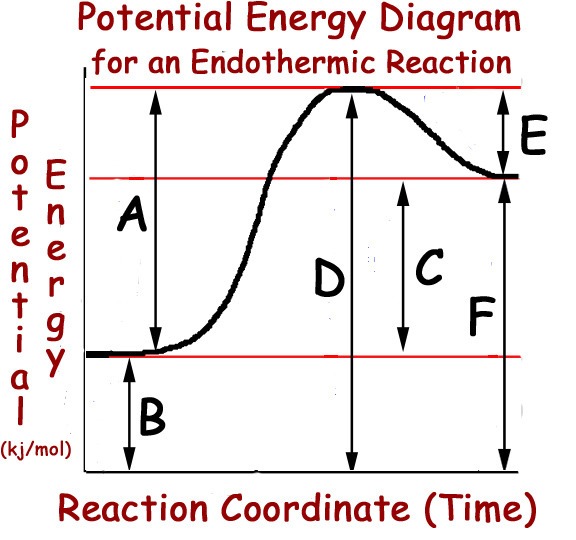
The diagram represents which type of reaction
a)
endothermic
b)
exothermic
9.

How much heat does an aluminum block absorb if 10.00 grams ae heated from 25.0oC to 50.0oC? the specific heat of aluminum is .900J/goC

a)

450 J

b)

-450 J

c)

225 J

d)

-225 J

10.

In an exothermic process the surroundings lose heat to the system.

a)

True

b)

False

11.

In an endothermic reaction the system is releasing energy to the surroundings.

a)
True
b)
False
12.
Thermal energy always moves:
a)
From a high temperature object to a lower temperature object.
b)
From a lower temperature object to a higher temperature object.
c)
From an object with lower kinetic energy to an object with higher kinetic energy.
d)
From an object of higher mass to an object of lower mass.
13.

What is the Heat of Reaction ΔH\Delta H  for this reaction?

a)

-200 KJ

b)

200 KJ

c)

400 KJ

d)

-300 KJ

14.

What type of reaction is this?

a)

Exothermic

b)

Endothermic

c)

Energy Producing

d)

No way to tell

15.
Endothermic reactions feel
a)
warm
b)
cold
16.

delta T is calculated by

a)

Ti - Tf

b)

Tf - Ti

c)

Tf + Ti

d)

Ti + Tf

17.

Heat flows from ________ temperature areas to ______ temperature areas.

a)

high, low

b)

low, high

18.

Which of the following is NOT a unit of heat?

a)

joules

b)

calories

c)

degrees Celsius

d)

All are units of heat.

19.

The sand at a beach gets very hot during the day, and cools down rapidly at night. The water stays close to the same temperature, because

a)

the sand has a higher specific heat capacity

b)

the water has a higher specific heat capacity

20.
Copper, Stainless Steel, Carbon Steel, and Zinc were all heated using 10,000 JOULES of thermal energy.  What material would be have the LARGEST change in temperature?
a)
Copper
b)
Carbon Steel
c)
Zinc
d)
Stainless Steel
21.
Copper, Stainless Steel, Carbon Steel, and Zinc were all heated using 10,000 JOULES of thermal energy.  Based on the chart, which material would be have the SMALLEST change in temperature?
a)
Copper
b)
Carbon Steel
c)
Zinc
d)
Stainless Steel
22.
If I have 2 blocks of Aluminium (one of 1kg and one of 10 kg) and heat them up with 6,000 Joules of energy.
Which one will have the SMALLEST change in temperature?
a)
1 kg
b)
10 kg
c)
They both heat up  to the same temperature
d)
It depends on the temperature of the room
23.
The temperature of an unknown piece of metal with a mass of 30.00 g changes from 25.0 °C to 35.0 °C when the metal absorbs 350.0 J of energy. What is the specific heat of the metal?
a)
1.17 J/g°C
b)
-1.17 J/g°C
c)
0.857 J/g°C
d)
-0.857 J/g°C
24.
According to the Law of Conservation of Energy, the energy in the universe is 
a)
ever changing
b)
constant
c)
flowing
d)
decreasing
25.
The measure of heat flow into or out of a system due to physical or chemical processes is called
a)
calorimetry
b)
temperature
c)
energy
d)
specific heat
26.
A metal cylinder at 95.6⁰C was placed in a cup of water at 22.0⁰C. After 3 minutes the final temperature was 26.8⁰C. How did heat energy flow?
a)
from the metal to the cup
b)
from the water to the metal
c)
from the metal to the water
d)
heat did not flow
27.
Energy due to position or composition is _______energy. (stored)
a)
potential
b)
rapid
c)
kinetic
d)
heat
28.

A large cup of ice is poured into a glass pitcher of freshly brewed hot tea. The ice melts quickly and the tea in the glass pitcher gets much colder. If we wait twenty-four hours, what temperature would we expect the tea and ice mixture to reach?

a)

The tea transferred energy to the ice making it melt. The mixture will be the temperature of the hot tea.

b)

The tea transferred energy to the ice until they had equal amounts of energy. They will reach a temperature somewhere between each of their original temperatures.

c)

The ice transferred energy to the tea until they had equal amounts of energy. They will reach a temperature somewhere between each of their original temperatures.

d)

The ice transferred energy to the tea making it melt. The mixture will be the temperature of the cold ice.

29.

The law of conservation of energy states that

a)

energy can be created or destroyed

b)

energy cannot be created or destroyed

c)

energy can be potential or kinetic only

d)

heat energy is kinetic energy

30.
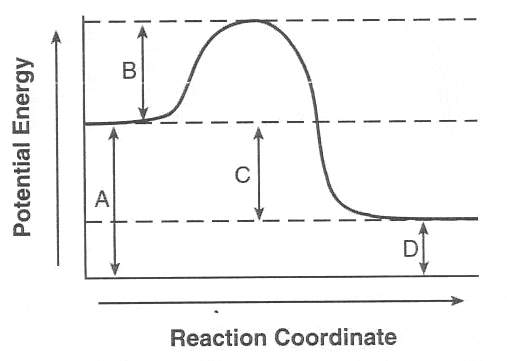
What letter represents ΔH?
a)
A
b)
B
c)
C
d)
D
31.
What is the sign of ΔH for all endothermic reactions?
a)
Positive
b)
Negative
32.
When a  piece of aluminum foil is taken out of the oven and cools from 100° to 50°, What is the change in temperature?
a)

-50°

b)

50°

c)
100°
d)
150°
33.

656.7 J of energy are added to a sample of iron and the temperature of the sample increases by 22.36oC. What must be the mass of this iron sample? (CFe = .4494 J/g * oC)

a)

65.34 g

b)

89.36 g

c)

48.36g

d)

35.21g

34.

If two objects have different temperatures when they come in contact, heat will flow from the warmer object to the cooler one UNTIL ____________

a)

one reaches a temperature of zero

b)

they both have an equal temperature

c)

one runs out of energy

35.
Calorimetry Question:
A piece of metal with a mass of 32.8 g is heated to 100.5°C and dropped into 138.2 g of water at 20.0°C.  The final temperature of the system is 30.2°C.  What is the specific heat capacity of the metal? (show your work)
a)
2.56 J/g°C
b)
0.391 J/g°C
c)
5.29 J/g°C
d)
3.50 J/g°C
36.

What does "ΔT" mean?

a)

A change in health

b)

A change in heat

c)

A change in height

d)

A change in temperature

37.

Identify the given ΔT in problem:

a)

15.75 g

b)

1086.75 J

c)

150°C

d)

unknown (aka ?)

38.
ΔH value in an endothermic reaction is a positive number.
a)
True
b)
False
39.
A catalyst works by
a)
changing the order of the reaction
b)
increasing the temperature
c)
lowering the activation energy
d)
making the activated complex
40.
Define 'Enthalpy'
a)
a) Energy stored in the movement of molecules in a substance
b)
b) The opposite of temperature
c)
c) The temperature of a molecule
d)
d) Energy stored in the chemical bonds in a substance
41.
Which statement is true regarding endothermic reactions?
a)
a) Temperature change is positive and enthalpy change is positive
b)
b) Temperature change is positive and enthalpy change is negative
c)
c) Temperature change is negative and enthalpy change is positive
d)
d) Temperature change is negative and enthalpy change is negative
42.

What is the Heat of Reaction ΔH\Delta H  for this reaction?

a)

-200 KJ

b)

200 KJ

c)

400 KJ

d)

-300 KJ

43.

How much activation energy is needed for this reaction?

a)

300 KJ

b)

500 KJ

c)

400 KJ

d)

100 KJ

44.

Are the products or reactants of this reaction storing more energy in their chemical bonds?

a)

Both storing the same

b)

No way to tell

c)

Products

d)

Reactants

45.

What type of reaction is this?

a)

Exothermic

b)

Endothermic

c)

Energy Producing

d)

No way to tell

46.

What kind of equation is this: 2KI + MgCl2 + 200KJ ----> 2KCl + MgI2

a)

Endothermic

b)

Exothermic

47.

In this equation, is more energy stored in the bonds of the reactants or products: NaCl + AgF +100KJ -----> NaF + AgCl

a)

Products

b)

Reactants

48.

How can you tell this reaction is exothermic: MgO + CaS ----> CaO + MgS + 200 KJ

a)

Energy is written on the products side

b)

Energy is being released

c)

Less energy is stored on product side

d)

All of these tell me

49.
Which of these conditions is always true for an exothermic process?
a)
They leave the surroundings feeling cold
b)
They release energy into the surroundings.
c)
They absorb energy from the surroundings
d)
The reactants gain energy as they form the products
50.
In an endothermic reaction the system is releasing energy.
a)
True
b)
False
51.
A reaction is performed in a beaker with a temperature probe recording the temperature changes of the reaction.  If the temperature began at 15.0 degrees Celsius and ended at 27.5 degrees Celsius.  If the reaction is our system, is the system endothermic or exothermic?
a)
Exothermic
b)
Endothermic
52.
Do reactants in an endothermic reaction have a higher or lower energy than the products? 
a)
Higher
b)
Lower
53.

When you freeze water, it turns to ice. What kind of change is this?

a)

endothermic

b)

exothermic

54.
What kind of reaction has a negative heat of reaction (ΔHr)?
a)
endothermic
b)
exothermic
55.

When heat is transferred, which way does it travel?

a)

from colder temperature to warmer temperature

b)

from warmer temperature to cooler temperature

c)

first class

d)

coach

56.
What happens to the energy of particles in a substance as it changes from gas, to liquid, to solid?
a)
KE decreases
b)
KE increases
c)
KE stays the same
d)
KE goes up and then goes down
57.
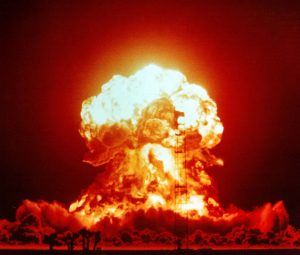
What type of reaction is shown in the photo?
a)
Exothermic
b)
Isothermic
c)
Endothermic
d)
None of the  above
58.

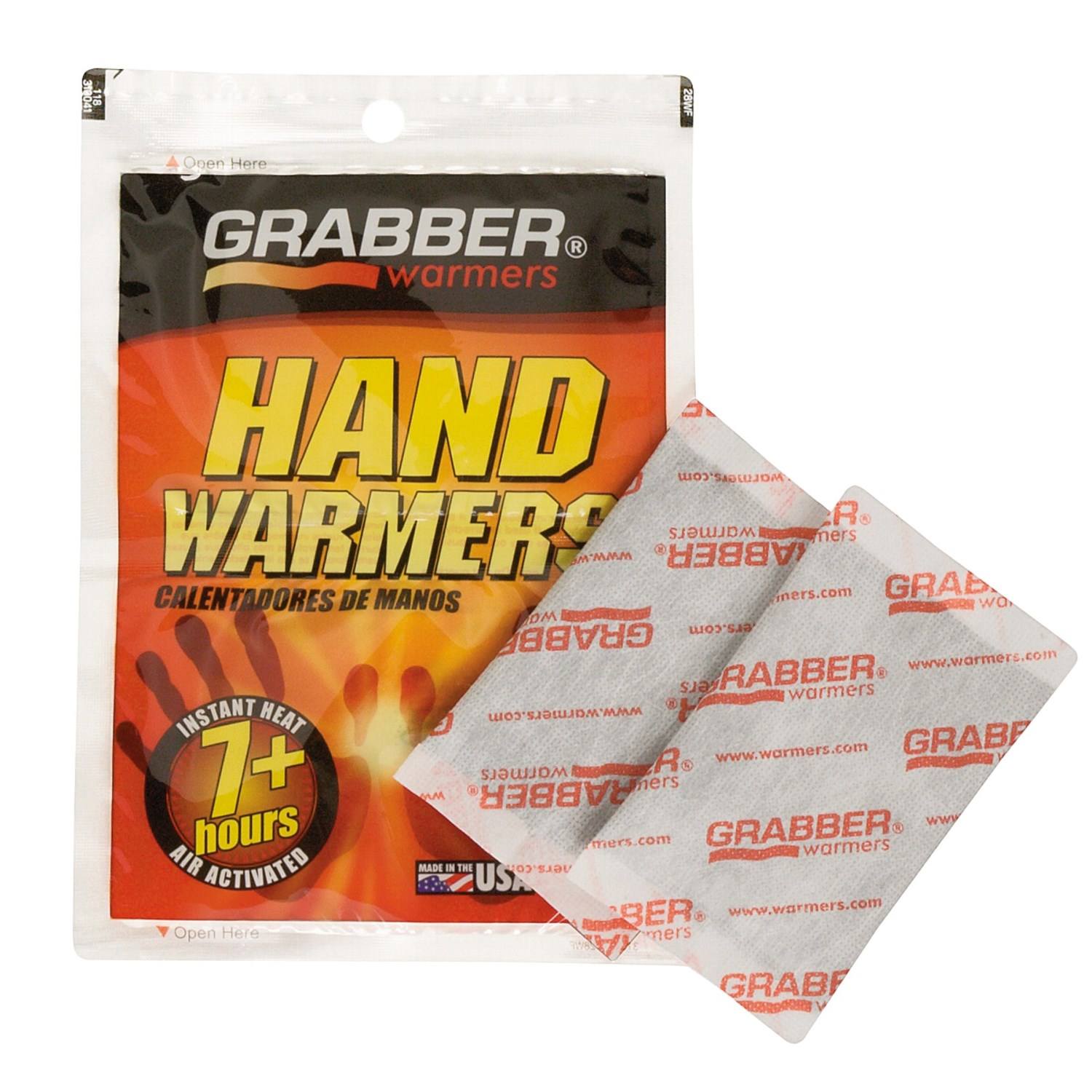
What type of reaction occurs in a hand warmer?

a)

exothermic

b)

endothermic

59.

What do you call the energy that is required to start a reaction?

a)

Alternative energy

b)

Activation energy

c)

Atmospheric energy

60.

A + Heat -------> C + D

a)

Endothermic

b)

Exothermic

61.

A + B-------> C + Heat

a)

Endothermic

b)

Exothermic

62.

Absorbs energy

a)

Endothermic

b)

Exothermic

63.

Burning and combustion

a)

Endothermic

b)

Exothermic

64.

Energy or heat is a product

a)

Endothermic

b)

Exothermic

65.

Cold Pack

a)

Endothermic

b)

Exothermic

66.

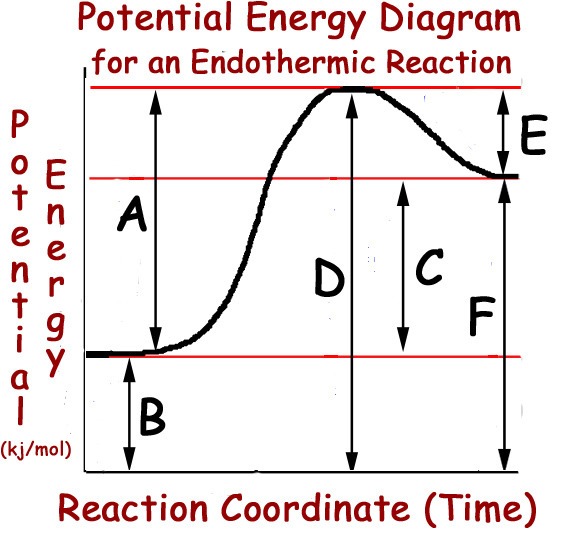
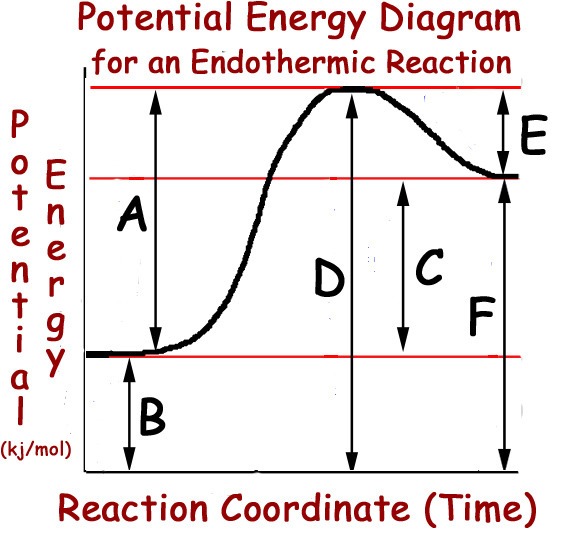
Which letter shows the activation energy

a)

A

b)

B

c)

C

67.

Is this showing an endothermic or an exothermic reaction?

a)

Endothermic

b)

Exothermic

68.

Which letter shows the heat change?

a)

A

b)

B

c)

C

d)

D

e)

E

69.

Which letter represents the reactants?

a)

A

b)

B

c)

C

d)

D

e)

E

70.

Which letter represents the products?

a)

A

b)

B

c)

C

d)

D

e)

E

71.

Which letter represents the transition state?

a)

A

b)

B

c)

C

d)

D

e)

E

72.
What letter represents the energy of the products?
a)
A
b)
B
c)
C
d)
D
73.
What letter represents the activation energy?
a)
A
b)
B
c)
C
d)
D
74.
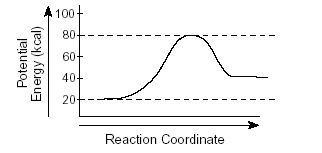
Is this reaction endothermic or exothermic?
a)
endothermic 
b)
exothermic
75.

What is the ΔH of this reaction?

a)

40 kJ

b)

20 kJ

c)

80 kJ

d)

-60 kJ

76.
What letter represents ΔH?
a)
A
b)
B
c)
C
d)
D
77.

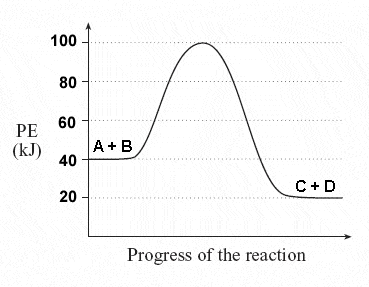
What is the change of the heat of the reaction (ΔH)?

a)

-40 kJ

b)

-20 kJ

c)

100 kJ

d)

60 kJ

78.
What is the PE of the reactants?
a)
100 kJ
b)
175 kJ
c)
50 kJ
d)
75 kJ
79.
What is the PE of the products?
a)
100 kJ
b)
175 kJ
c)
50 kJ
d)
75 kJ
80.
What is the activation energy?
a)
100 kJ
b)
175 kJ
c)
50 kJ
d)
75 kJ
81.

What is the change of the heat of the reaction (ΔH)?

a)

100 kJ

b)

-175 kJ

c)

-50 kJ

d)

75 kJ

82.
Copper, Stainless Steel, Carbon Steel, and Zinc were all heated using the same thermal energy.  What material would be the coolest after being heated?
a)
Copper
b)
Carbon Steel
c)
Zinc
d)
Stainless Steel
83.
What unit do you use to measure Thermal Energy?
a)
J/Kg ºC
b)
Kg
c)
ºC
d)
J
84.
What  is the formula to calculate heat energy required to raise the temperature of any substance?
a)
Q = m Cp ∆T
b)
Q = m Cp
c)
Q =  ½ m v
d)
m = Q Cp
85.
Which direction will the heat flow while this person holds a hot cup of tea?
a)
from the cup to her hand
b)
from her hand to the cup
c)
no heat is transferred
86.
Which direction will the heat flow while this ice cap melts?
a)
there is no heat transfer
b)
from the icecap to the water
c)
from the water to the icecap
87.
A material was cooled from 100ºC to 40ºC.  What is the temperature change?
a)
60ºC
b)
40ºC
c)
-60ºC
d)
-40ºC
88.
What does temperature measure?
a)
Heat
b)
ºC
c)
Kinetic Energy
d)
Thermal Energy
89.
If the specific heat of water is 4,186 J/kg∙°C, how much heat is required to increase the temperature of 1.2 kg of water from 23 °C to 39 °C? 
a)
-80,371.2
b)
44,938.6
c)
80,371.2
d)
112,575.9
90.
The specific heat(c) of copper is 0.39 J/g °C. What is the temperature change(∆t) when 100 Joules of heat(Q) is added to 20 grams?
a)
12.82 °C
b)
24.12°C
c)
351 °C
91.

What is Specific Heat?

a)

The amount of thermal energy required to increase the temperature of 1kg of a material by 1 degree.

b)

The amount of radiant energy required to increase the temperature of 1kgof a material by 1 degree.

c)

The amount of energy required to increase the temperature of 1kgof a material by 1 degree.

d)

The amount of friction required to increase the temperature of 1kgof a material by 1 degree.

92.

A sample of iron receives 50.J of heat energy that raises the temperature of the iron 25.0°C. If iron has a specific heat of .10 J/gK, what is the mass of the iron sample?

a)

25g

b)

30g

c)

20g

d)

50g

93.
The unit(s) for heat are?
a)
calories
b)
joules
c)
calories or joules
94.
The amount of energy required to raise the temperature 1ºC for every kilogram is called____?
a)
Thermal Energy
b)
Specific Heat
c)
Temperature
d)
Kinetic Energy
95.
What is the symbol for Thermal Energy?
a)
Q
b)
t
c)
m
d)
C
96.
Water has a specific heat of 4184 J/KgºC.  Wood has a specific heat of 1760 J/KgºC.  What material needs more energy to raise the temperature 1ºC
a)
Wood
b)
Water
c)
Both are the same
97.
When a  piece of aluminum foil is taken out of the oven and cools from 100° C to 50°C, What is the change in temperature?
a)
50°
b)
c)
100°
d)
150°
98.

Which will heat up the fastest? (a)  

Choose from the below words
copper
granite
iron
basalt
99.

Which of the following best explains why the sand at the beach is hotter than the water?

a)

Sand has a higher specific heat than water.

b)

Sand has a lower specific heat than water.

c)

Sand has a greater mass than water.

d)

Water has a greater mass than sand.

100.
20 g of water. specific heat of water is 4.18 J/g°C.  temperature changes from 25° C to 20° Chow much heat energy (Q) moves from the water to the surroundings?
a)
418 Joules
b)
209 J
c)
83 J
d)
4.18 J
101.

If two objects have different temperatures when they come in contact, heat will flow from the warmer object to the cooler one UNTIL ____________

a)

one reaches a temperature of zero

b)

they both have an equal temperature

c)

one runs out of energy

102.

Calorimetry Problem

What is the specific heat of an unknown substance if 100.0 g of it at 200.0 °C reaches an equilibrium temperature of 27.1 °C when it comes in contact with a calorimeter of water.  The water weighs 75. g and had an initial temperature of 20.00 °C?  (Specific heat of water is 4.18 J/g°C) (show your work)

a)

0.111 J/g°C

b)

1.29 J/g°C

c)

0.129 J/g°C

d)

22225.85 J

103.
Calorimetry Question:
A piece of metal with a mass of 32.8 g is heated to 100.5°C and dropped into 138.2 g of water at 20.0°C.  The final temperature of the system is 30.2°C.  What is the specific heat capacity of the metal? (show your work)
a)
2.56 J/g°C
b)
0.391 J/g°C
c)
5.29 J/g°C
d)
3.50 J/g°C
104.

What does "q" mean?

a)

A measure of heat energy

b)

A change in heat energy

c)

A measure of kinetic energy

d)

A change in temperature

105.
What is a tool that measures the heat of chemical reactions?
a)
calorimeter
b)
 calorie
c)
Styrofoam™ cup
d)
none of these
106.
Calorimeters use insulating materials to:
a)
encourage affordable materials in science experiments in schools.
b)
preserve the heat of the environment outside the Styrofoam cup.
c)
prevent heat from escaping to the environment.
d)
keep the liquid inside the Styrofoam cup from overheating.
107.
A metal cube at temperature of 10°C immersed in a liquid at temperature of 70°C.
What is the temperature of the metal cube when thermal equilibrium is achieved between the cube and the liquid?
a)
Between 10°C and 70°C
b)
More than 70°C
c)
Less than 10°C
d)
Same as the room temperature
108.

The specific heat of water is 4.18 J/g°C.

If 980. J of energy is added to 6.20 g of water at 18.0 °C, what is the final temperature of the water?

a)

37.8 °C

b)

-19.8 °C

c)

19.8 °C

d)

55.8 °C

109.

What does "ΔT" mean?

a)

A change in health

b)

A change in heat

c)

A change in height

d)

A change in temperature

110.
For the formula:
 Q= m c ∆T
The  units for specific heat are:
a)
g /J C
b)
°C/g J
c)
kJ/g
d)
J/g°C
111.
What would be the effect on the particles if more heat is supplied to the system?
a)
They would slow down
b)
They would stop moving
c)
They would speed up
d)
There would be no effect
112.

If two objects have different temperatures when they come in contact, heat will flow from the warmer object to the cooler one UNTIL ____________

a)

one reaches a temperature of zero

b)

they both have an equal temperature

c)

one runs out of energy

113.
The total energy of all the particles in a substance is called: 
a)
temperature
b)
thermal energy
c)
degrees
d)
mass
114.

If the specific heat of water is 4.18 J/g∙°C, how much heat is required to increase the temperature of 1.2 kg of water from 23 °C to 39 °C? (show your work)

a)

-80,256 J

b)

80.256 J

c)

80,256 J

d)

-80.256 J

115.
What is the specific heat of an unknown substance if 100.0 g of it at 200.0 °C reaches an equilibrium temperature of 27.1 °C when it comes in contact with a calorimeter of water.  The water weighs 75. g and had an initial temperature of 20.00 °C?  (Specific heat of water is 4.18 J/g°C) (show your work)
a)
0.111 J/g°C
b)
1.29 J/g°C
c)
0.129 J/g°C
d)
22225.85 J
116.

For a skillet, used for cooking, do you want a high or low specific heat

a)

High, so that it will need more energy to heat up

b)

Low, so that it will change temperature quickly

117.
The SI unit of heat and energy is the __________.
a)
calorie
b)
heat
c)
joule
d)
watt
118.
A sample of iron receives 50.J of heat energy that raises the temperature of the iron by 25.0°C. If iron has a specific heat of 0.10 J/g°C, what is the mass of the iron sample?  (show your work)
a)
25g
b)
30g
c)
20g
d)
50g
119.
A reaction is performed in a beaker with a temperature probe recording the temperature changes of the reaction.  If the temperature began at 15.0 degrees Celsius and ended at 27.5 degrees Celsius. Is the reaction endothermic or exothermic?
a)
Exothermic
b)
Endothermic
120.
Calorimetry Question:
A piece of metal with a mass of 32.8 g is heated to 100.5°C and dropped into 138.2 g of water at 20.0°C.  The final temperature of the system is 30.2°C.  What is the specific heat capacity of the metal? (show your work)
a)
2.56 J/g°C
b)
0.391 J/g°C
c)
5.29 J/g°C
d)
3.50 J/g°C
121.
In an exothermic process, the surroundings are gaining energy.
a)
True
b)
False
122.

What does "q" mean?

a)

A measure of heat energy

b)

A change in heat energy

c)

A measure of kinetic energy

d)

A change in temperature

123.
What is a tool that measures the heat of chemical reactions?
a)
calorimeter
b)
 calorie
c)
Styrofoam™ cup
d)
none of these
124.
Calorimeters use insulating materials to:
a)
encourage affordable materials in science experiments in schools.
b)
preserve the heat of the environment outside the Styrofoam cup.
c)
prevent heat from escaping to the environment.
d)
keep the liquid inside the Styrofoam cup from overheating.
125.
A metal cube at temperature of 10°C immersed in a liquid at temperature of 70°C.
What is the temperature of the metal cube when thermal equilibrium is achieved between the cube and the liquid?
a)
Between 10°C and 70°C
b)
More than 70°C
c)
Less than 10°C
d)
Same as the room temperature
126.

The specific heat of water is 4.18 J/g°C.

If 980. J of energy is added to 6.20 g of water at 18.0 °C, what is the final temperature of the water?

a)

37.8 °C

b)

-19.8 °C

c)

19.8 °C

d)

55.8 °C

127.

What does "ΔT" mean?

a)

A change in health

b)

A change in heat

c)

A change in height

d)

A change in temperature