wayground logo

Free Printable Worksheets

Font size

S
M
L
XL
Worksheets

Chemistry 1st Semester Final Review

Total questions: 131

Worksheet time: 2hrs 18mins

Name
Class
Date
1.

Which most often occurs when a pot of water boils?

a)

Condensation

b)

freezing

c)

melting

d)

evaporation

2.

How is heat transferred in radiation?

a)

through solids

b)

through liquids

c)

through time

d)

through air

3.

Which best explains why a wooden spoon can be used to stir hot soup on the stove?

a)

Wood is a good conductor of heat and transfers energy to the spoon.

b)

Wood is a poor conductor of heat and transfers energy to the spoon.

c)

Wood is a good conductor of heat and does not allow the transfer of energy to the spoon.

d)

Wood is a poor conductor of heat and does not allow the transfer of energy to the spoon.

4.

Which shows an example of convection?

a)

Jose cooks an egg in a pot of boiling water.

b)

Clara burns her hand by touching a light bulb.

c)

Lucy wraps herself in an electric blanket to keep warm.

d)

Ben holds the end of a metal rod in a fire to cook hot dogs.

5.

Which is an example of radiated heat for cooking?

a)

cooking a pot of soup

b)

scrambling eggs on the stove

c)

grilling hot dogs over a campfire

d)

frying hamburgers in a frying pan

6.

Which substance will conduct the least amount of heat?

a)

glass

b)

copper

c)

plastic

d)

aluminum

7.

Which is an example of radiation?

a)

boiling a pot of noodles for dinner

b)

getting hot from lying in the sun

c)

feeling warm while taking a shower

d)

burning yourself after touching a hot plate

8.

Why does an ice cube melt when dropped into hot liquid?

a)

The liquid absorbs heat from the ice.

b)

Heat from the liquid transfers to the ice.

c)

Heat from the ice transfers to the liquid.

d)

Cold from the ice transfers into the liquid.

9.

Which is the best example of conduction?

a)

boiling a pot of water

b)

feeling heat from a fireplace

c)

a hot air balloon rising and falling

d)

touching a hot handle and getting burned

10.

Which best describes the transfer of heat due to the movement of gases and liquids?

a)

radiation

b)

convection

c)

evaporation

d)

condensation

11.

Which is an example of heat being transferred by conduction?

a)

a furnace heating the air in a school

b)

an ice cube melting in a person's hand

c)

a pot of water on a stove boiling

d)

the sun heating water in a swimming pool

12.

Which best explains why metal is a good material to make frying pans?

a)

Metal is a good conductor of heat and transfers heat from the stove to the food.

b)

Metal is a good conductor of heat and does not transfer heat from the stove to the food.

c)

Metal is a poor conductor of heat and transfers heat from the stove to the food.

d)

Metal is a poor conductor of heat and does not transfer heat from the stove to the food.

13.

How does heat energy from the Sun reach Earth?

a)

radiation

b)

solar wind

c)

conduction

d)

convection

14.

Which would most likely turn gas into a liquid?

a)

cooling

b)

boiling

c)

warming

d)

freezing

15.

Sarah is stirring her hot chocolate with a metal spoon, and she notices that the spoon is getting hot. This is most likely caused by which type of heat?

a)

conduction

b)

convection

c)

radiation

d)

insulation

16.

Ice cubes are placed in a glass of water that is at room temperature. Which statement best describes the temperature of the water after 10 minutes?

a)

The temperature decreases because some of the water's heat is lost to the ice.

b)

The temperature decreases because some of the ice's heat is lost to the water.

c)

The temperature increases because some of the coolness of the water is absorbed by the ice.

d)

The temperature increases because some of the coolness of the ice is absorbed by the water.

17.
The sun shines down on this family as the play on the beach.
a)
conduction
b)
convection
c)
radiation
18.
A group of friends gather around a fire to stay warm.
a)
conduction
b)
convection
c)
radiation
19.
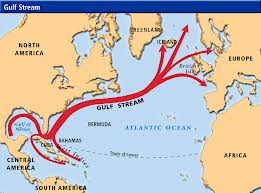
The Gulf Stream is a current that brings warm ocean water from the south to the north.
a)
conduction
b)
convection
c)
radiation
20.
Walking on the warm sand sand with your bare feet.
a)
conduction
b)
convection
c)
radiation
21.
Blow drying your wet hair.
a)
conduction
b)
convection
c)
radiation
22.
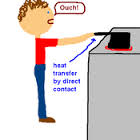
The man goes to take the hot pot off the stove with his bare hands.
a)
conduction
b)
convection
c)
radiation
23.
Warm air rises and the cool air sinks.
a)
conduction
b)
convection
c)
radiation
24.
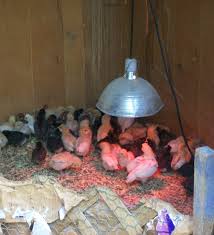
The baby chickens are kept warm from the heat lamps.
a)
conduction
b)
convection
c)
radiation
25.
In some cultures, walking on fire is the ultimate sign of strength.
a)
conduction
b)
convection
c)
radiation
26.
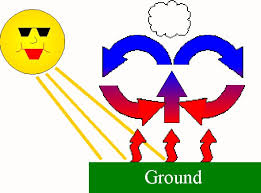
In this experiment, the WARM red dye and the COLD blue dye was placed in the water at the same time. The warm red dye rose to the top while the cold blue dye sank to the bottom.
a)
conduction
b)
convection
c)
radiation
27.
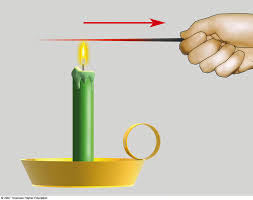
The candle will slowly heat the metal and transfer the heat directly to the mans hand.
a)
conduction
b)
convection
c)
radiation
28.
Johnny accidentally grabbed the handle of the hot pot.
a)
conduction
b)
convection
c)
radiation
29.
The warm air from this heater creates a current when the warm air rises and the cold air sinks.
a)
conduction
b)
convection
c)
radiation
30.
Heat transfers from an area of ____temperature to an area of ___ temperature.
a)
high to low
b)
low to high
c)
high to high
31.
In how many ways does heat move around the universe?
a)
One
b)
Three
c)
Two
d)
Ten
32.
Hot air moving up is an example of 
a)
Radiation
b)
Conduction
c)
Magic
d)
Convection
33.
Molecules in cold things move more _________
than in hot things.
a)
quickly
b)
slowly
c)
happily
d)
merrily
34.
The transfer of heat by currents through liquids of gases is called
a)
Perspiration
b)
Radiation
c)
Conduction
d)
Convection
35.
Conduction occurs in...
a)
solids
b)
liquids
c)
gases
36.
Warm air is __________ dense than cold air and rises creating convection currents.
a)
more
b)
less
37.

The atomic number identifies the number of __________.

a)

electrons

b)

atoms

c)

protons

d)

neutrons

38.

Subatomic particles that have a negative charge

a)

electrons

b)

protons

c)

quarks

d)

neutrons

39.
Subatomic particles with a positive charge
a)
neutrons
b)
atomic mass
c)
protons
d)
isotopes
40.

These are found in the nucleus and have a neutral charge.

a)

proton

b)

electron

c)

neutron

41.
Value representing the number of protons in an element
a)
Atomic Mass
b)
Mass Number
c)
Valence Electrons
d)
Atomic Number
42.
Who was the first person to talk about atoms?
a)
Dalton
b)
Democritus
c)
Bohr
d)
Thomson
43.
Who's experiments lead to the discovery of the nucleus and the mostly empty space around it?
a)
Democritus
b)
Dalton
c)
Thompson
d)
Rutherford 
44.
What did JJ Thomson's work contribute to the atom? 
a)
Protons
b)
Neutrons
c)
Electrons
d)
Nucleus
45.
Which was the last sub-atomic particle to be discovered?
a)
Proton
b)
Neutron
c)
Electron
d)
Nucleus
46.
Which particles are located in the nucleus? 
a)
Protons & Electrons 
b)
Electrons & Neutrons 
c)
Protons & Neutrons 
47.
Which sub-atomic particles were determined to have charges? 
a)
Protons & Electrons 
b)
Electrons & Neutrons
c)
Protons & Neutrons
48.
What is the name of the experiment that led to the discovery of the electron?
a)
Cathode Ray Tube (CRT) Experiment 
b)
Gold Foil Experiment
c)
Atomic Electrification Experiment 
d)
Plum Pudding Experiment
49.
Rutherford conclude that atoms were _________. 
a)
Mainly empty space 
b)
Made of protons, neutrons, and electrons
c)
Uniform throughout
d)
Dense positively charged particles
50.

An atom has 25 protons and 30 neutrons. How many electrons are needed to make the atom neutral?

a)

0

b)

25

c)

30

d)

35

51.
What is the overall charge of the nucleus?
a)
Positive
b)
Negative
c)
No Charge
d)
Both positive and negative
52.

Subatomic particles with a negative charge

a)

Electrons

b)

Neutrons

c)

Protons

d)

Quarks

53.
Subatomic particles with a positive charge
a)
neutrons
b)
atomic mass
c)
protons
d)
isotopes
54.
Measure mainly of the nuclear particles: protons + neutrons
a)
Subatomic Particles
b)
Atomic Number
c)
Atomic Mass
d)
Gluons
55.
Value representing the number of protons in an element
a)
Atomic Mass
b)
Mass Number
c)
Valence Electrons
d)
Atomic Number
56.
Subatomic particles that are neutral in charge
a)
Neutrons
b)
Protons
c)
Nucleus 
d)
Electrons
57.
A tiny but very dense, positively charged portion of the atom that holds most of the atomic mass
a)
Electron Shells
b)
Orbitals
c)
Electron Cloud
d)
Nucleus
58.
Arrangement of elements organized by atomic number
a)
Electron Cloud 
b)
Periodic Table 
c)
Electron Configuration
d)
None of these
59.
The only element with no neutrons in its nucleus.
a)
Oxygen
b)
Helium 
c)
Hydrogen
d)
Lithium
60.

The smallest particle of an element.

a)

Element

b)

Molecule

c)

Atom

61.

What is one way Neutrons are different from electrons?

a)

they both are negative

b)

neutrons have no charge, while electrons have a negative charge

c)

Both are in the nucleus( center of atom)

d)

Electrons are inside nucleus and neutrons are outside the nucleus.

62.

What is the atomic number?

a)

35

b)

18

c)

17

d)

52

63.

How many protons and electrons does this element have?

a)

35

b)

18

c)

17

d)

52

64.

How many neutrons does Chlorine have?

a)

18

b)

17

c)

35

d)

52

65.

What is the atomic mass of Neon?

a)

10

b)

20

c)

30

66.

How many neutrons does calcium have?

a)

20

b)

40

c)

60

d)

0

67.

What is the atomic mass of Arsenic?

a)

33

b)

107

c)

75

68.
What number indicates the nucleus?
a)
1
b)
2
c)
3
d)
4
69.
What number indicates an electron?
a)
1
b)
2
c)
3
d)
4
70.
All matter is made of 
a)
energy 
b)
atoms 
c)
air
d)
chemistry
71.
Referring to the table, what is the relative mass of a proton?
a)
10
b)
1
c)
0.1
d)
0.01
72.
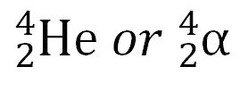
What do these symbols represent?
a)
alpha particle
b)
beta particle
c)
neutron
d)
gamma ray
73.
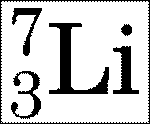
How many protons are in this atom?
a)
3
b)
4
c)
6
d)
10
74.
What do you call the energy required to prevent the protons in the nucleus from repelling?
a)
nuclear energy
b)
binding energy
c)
radioacitve energy
d)
electromagnetic energy
75.
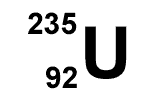
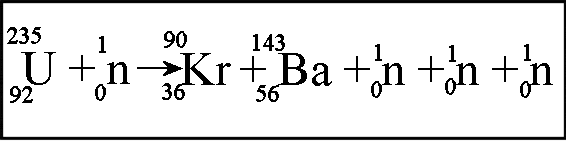
How many neutrons are in this isotope of Uranium?
a)
235
b)
92
c)
327
d)
143
76.
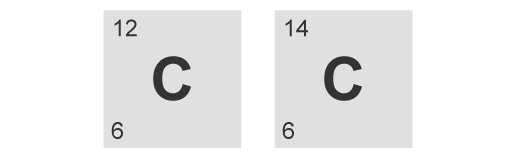
How are these isotopes different?
a)
Different atomic numbers
b)
Different number of protons
c)
Different number of neutrons
d)
Different number of electrons
77.
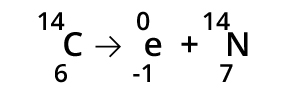
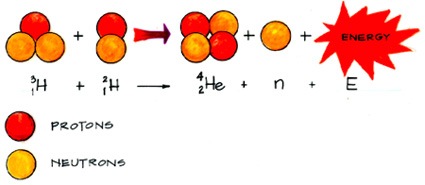
What process is modeled by the equation?
a)
alpha decay
b)
beta decay
c)
fission
d)
fusion
78.
What process is modeled with this equation?
a)
alpha decay
b)
beta decay
c)
fission
d)
fusion
79.
What is the mass number of at isotope that has 20 protons, 21 neutrons and 18 electrons?
a)
18
b)
20
c)
21
d)
41
80.
What is one problem with using nuclear fission as an energy source?
a)
finding radioactive elements that have longer half-lives
b)
finding ways of storing radioactive wastes
c)
finding compounds to cool heated water
d)
finding non-radioactive elements for reactors
81.
What type of nuclear equation is this?
a)
fusion
b)
fission
c)
alpha
d)
beta
82.
What sort of shield will block gamma rays?
a)
skin
b)
paper
c)
aluminum
d)
thick lead
83.
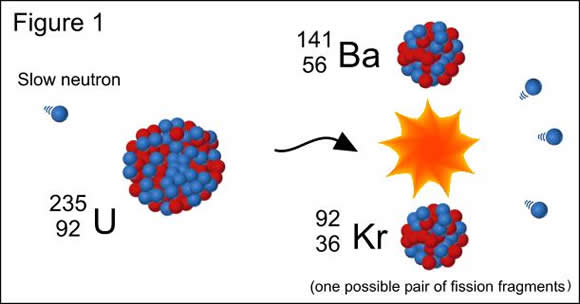
Which nuclear process is shown in the picture?
a)
fission
b)
fusion
c)
alpha decay
d)
beta decay
84.
In a neutral atom, the number of protons always equals
a)
the number of neutrons.
b)
the number of electrons.
c)
the mass number.
d)
the average atomic mass.
85.
Why does an atom undergo beta decay?
a)
It has too many electrons.
b)
It has an atomic number greater than 83
c)
It has more neutrons than protons
d)
It has more protons than neutrons
86.
What happens to the atomic number during alpha decay?
a)
The atomic number decreases by 4
b)
The atomic number increases by 1
c)
The atomic number decreases by 2.
d)
The atomic number stays the same.
87.
Which process produces alpha particles?
a)
Alpha decay
b)
Beta decay
c)
Gamma decay
d)
Nuclear fusion
88.
Which process produces beta particles?
a)
Alpha decay
b)
Beta decay
c)
Gamma decay
d)
Nuclear fusion
89.
Which process involves the joining of small nuclei?
a)
Beta decay
b)
Alpha decay
c)
Nuclear fission
d)
Nuclear fusion
90.
Which process involves the splitting of large nuclei?
a)
Beta decay
b)
Alpha decay
c)
Nuclear fission
d)
Nuclear fusion
91.
The time taken for half of an amount of radioactive atoms to decay.
a)
Nuclear fusion
b)
Full-life
c)
Dead time
d)
Half-life
92.
Scientist involved with discovery of radioactivity.
a)
Albert Einstein
b)
Ernest Rutherford
c)
Marie Curie
d)
Isaac Newton
93.
The nuclear process occurring at a nuclear power plant.
a)
Nuclear fusion
b)
Nuclear fission
c)
Combustion
d)
Multiplication
94.
Arrange in order of increasing ability to penetrate matter.
a)
Beta, gamma, alpha
b)
Alpha, gamma, beta
c)
Gamma, beta, alpha
d)
Alpha, beta, gamma
95.
Complete the sentence: As time passes the level of radiation produced by a radioactive material...
a)
Decreases
b)
Increases
c)
Remains constant
96.
Classify this process.
a)
Nuclear fission
b)
Nuclear fusion
c)
Alpha decay
d)
Beta decay
97.
Sodium (Na) and potassium (K) are in the same group on the periodic table. Based on their locations, which statement about sodium and potassium is true?
a)
Sodium is less electronegative than potassium. 
b)
Sodium has fewer energy levels than potassium. 
c)
Sodium has a larger ionic radius than potassium. 
d)
Sodium has lower ionization energy than potassium. 
98.
Which of these elements has the greatest atomic radius? 
a)
H
b)
N
c)
Cl
d)
Cs
99.
The Periodic Table of the Elements is useful for revealing patterns and trends in the elements. Which statement accurately describes a pattern in the size of atomic radii in the Periodic Table of the Elements?
a)
Atomic radii decrease from left to right across a period and decrease from top to bottom in a group.
b)
Atomic radii increase from left to right across a period and increase from top to bottom in a group.
c)
Atomic radii decrease from left to right across a period and increase from top to bottom in a group.
d)
Atomic radii increase from left to right across a period and decrease from top to bottom in a group.
100.
The symbols W, X, Y, and Z represent four elements shown on the outline of a periodic table.
Which element has the highest electronegativity?

a)
W
b)
X
c)
Y
d)
Z
101.
Fluorine, chlorine, bromine, and iodine all have the same number of valence electrons and have a tendency to gain electrons. Which element has the greatest ionization energy and electronegativity?
a)
fluorine
b)
chlorine 
c)
bromine 
d)
iodine 
102.
The ionization potential of an element is the amount of energy required to remove an electron from an isolated atom or molecule. According to the periodic table, which of the following indicates the correct decreasing order of ionization energy?
a)
Li > Na > K > Cs
b)
Na > K > Li > Cs
c)
Li > K > Na > Cs 
d)
Cs > K > Na > Li 
103.
All elements found on the left side of the Periodic Table of the Elements have what properties in common?
a)
They conduct heat and electricity 
b)
They are all gases 
c)
They are brittle and dull
d)
They are radioactive
104.
Which of these elements has an electron structure most similar to that of element X?
a)
1
b)
2
c)
3
d)
4
105.
Based on their locations in the periodic table, which element has chemical properties most similar to those of calcium, Ca?
a)
beryllium, Be
b)
potassium, K
c)
titanium, Ti
d)
yttrium, Y
106.
The number of valence electrons in an element affects the reactivity of that element. Which element listed has the fewest valence electrons?
a)
beryllium (Be)
b)
sodium (Na) 
c)
oxygen (O) 
d)
neon (Ne)
107.
According to the Periodic Table of the Elements, which set of elements has similar properties?
a)
H, C, I
b)
He, H, Al
c)
He, Ne, Ar
d)
Na, Ca, Al
108.
What is the family name of this group of elements? 
a)
Alkali metals 
b)
Halogens 
c)
Noble Gases 
d)
Alkali Earth Metals 
109.
Which element has 2 valence electrons? 
a)
cesium (Cs) 
b)
magnesium (Mg)
c)
boron (B)
d)
argon (Ar) 
110.
How many Valance electrons does Iodine Have?
a)
6
b)
16
c)
7
d)
17
111.
Which of the following will have a lower ionization energy than Scandium (Sc)?
a)
Helium (He)
b)
Titanium (Ti)
c)
Calcium (Ca)
d)
Magnesium (Mg)
112.
Which atom has the largest atomic radius?
a)
potassium
b)
rubidium 
c)
francium
d)
cesium
113.
Electronegativity is...
a)
how good an atom is at attracting electrons
b)
the ability of an atom to lose electrons
c)
the energy required to remove an electron from a specific atom
d)
how easy it is to make friends. 
114.
Metals have the largest - 
a)
atomic radius and electronegativity
b)
electronegativity and ionization energy
c)
atomic radius only
d)
ionization energy and atomic radius
115.
Which of the following will have a larger radius than Zinc?
a)
Gallium
b)
Aluminum
c)
Magnesium
d)
Strontium
116.
As you move down the periodic table atoms get bigger.  This is because ____________.
a)
The atoms have more mass.
b)
The atoms have more protons.
c)
The atoms have more energy levels
d)
The atoms have more neutrons
117.

On the periodic table, the PERIODS are

a)

the rows that go left to right.

b)

the columns that got top to bottom.

c)

the little spot at the end of a sentence.

118.

On the periodic table, the GROUP or FAMILY are

a)

the rows that go left to right.

b)

the columns that got top to bottom.

c)

your people that you have a lot in common with.

119.

The metals are located

a)

to the left of the stair step.

b)

to the right of the stair step.

c)

on and around the stair step.

120.

The non-metals are located

a)

to the left of the stair step.

b)

to the right of the stair step.

c)

on and around the stair step.

121.

The metalloids are located

a)

to the left of the stair step.

b)

to the right of the stair step.

c)

on and around the stair step.

122.

Metals are MOSTLY _____ at room temperature.

a)

solid

b)

liquid

c)

gas

123.

Nonmetals are MOSTLY _____ at room temperature.

a)

solid

b)

liquid

c)

gas

124.

How are the elements on the periodic table arranged?

a)

Atomic mass

b)

Atomic number

c)

State of matter

d)

Type of element (metal, nonmetal, metalloid)

125.

Valence electrons are

a)

the number of electrons in the outer most energy shell.

b)

the number of protons in the nucleus.

c)

the atomic mass.

d)

total number of electrons.

126.

How do you find the number of valence electrons in an atom?

a)

Look at the group it's in, but SKIP THE DIP.

b)

Look at the period it's in.

c)

Look at the group it's in.

d)

Subtract the neutrons from electrons.

127.

How many valence electrons does phosphorus (P).

a)

3

b)

5

c)

15

d)

31

128.

Which of the following elements has 7 valence electrons?

a)

Sodium (Na)

b)

Aluminum (Al)

c)

Fluorine (Fl)

d)

Calcium (Ca)

129.

Which of the following is a metal?

a)

Calcium (Ca)

b)

Neon (Ne)

c)

Oxygen (O)

d)

Sulfur (S)

130.

Chlorine is what state of matter?

a)

solid

b)

liquid

c)

gas

131.

Nitrogen is a

a)

metal.

b)

nonmetal.

c)

metalloid.