
 Worksheets
Unit 2 Diamond Review 12-25
Total questions: 127
Worksheet time: 7hrs 1mins
You are part of a team tasked with analyzing global diamond data. What strategy would you use to interpret the data and present your findings to the class?
Only look at data from one country
Collect, analyze, and compare data from multiple sources, then use visual aids like maps or charts to present your findings
Ignore data that does not support your opinion
Present your findings without any evidence
Which process causes rocks and minerals to change over time?
Weathering and erosion
Melting and freezing
Photosynthesis
Evaporation
Which of the following is a property of metal ions?
They have a positive (+) charge.
They have a negative (-) charge.
They are always neutral.
They do not form ions.
Covalent bonds are typically formed between which types of elements?
Two nonmetals
A metal and a nonmetal
Two metals
A noble gas and a metal
Which type of compound is formed between two nonmetals that share electrons?
Covalent compound
Ionic compound
Metallic compound
Hydrogen compound
Explain why covalent compounds are typically formed between two nonmetals rather than between a metal and a nonmetal.
Nonmetals have similar tendencies to gain electrons, so they share electrons to achieve stability.
Metals and nonmetals both want to lose electrons, so they cannot share.
Metals and nonmetals both want to gain electrons, so they cannot share.
Metals and nonmetals have the same electronegativity, so they do not react.
Moreover, the environmental impact of mining for resources such as gold and diamonds has been severe. The removal of land for mining has led to deforestation, water contamination, and the destruction of ecosystems. In many cases, the local communities have been left to deal with the long-term environmental damage, while the profits from the resources have flowed out of the region.
What is one of the main environmental impacts of mining in Africa?
Increased forestation
Creation of new ecosystems
Water contamination and deforestation
Improved agricultural practices
. How have mining operations impacted local African communities in modern times? a) . b) c) . d)
They have led to sustainable economic growth
They have provided equal economic opportunities for all.
They have often displaced communities and harmed local environments
They have reduced levels of poverty across Africa.
How are minerals identified?
By their color
By their luster
All of the above
By their hardness
Why is color the least useful property for mineral identification?
Because color can change over time
Because many different minerals have the same color
Because some minerals come in many colors
Because color is not a physical property of minerals
What is luster?
A mineral's crystal shape
A mineral's ability to reflect light
A mineral's resistance to being scratched
A mineral's specific gravity
What is hardness?
A mineral's specific gravity
A mineral's ability to reflect light
A mineral's crystal shape
A mineral's resistance to being scratched
Which scale is commonly used to compare the hardness of minerals?
Luster scale
Cleavage scale
Specific gravity scale
Mohs scale

Color and hardness are examples of a mineral's
chemical properties
molecular qualities
atomic structure
physical properties
What is the number of the most easily scratched mineral on the Mohs Hardness Scale?
1
4
7
10

A _____ is a solid in which the atoms are arranged in repeating patterns.
crystal
fractal
mineral
rock
Minerals that glow when placed under ultraviolet light have
chatoyancy
magnetism
fluorescence
asterism
An atom that contains too many protons or neutrons will have an unstable nucleus and will become
phosphorescence
fluorescent
magnetic
radioactive
What is an element?
Which one is a mineral? Why?
SUGAR or SALT
Match the following mineral tests to their descriptions
Streak
Color of the mark left when a mineral is rubbed on a ceramic plate
Mohs Test
Tests a mineral's hardness on a scale of 1-10
Luster
Metallic, Glassy, Pearly, Dull
Cleavage & Fracture
Looking at the way the mineral breaks
Density
Amount of matter in a given volume (M/V)
What process describes two small nuclei combining into a larger nucleus?
fission
fusion
alpha decay
beta decay
What process is described by the splitting of a nucleus into smaller nuclei?
fusion
fission
half-life
gamma radiation
How do nuclear power-plants work?
Fusion
Half-life
Fission
Fusion or fission

What nuclear process is shown in the picture?
alpha decay
gamma emission
fusion
fission

Which nuclear process if shown in the picture?
alpha decay
beta decay
fusion
fission
Which of the following is NOT an example of nuclear fission?
nuclear power plants
the sun
atomic bombs

The nuclear equation shown models which nuclear process?
fission
fusion
alpha decay
beta decay
Fill in the blanks: In nuclear _____, two ____ nuclei are ______ together to form one larger nucleus.
fission; large; split
fission; smaller; combined
fusion; smaller; combined
fusion; larger; split
Fill in the blanks: In a nuclear ____ reaction, a _____ nucleus is bombarded y a small neutron causing it to become unstable.
fission; large
fission; small
fusion; large
fusion; small
Which of the following is NOT a true statement about nuclear fission?
big atoms split apart
it occurs naturally
it produces radioactive waste
it releases less energy than fusion
Physical property: which type of metal is malleable?
metal
nonmetal
They can conduct electricity in their solid state
metal
nonmetal
Physical Property: brittle (shatters when hit)
metal
nonmetal
Physical Property: Does not CONDUCT electricity/heat
metal
nonmetal

What color are the non-metal elements found in the periodic table?
Not sure
The Blue
The Red
The yellow

Which elements are found on the left to middle of The Periodic Table?
Metals
Nonmetals
Metalloids
Candles
I have an object that is not shiny, brittle, and a bad conductor, what is it?
metalloid
non-metal
metal
matter

If you have a material that can conduct electricity well it is probably a...
Metalloid
Matter
Non-metal
Metal

Which of the following is a good conductor of heat?
Metal
Nonmetal
Metalloid

What would happen to the blue non-metal if you hit it with the hammer
It would change its shape like the metal
It would break apart because it is brittle
What color are the metalloids found in the periodic table?
Not sure
The Blue
The Red
The yellow

_____ and ______work continuously to wear down the material on the earth's surface
weathering
erosion
earthquakes
dissolving
Why do elements form ions?
To gain stability
To lose energy
To increase mass
To change color.
Elements form ions to achieve a stable electron configuration. Which of the following is a reason for this?
To become heavier
To become more reactive
To achieve a full outer shell
To change state.
What is the main reason noble gas electron configurations are considered stable?
They have a full outer shell of electrons.
They have an odd number of electrons.
They can easily lose electrons.
They have a high number of protons.
Ionic bonds form when atoms (a) or (b) electrons.
share
ignore
create
What is a chemical bond?
A force that holds atoms together
A type of chemical reaction
A form of energy
A type of molecule.
A cation is a type of ion that has a ______.
positive charge
negative charge
neutral charge
variable charge
Which of the following is especially helpful when used to illustrate the formation of chemical bonds?
A) Electron-dot structures
B) Ionization energy
C) Electron affinity
D) Atomic mass
Which of the following elements show a general lack of chemical reactivity due to high ionization energies and low electron affinities?
Alkali metals
Noble gases
Halogens
Transition metals
The difference in reactivity among elements is directly related to the (a) .
Which of the following statements is true about noble gases?
They have incomplete outermost energy levels.
They have a full outermost energy level.
They tend to lose electrons easily.
They are highly reactive.
A positive ion forms when an atom loses one or more (a) electrons to attain a noble gas configuration.
core
inner
outer

When a sodium atom loses its outer valence electron, it becomes a (a) with an electron configuration identical to that of neon.
anion
isotope
molecule
Group 13 atoms form ions with a charge of __ when the s²p¹ electrons are lost
1+
2+
3+
4+

When a zinc atom forms an ion, it loses two electrons from which orbital?
3d
4s
3p
4p
Which of the following statements is true about nonmetals and electron gain?
Nonmetals lose electrons to form positive ions.
Nonmetals gain electrons to attain a stable outer electron configuration.
Nonmetals do not participate in ion formation.
Nonmetals have the same electron configuration as noble gases without gaining electrons.

Chlorine gains one electron to form an ion with a ___ charge.
1+
2+
1-
2-
What is an anion?
A) A positively charged ion
B) A negatively charged ion
C) A neutral atom
D) A molecule with no charge
A chlorine atom that gains an electron becomes a ______ anion
B) chlorate
C) chlorite
D) chloric

What is the number of electrons in a neutral chlorine atom?
16
17
18
19
Which of the following statements is true about nonmetals forming ions?
Nonmetals lose electrons to achieve an octet.
Nonmetals gain electrons to achieve an octet.
Nonmetals neither gain nor lose electrons.
Nonmetals always gain three electrons.
What charge will a sulfide (S) ion have?
2+
3+
2-
3-
How many electrons are in a Li+ ion?
1
2
3
4
Which atom has the largest atomic radius?
potassium
rubidium
francium
cesium
Which statement correctly and completely identifies a trend?
Atomic radius decreases across a period and increases down a group.
Electronegativity decreases across a period and decreases down a group.
Ionization energy increases across a period and increases down a group.
Ionic radius increases across a period and increases down a group.
Metals lose electrons to form cations. Do the cations have a larger or smaller ionic radius than the neutral atom from which they were formed?
smaller
bigger
Nonmetals gain electrons to form anions. Do anions have a larger or smaller ionic radius than the neutral atom from which they were formed?
smaller
larger
H or F?
Which of the following is true regarding the law of conservation of mass?
It dictates that the number of molecules on each side of a chemical equation must be the same.
It dictates that the number of atoms of each element must be the same on both sides of a chemical equation.
It states that the mass of the reactants must remain constant in order for a chemical reaction to proceed.
It does not apply to chemical reactions.
Which of the following may indicate that a chemical reaction has occured?
release of energy as light
a color change
gas bubble formation
all of these
Which of the following is a product in the reaction described by the word equation: iron + copper(II) sulfate --> iron(II) sulfate + copper
iron(II) sulfate
copper
iron
two of these are correct
H2 + O2 -> H2O
Chemical reactions
create and destoy atoms
only occurs outside living organisms
occurs only in living organisms
produce new substances
In the chemical equation H2O2(ag) → H2O(l) + O2(g), the O2 is a
reactants
yield
products
solid

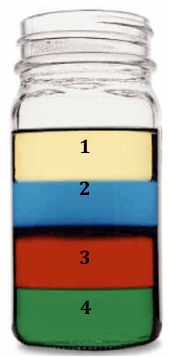
Why do objects sink or float in H2O?
Because their densities are higher or lower than compared to water
Because their densities are using gravity to pull down
Because their densities are heavier or lighter
Because their mass and volumes are equal


What happens when two oppositely charged ions are pushed together?
they will repel (move apart)
they will be attracted to each other (move together)

What happens when two negatively charged ions are pushed together?
they will repel (move apart)
they will be attracted to each other (move together)

The positive ions tend to _____________ electrons.
lose
gain
The negative ions tend to _____________ electrons.
lose
gain
Why are sodium and chlorine attracted to each other?
they have opposite charges
they both have negative charges
they both have positive charges
How does oxygen become an oxide ion?
it loses 2 electrons
it gains 2 electrons
How do covalent bonds form?
Donating & receiving valence electrons between atoms
Oppositely charged ions attract each other & form bonds
Scientists are still not sure how they form
Sharing valence electrons between atoms
The formation of a covalent bond relies on the interaction or bonding of...
2 Nonmetals
1 Nonmetal & 1 Metal
2 Metals
2 Noble Gases
What type of elements share electrons and form covalent bonds?
Nonmetals
Metals
Metalloids
A Metal & A Nonmetal

What type of bond will this compound likely form H-Cl?
Ionic compound
Covalent compound
Metallic compound

What type of bond will this ammonia compound likely form (NH3)?
Ionic compound
Covalent compound
Metallic compound

What type of bond will this compound likely form [Na]+ & [Cl]- ?
Ionic compound
Covalent compound
Metallic compound

What type of bond will this ammonium chloride compound likely form?
Ionic compound
Covalent compound
Metallic compound

When assigning the number of individual atoms in a chemical formula it is written as a...
superscript
subscript
coefficient
script
How many total atoms are in the ionic compound Ca(NO3)2 (Calcium nitrate)?
3
5
6
9
10
How many total atoms are in the covalent compound C4H10 (Butane)?
6
8
10
12
14

Choose the correct Lewis dot structure for Nitrogen. It is okay if the lone pair is rotated.
E
F
G
H

Choose the correct Lewis dot structure for Neon.
E
F
G
H
A molecule is also known as a ___________________.
ionic compound
covalent compound
metallic compound
formula unit

