
 Worksheets
Biology EOC Review Part 3
Total questions: 35
Worksheet time: 35mins
Reproductive cells are __________
(Select all that apply)
haploid
diploid
somatic
gamete
diverse
Which process creates reproductive cells used in sexual reproduction?
meiosis
crossing over
mitosis
fertilization
Potatoes have a diploid number of 48. How many chromosomes do the gametes of a potato plant have?
(a)

Term D in the diagram would represent
Meiosis
Gametes
Fertilization
Zygote
Mitosis
Meiosis results in
4 haploid daughter cells
4 diploid daughter cells
2 diploid daughter cells
2 haploid daughter cells
A mosquito has a haploid number of 3. A mosquito zygote has (a) chromosomes (number not word!)
In asexual reproduction, all of the offspring are
genetically identical
the same age
genetically diverse
made from gametes

Which process and type of resulting cells are represented?
mitosis, gametes
meiosis, gametes
mitosis, somatic
meiosis, somatic
The physical traits of an organism
Gene
Genotype
Dominant
Phenotype
What is the first step that occurs prior to cell division?
DNA is replicated
The nucleus dissolves
Crossing over
The cell splits in half
Segments of DNA are called _______________________
Genes
Nucleotide
Genotypes
Chromosomes
The genes of an organism
Chromosome
Phenotype
Homozygous
Genotype
This means Same Gene
Dominant
Recessive
Heterozygous
Homozygous
This means Different Gene
Dominant
Recessive
Homozygous
Heterozygous
White hair (W) is dominant in horses, and non-white (w) is recessive. A homozygous white horse is crossed with a homozygous non-white horse. What percentage of offspring would have white hair?
0%
50%
75%
100%

Brown eyes are dominant to blue eyes and abbreviated using the letter B and b. Write the genotype of a homozygous brown eyes individual
(a)

Some organisms have features that have different functions, but similar structures. One example is the forelimb of humans, dogs, birds, and whales. What term best describes the relationship between these forelimbs?
They are homologous.
They are vestigial.
They are analogous.
They are embryological.
How do fossils support evolution?
Individual species disappear and reappear in the fossil record over time.
Organisms in the fossil record are identical to living organisms.
The fossil record provides evidence that all organisms developed at the same time.
The fossil record provides evidence that organisms have changed over time.

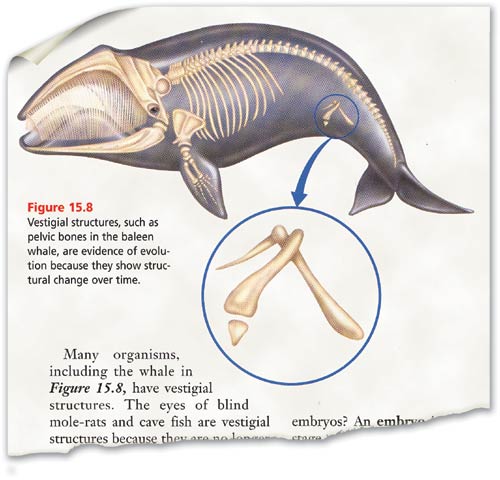
What best describes the hind leg bones seen in the whale?
The bones are analogous structures to the fins of living fish.
The bones are vestigial structures that had a function in an ancestor.
The bones are homologous structures to the wings of butterflies.
The bones are fossil structures from an extinct ancestor.
Mutations are important because they bring about --
death in the organisms in which they develop.
benefits for the individual, not the population.
genetic variation needed for a population to evolve.
equilibrium within a population.
What is the term for a feature that allows an organism to better survive and reproduce in its environment?
adaptation
variation
homologous structure
vestigial structure
Why are advantageous traits more likely to be passed down to offspring?
because they come from recessive alleles.
because they come from dominant alleles
because they help the organism survive and reproduce.
because once a trait is in the gene pool, it cannot go away.

The scientific theory of evolution is supported by different types of evidence. The diagram shows the skeletons of three different animal species. How does comparing the skeletons of these animals provide support for the scientific theory of evolution?
It provides information about the organisms' habitats.
It provides information to determine the organisms' ages.
It shows possible common ancestry between organisms.
It shows possible chromosomal similarities between organisms.

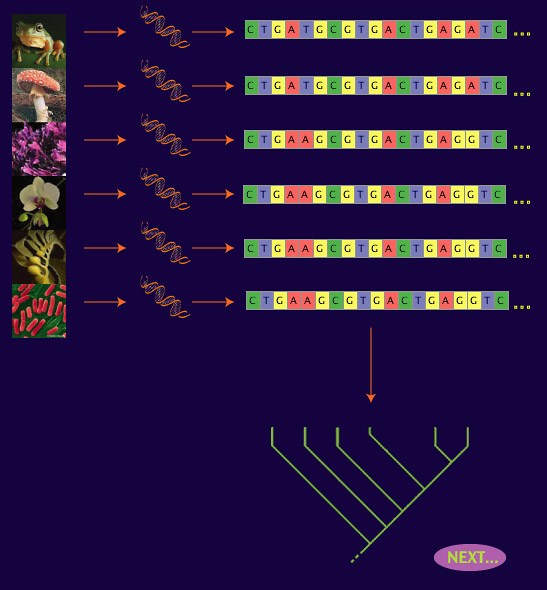
Amino acid sequences can be compared to determine relationships between species. When comparing the sequences provided, which two organisms are humans most closely related to?
horses and gorillas
gorillas and chimpanzees
chimpanzees and zebras
zebras and horses
When scientists compare the amino acid sequences for the red blood cell protein hemoglobin between various species, what can they determine about the evolutionary relationship between the species?
It can be determined how efficient hemoglobin is for different species.
It can determine relatedness between members of the same species.
It can provide evidence about the relatedness of different species.
It can show which species evolved first.
What is the study of organisms at the early stages of development?
DNA studies
embryology
extinction
fossil record
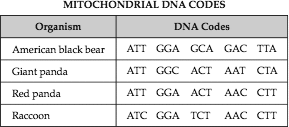
What conclusions can be made based on this table shown?
the American black bear and the giant panda are most closely related
the giant panda and the red panda are most closely related
the red panda and the racoon are the most closely related
the giant panda and the racoon are most closely related
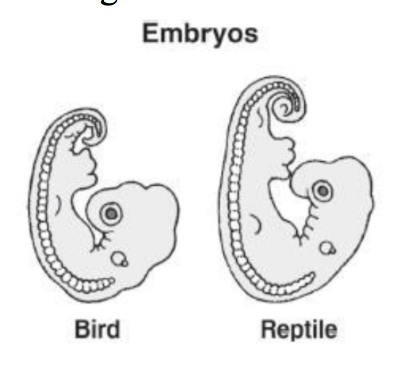
The diagram illustrates an embryonic stage of two organisms. Which of the following can be determined by observing the embryos shown in the diagram?
The organisms belong to the same genus.
The organisms are native to the same geographic areas.
The organisms share a common ancestry.
The organisms will grow into anatomically similar adults.
Which of the following is a situation that could cause evolutionary change that is NOT due to natural selection?
A volcano erupts and kills many individuals in a population.
A mutation produces sea stars that are less visible to predators.
An insecticide is sprayed in a community to combat mosquitoes.
Cattle are treated with antibiotics to prevent the spread of infections.
A population that is isolated in a remote environment is still able to experience genetic variation. How could genetic variation that contributes to evolution occur in such a population?
A mutation in a liver cell produces liver cancer.
Lateral gene transfer occurs that produces an organism that is less resistant to drought.
A mutation in an egg cell causes a change in DNA that produces an organism that is more sensitive to sunlight.
A mistake in DNA replication before meiosis produces an organism that is better able to outrun predators.

