wayground logo

Free Printable Worksheets

Font size

S
M
L
XL
Worksheets

Tissues

Total questions: 40

Worksheet time: 1hrs 27mins

Name
Class
Date
1.
Which tissue is this?
a)
Simple Squamous
b)
Stratified Squamous
c)
Simple cuboidal
d)
Pseudostratified columnar
2.
Which tissue is this?
a)
Simple squamous
b)
simple columnar
c)
transitional
d)
simple cuboidal
3.
What type of Connective tissue is found at the ends of bones to reduce friction?
a)
Cartilage
b)
Dense connective tissue
c)
Adipose Tissue
d)
Loose connective tissue
4.
Define tissue with regards to anatomy
a)
A group of structurally and functionally related cells that come together to perform common functions
b)
Multiple sheets of thin paper used to clean your nose
c)
A series of different cells in the same area
d)
The smallest structural and functional unit of an organism
5.

Where would simple columnar tissue be found?

a)

heart

b)

stomach and intestines

c)

bladder

d)

skeletal muscles

6.

Stratified means

a)

striped

b)

layered

c)

thin

d)

selective

7.

Blood, bone and cartilage are all examples of :

a)

simple cuboidal tissue

b)

epithelial tissue

c)

connective tissue

d)

transitional tissue

8.
This type of tissue lines the internal organs and covers the outside of the body as  skin
a)
epithelial
b)
connective
c)
muscular
d)
nervous
9.
This type of tissue includes ligaments, tendons, and cartilage
a)
epithelial
b)
connective
c)
muscular
d)
nervous
10.
Epithelial tissue is
a)
Bone, cartilage,dense connective tissue, loose connective tissue, and blood
b)
Highly specialized tissue that contracts or shortens to produce movement
c)
Lining and covering tissue of the body such as skin
11.

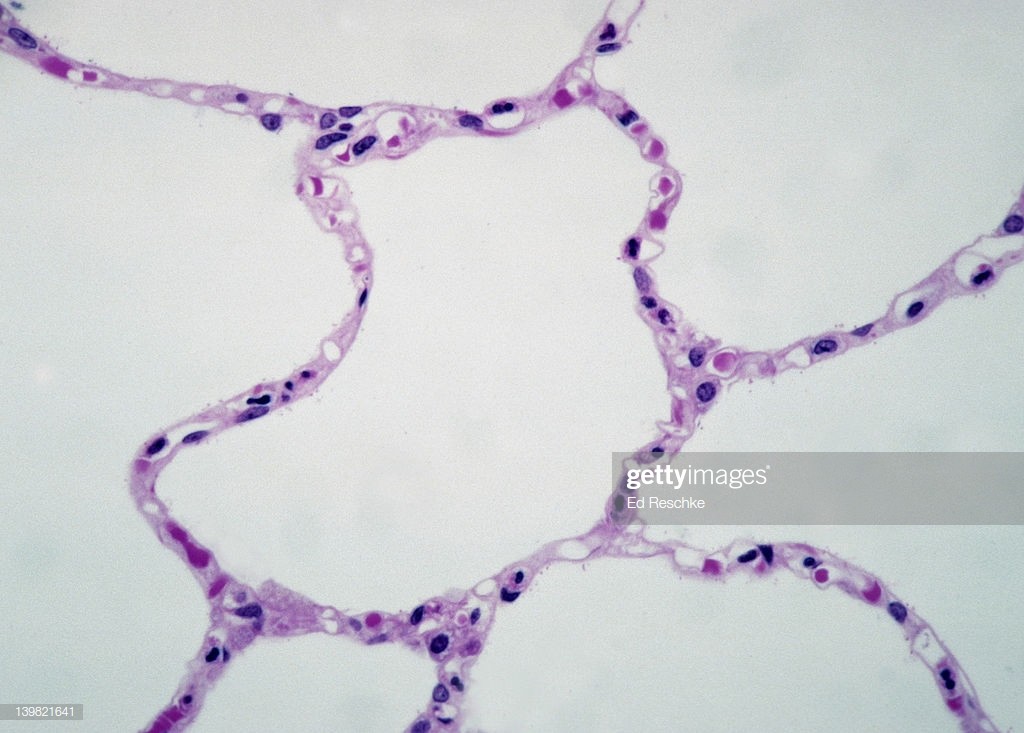
What type of epithelium lines the air sacs in this slide of lung tissue?

a)

simple cuboidal

b)

simple columnar

c)

simple squamous

d)

pseudostratified columnar

12.

Which of the following is NOT a main function of epithelial tissues?

a)

covering exposed surfaces

b)

lining internal passageways

c)

producing glandular secretions

d)

contracting to produce movement

13.
Identify:
a)
Pseudostratified
b)
Smooth Muscle
c)
Transitional
d)
Stratified Squamous
14.
Identify:
a)
Smooth Muscle
b)
Columnar
c)
Transitional
d)
Pseudostratified
15.
Used in places where diffusion needs to occur, such as blood vessels and air sacs in the lungs
a)
Cuboidal
b)
Columnar
c)
Simple Squamous
d)
Stratified Squamous
16.

The difference between endocrine and exocrine glands can best be described by which of the following?

a)

exocrine secretions are released into surrounding tissues and blood whereas endocrine secretions are discharged onto the surface of the skin or other epithelial surfaces

b)

endocrine secretions are released into the surrounding tissues and blood whereas exocrine secretions are discharged onto the surface of the skin or other epithelial surfaces

c)

exocrine secretions and endocrine secretions are both released directly into the blood at all times

d)

exocrine secretions and endocrine secretions are both released directly onto the surface of the skin at all times

17.
Where is epithelial tissue found?
a)
glands
b)
covering body surfaces
c)
lines organs
d)
all of the above
18.

According to the picture, where is the basement membrane?

a)

Apical Side

b)

Columnar Cells

c)

Avascular tissue

d)

Basal Side

19.

Epithelial tissue regenerate really quickly

a)

True

b)

False

20.
Connective tissue is
a)
The tissue that protects, supports, binds together, stores fat, produces blood cells
b)
Tissue that is the lining, covering, and glandular tissue of the body
c)
Tissue that contracts and shortens to produce movement
21.

Which type of fiber is long and thin and allows for stretch and recoil?

a)

collagen

b)

elastin

c)

reticular

22.

Which type of fiber is the thickest and has the highest tensile strength?

a)

collagen

b)

elastin

c)

reticular

23.

Which type of fiber has short, fine highly branched fibers?

a)

collagen

b)

elastin

c)

reticular

24.

Which type of tissue provides insulation and a storage of fuel?

a)

areolar

b)

elastic connective

c)

adipose

d)

hyaline cartilage

25.
Which is NOT one of the 3 components that make up connective tissue?
a)
Extracellular matrix 
b)
Fibers
c)
Cells
d)
Basement membrane 
26.
Connective tissue fibers include
a)
proteoglycans, adhesion proteins and interstitial
b)
collagen, elastic and reticular
c)
osteoblasts, fibroblasts and hemoblasts
27.
This type of connective tissue fiber forms strong, rope-like structures such as tendons and ligaments.
a)
Elastic
b)
Collagen
c)
Reticular
d)
Bone
28.
This tissue carries nutrients, waste, respiratory gases, and many other substances throughout the body.
a)
Bone
b)
Cartilage
c)
Blood
d)
Adipose
29.
Attach muscles to bones
a)
Tendons
b)
Ligaments
30.

The neuron is part of the

a)

nervous tissue

b)

connective tissue

c)

epithelial tissue

d)

muscular tissue

31.

the functions of muscle tissue include

a)

binding structures together

b)

forms glands

c)

help move substances and structures in the body

d)

conduct impulses

32.

Muscles are located in all the following EXCEPT

a)

in the digestive tract

b)

in the heart

c)

attached to bones

d)

inside bones

33.

The type of type that includes blood

a)

epithelial

b)

muscle

c)

connective

d)

nervous

34.

Striated muscles are found in

a)

Gall bladder

b)

Wall of bronchi

c)

Leg muscles

d)

Lungs

35.

Which muscles act involuntarily?

a)

striated muscles

b)

cardiac muscles

c)

skeletal muscles

d)

All the above

36.

The muscular tissue which function throughout the life

continuously without fatigue is

a)

skeletal muscle

b)

cardiac muscle

c)

smooth muscle

d)

voluntary muscle

37.

Of the 3 types of muscles,which is found in hollow oragans and around blood vessels.

a)

Skeletal Muscle

b)

Cardiac Muscle

c)

Smooth Muscle

38.
Name this tissue
a)
Bone
b)
Cartilage
c)
Blood
d)
Adipose
39.
Which connective tissue contains a gel-like matrix and is found in the nose, ear, and at the end of bones.
a)
Bone
b)
Cartilage
c)
Blood
d)
Adipose
40.
Which of the following is a type of cartilage?
a)
Hyaline cartilage 
b)
Fibrocartilage
c)
Elastic cartilage 
d)
All of the above