wayground logo

Free Printable Worksheets

Font size

S
M
L
XL
Worksheets

Unit 5 Review

Total questions: 39

Worksheet time: 30mins

Name
Class
Date
1.
What phase of mitosis is occuring in the picture?
a)
Prophase
b)
Metaphase
c)
Cytokinesis
d)
Telophase
2.
In which phase does the cell spend most of it's life?
a)
Interphase
b)
Nuclear Division
c)
Telophase
d)
Mitosis
3.
What phase of mitosis is pictured?
a)
Metaphase
b)
Telophase
c)
Prophase
d)
Anaphase
4.
Before cells can divide, what must be copied?
a)
mitochondria
b)
cytoplasm
c)
DNA
d)
Cell Wall
5.
Name the phase:
a)
Prophase
b)
Metaphase
c)
Anaphase
d)
Telophase
6.
In mitosis, the two resulting cells are
a)
different from the starting cell and identical to each other.
b)
different from the starting cell and different from each other.
c)
identical to the starting cell and different from each other.
d)
identical to the starting cell and identical to each other.
7.
A chromatid is attached to a spindle fiber by the
a)
nucleolus
b)
deep furrow
c)
centromere
d)
centriole
8.
What is the name of the structure labeled X?
a)
Centriole
b)
Centrosome
c)
Chromatid
d)
Chromosome 
9.

Nuclear membranes form, cell begins to pinch to begin splitting describes:

a)

Prophase

b)

Anaphase

c)

Telophase

d)

Metaphase

10.

If there are 20 chromosomes in the nucleus before mitosis how many will there be in each new daughter cell after cytokinesis?

a)

20

b)

10

c)

40

d)

200

11.
What is the purpose of mitosis?
a)
To increase the surface area of a cell
b)
To allow cells to divide for growth, repair, and renewal
c)
For increasing genetic variation within a species
d)
To allow for DNA replication and protein synthesis
12.
Which of the following describes cancer?
a)
Nondisjunction of gamete cells
b)
Cell division without replication of DNA
c)
Mitosis without cytokinesis
d)
Uncontrolled cell division
13.

Where is DNA located in eukaryotic cells?

a)

cytoplasm

b)

nucleus

c)

mitochondria

d)

chloroplasts

14.

When during the cell cycle is a cell's DNA replicated?

a)

G1

b)

S

c)

G2

d)

M

15.
Which of the following units are repeatedly joined together to form a strand of DNA?
a)
amino acids
b)
nucleotides
c)
fatty acids
d)
polysaccharides
16.
The enzyme that unwinds the DNA to prepare for replication
a)
helicase
b)
replicase
c)
polymerase
d)
synthase
17.
Which enzyme is responsible for adding nucleotides?
a)
Topoisomerase
b)
DNA Polymerase
c)
Ligase
d)
Primase
18.
The process of DNA replication is called semi conservative because it results in
a)
none of these
b)
Two DNA molecules.  One original molecule and one with two new strands
c)
two exact copies with new strands
d)
two identical molecules, each with 1 original strand and one new.
19.
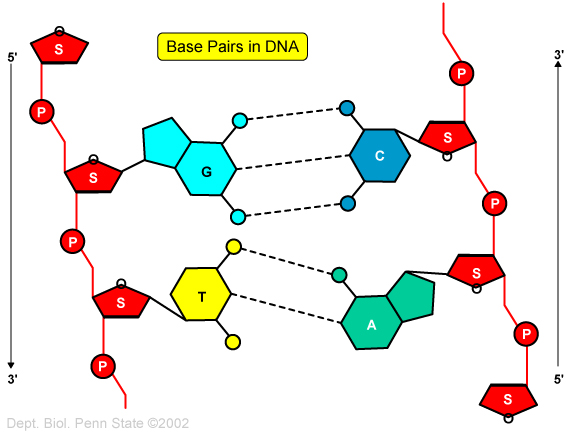
Nitrogenous bases are joined by which type of bond?
a)
polar bonds
b)
ionic bonds
c)
covalent bonds
d)
hydrogen bonds
20.
Why does DNA stay in the nueclus?
a)
To protect it from becoming damaged.
b)
It is lazy. 
c)
It is grounded. 
d)
It cannot move. 
21.
The process by which the genetic code of DNA is copied into a strand of RNA is called
a)
translation
b)
transcription
c)
transformation
d)
replication
22.
Where does transcription take place?
a)
nucleus
b)
cytoplasm
c)
ribosome
23.

_____________: Relaxed form of DNA that is present in the nucleus during interphase of eukaryotic cells

a)

RNA

b)

Chromosome

c)

DNA

d)

Chromatin

24.

Examples of environmental factors for mutations are

a)

harmful chemicals

b)

exposure to x-rays

c)

radiation

d)

mistakes during replication

25.

A change in the DNA sequence that doesn't change protein made.

a)

Nonsense

b)

Silent

c)

Missense

d)

Substitution

26.

After transcription mRNA goes from the nucleus to the _________.

a)

Ribosome

b)

Mitochondria

c)

Endoplasmic Reticulum

d)

Vacuoles

27.
RNA is read in sections called:
a)
Triplets
b)
Genes
c)
Codons
d)
Genes
28.
Translation is a process that produces
a)

mRNA

b)

DNA

c)

Polypeptide Chains (proteins)

d)

tRNA

29.
tRNA is involved in
a)
carrying amino acids 
b)
carrying ribosomes
c)
carrying glucose
d)
carrying lipids
30.

What are the building blocks of proteins called?

a)

Nucleic Acids

b)

Glucose

c)

Amino Acids

d)

Phosphate Groups

31.

Why do sexually reproducing organisms need meiosis?

a)

To double the number of chromosomes in a new organism

b)

So that gametes have half the number of chromosomes of the organism

c)

So that offspring are identical

d)

So that human sperm and egg cells will each have 46 chromosomes.

32.

Humans have a diploid number of 46 chromosomes in our body cells. How many chromosomes will our gametes have if they are considered HAPLOID?

a)

46

b)

23

c)

92

d)

10

33.

What happens during Prophase I? You will need to think about what you learned during mitosis to fully answer the question.

a)

Crossing over

b)

Nuclear Membrane disappears

c)

DNA coils into chromosomes

d)

Chromosomes line up in the middle of the cell

34.

What is produced at the end of meiosis II? Choose all correct answers

a)

4 cells

b)

Haploid Cells

c)

Unique Cells

d)

2 Cells

e)

Clones

35.

Sex cells are called ______________ and body cells are called ___________.

a)

gametes; somatic

b)

somatic; gametes

c)

daughters; parents

d)

parents; daughters

36.
Crossing over is important because....
a)
It prevents mutations from entering the gametes. 
b)
It allows for even distribution of chromosomes in the gametes.
c)
It allows for more genetic diversity of gametes.
d)
It allows for genetic uniformity of gametes. 
37.

What is the sex of the individual whose karyotype is seen in the image?

a)

Male

b)

Female

38.

a photograph or picture of chromosomes grouped in ordered pairs is a ______________

a)

pedigree

b)

Punnett Square

c)

Venn Diagram

d)

Karyotype

39.

This is an example of

a)

Homologous Chromosomes

b)

Non-homologous Chromosomes

c)

Sister Chromatids

d)

Duplicated DNA