wayground logo

Free Printable Worksheets

Font size

S
M
L
XL
Worksheets

Electricity

Total questions: 37

Worksheet time: 51mins

Name
Class
Date
1.
A particle that carries a negative electric charge is called a(n) ______.
a)
neutron
b)
atom
c)
proton
d)
electron
2.
An example of a voltage source is a _____.
a)
voltmeter
b)
battery
c)
resistance
d)
switch
3.
A circuit that is connected to Earth is said to be _____.
a)
series
b)
parallel
c)
grounded
d)
discharged
4.
Your hair might be attracted to your comb as your hair and the combe become oppositely charged.
a)
true
b)
false
5.
A neutral object becomes negatively charged when it loses electrons.
a)
true
b)
false
6.
Electrical resistance is low in a good conductor.
a)
true
b)
false
7.

Electricity is a form of energy involving the flow of atoms.

a)

True

b)

False

8.

What are the two types of electricity?

a)

Static and electrons

b)

Current and voltage

c)

Series and parallel

d)

Static and current

9.

In a circuit diagram, this symbol represents a

a)

switch

b)

multimeter

c)

battery

d)

globe

10.

What is used to measure electric current?

a)

Voltmeter

b)

Ammeter

c)

Wattmeter

d)

pH meter

11.

Voltage is the measure of the...

a)

difference in electrical energy between 2 parts of a circuit

b)

amount of electric charge that flows through a circuit

12.

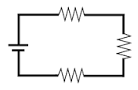
What type of circuit is this?

a)

Series

b)

Parallel

c)

Simple

13.

In a series circuit, how is the brightness of a light globe affected when another globe is connected?

a)

It gets brighter

b)

It stays the same

c)

It gets dimmer

d)

It goes out

14.

If the current in an electrical circuit is constant, what will happen to the voltage if the resistance is increased?

a)

Voltage will increase

b)

Voltage will decrease

c)

Voltage will stay the same

15.

Why are Christmas lights wired in parallel?

a)

It is cheaper to make

b)

You can make longer strands

c)

It uses less electricity

d)

If a light breaks, the others keep working

16.

If you increase the voltage across a resistor, what will happen to the current?

a)

Current will increase

b)

Current will decrease

c)

Current will stay the same

17.

If you increase the size of the resistor and keep the voltage the same, what will happen to the current?

a)

Current will increase

b)

Current will decrease

c)

Current will stay the same

18.

Which of these materials is a good insulator?

a)

gold

b)

copper

c)

silver

d)

plastic

19.
Electricity that flows in a closed path is called a
a)
path
b)
current
c)
circuit
20.
Two types of circuits are
a)
parallel and magnetic
b)
electromagnetic and series
c)
series and parallel
21.
The unit for current is the 
a)
Volt
b)
Ohm
c)
Electron
d)
Amp
22.
Identify the conductor below.
a)
cloth rag
b)
plastic bottle
c)
gold ring
23.
What is the unit for resistance?
a)
Volts
b)
Amperes
c)
Ohms
24.
What type of circuit is pictured?
a)
series
b)
parallel
25.
If the battery produced 12.6 Volts and what would be the current flow be for a 6 Ohm resistor
a)
2.1 Amps
b)
2.4 Amps
c)
1.71 Amps
d)
15 Amps
26.
What would the circuit resistance be if a 7.5 Amp draw was present with the engine running and the charging system producing 15 Volts
a)
15 Ohms
b)
4 Ohms
c)
0.3333 Ohms
d)
2 Ohms
27.
Electric current that flows in only one direction. 
a)
Voltage 
b)
Direct Current 
c)
Alternating Current
d)
Series Circuit 
28.
Electric current that reverses its direction of flow in a regular pattern  
a)
Voltage 
b)
Direct Current 
c)
Alternating Current 
d)
Parallel Circuit 
29.
According to this law, the current in a circuit equals the voltage difference divided by the resistance. 
a)
Law of Conservation of Energy 
b)
Ohm's Law 
c)
Law of Conservation of Charges
d)
Newton's First Law 
30.
The accumulation of excess electric charge on an object is called
a)
Static electricity 
b)
Electric discharge
c)
Resistance
d)
Circuit 
31.
If you rub a glass rod with a piece of silk, the rod becomes positively charged. This means that
a)
friction destroyed electrons in the rod.
b)
the silk has become negatively charged.
c)
protons have moved to the rod.
d)
glass attracts more protons.
32.
Objects that have opposite charges
a)
are attracted to each other, and the force between the objects pulls them together.
b)
are attracted to each other, and the force between the objects pushes them apart.
c)
are repelled by each other, and the force between the objects pulls them together.
d)
are repelled by each other, and the force between the objects pushes them apart.  
33.

Will the balloons ATTRACT or REPEL each other?

a)
b)
34.

Will the balloons ATTRACT or REPEL each other?

a)
b)
35.

Static electricity can "jump" from the charged object to another object, causing . . .

a)

static cling (objects sticking together)

b)

electric discharge (and a shock!)

36.
What charge does an electron have?
a)
negative (-)
b)
positive (+)
c)
neutral or no charge (0)
37.
If a substance has a higher number of electrons than protons on its surface, what type of charge does it have?
a)
A positive charge.
b)
A negative charge.
c)
A neutral charge
d)
No charge at all