wayground logo

Free Printable Worksheets

Font size

S
M
L
XL
Worksheets

Ecology Review Quiz

Total questions: 46

Worksheet time: 1hrs 10mins

Name
Class
Date
1.
Which is a producer?
a)
deer
b)
tall grass
c)
lion
d)
worm
2.
What does a Primary Consumer eat?
a)
Tertiary Consumers
b)
Secondary Consumers
c)
Producers
3.
An organism that lives by breaking apart dead organic matter into simpler parts is...
a)
scavenger
b)
consumer
c)
decomposer
d)
carnivore
4.
An animal that eats other animals is a....
a)
carnivore
b)
omnivore
c)
herbivore
d)
decomposer
5.
In a food web, arrows point at:
a)
who gets energy.
b)
who gets eaten.
6.
What does a food web represent?
a)
All connections of energy flow throughout all organisms in a ecosystem.
b)
The specific ways that mutualism is carried out.
c)
A single pathway or energy flow between organisms. 
d)
How carnivores get their food. 
7.
What is missing from this food chain?
Grass > Grasshopper > Bird > Snake
a)
Producer
b)
Primary Consumer
c)
Secondary Consumer
d)
Decomposer
8.
A community of living and nonliving things in their natural environment makes up a 
a)
food web
b)
ecosystem
c)
food chain
9.
If the grasshopper were to be removed completely from the food web, what organism would be most effected?
a)
The squirrel
b)
The shrew
c)
The deer
d)
The rabbit
10.
Which organism recieves the least amount of energy from the producer?
a)
Owl
b)
Grasshopper
c)
Lilypad
d)
Mouse
11.

What is the general term used to describe the interaction between two different organisms that are living in close physical association?

a)

photosynthesis

b)

symbiosis

c)

habitat

d)

prey

e)

omnivore

12.

The animal in an ecological relationship that results in another animal being hunted, killed, and eaten…

a)

autotroph

b)

habitat

c)

predator

d)

herbivore

e)

producer

13.

What would you call an ecological symbiotic relationship that is helpful to both organisms involved?

a)
commensalism
b)
niche
c)
mutualism
d)
habitat
e)
parasitism
14.

An ecological symbiotic relationship between two organisms where one benefits and the other is harmed…

a)

parasitism

b)

herbivore

c)

mutualism

d)

carnivore

e)

commensalism

15.

This is the job or role of a specific organism within its habitat...

a)

producer

b)

prey

c)

carnivore

d)

niche

e)

photosynthesis

16.

What you would call an ecological symbiotic relationship between two organisms where one benefits, but the other is not helped or harmed?

a)

mutualsim

b)

predator

c)

commensalism

d)

parasitism

e)

herbivory

17.

The name of the process that producers use to make their own food…

a)

respiration

b)

commensalism

c)

food chains

d)

photosynthesis

e)

symbiosis

18.

Another word for a plant or other producer that makes its own food using energy from sunlight…

a)

photosynthesis

b)

autotroph

c)

consumer

d)

carnivore

e)

herbivore

19.

Technically speaking, ALL food chains should end with these types of organisms so that nutrients can be recycled back into the habitat…

a)

parasites

b)

predators

c)

herbivores

d)

symbiotes

e)

decomposers

20.

What is the term used to describe ALL of the populations of ALL the species of living organisms within a particular habitat?

a)

savanna

b)

wildlife

c)

community

d)

habitat

e)

ecosystem

21.

This is the term used for the study of how living things interact with each other and their environment...

a)

ecology

b)

archeology

c)

biology

d)

astronomy

e)

phrenology

22.

What do you call the total count of a specific organism living within their natural habitat?

a)

ecosystem

b)

community

c)

population

d)

symbiosis

e)

niche

23.

Where does the energy come from initially for this food chain to work?

a)

Plants

b)
Sun
c)
Deer
d)
Wolf
24.
Pseudoscorpions often hitch rides on the backs of large beetles or true bugs. What is the ecological relationship?
a)
Mutualism
b)
Commensalism
c)
Parasitism
d)
Cooperation
25.
Cows and pronghorn both eat the same types of food in areas of Utah. What is the ecological relationship?
a)
Cooperation
b)
Parasitism
c)
Commensalism
d)
Competition
26.
Ants protect soft bodied aphids and in return the aphids feed the ants a sugary drink. What is the ecological relationship?
a)
Cooperation
b)
Parasitism
c)
Commensalism
d)
Mutualism
27.
What term best describes the vole, the small rodent, in this image?
a)
Prey
b)
Predator
c)
Producer
d)
Competition
28.
Chickens will eat both insects and seeds. Which term best describes this feeding pattern?
a)
Omnivore
b)
Carnivore
c)
Herbivore
d)
Producer
29.
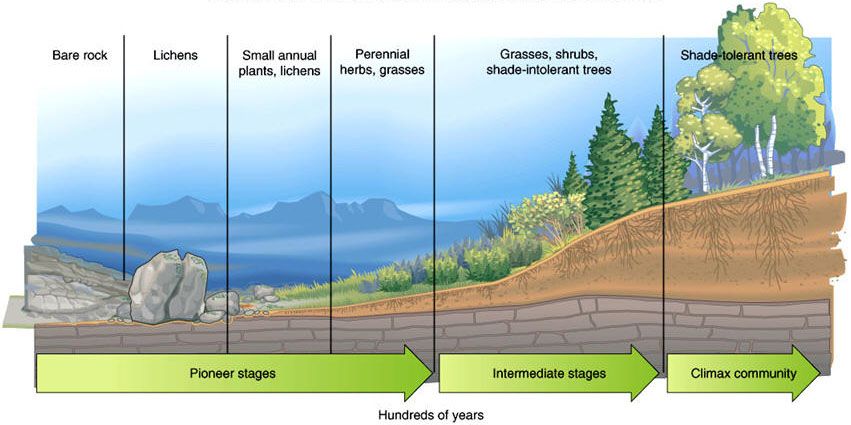
What is the order of succession shown in this figure?
a)
A, B, C, D
b)
B, A, D, C
c)
C, D, A, B
d)
D, A, B, C
30.
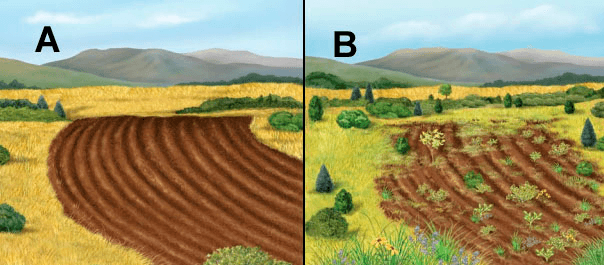
What type of succession is shown going from figure A to figure B?
a)
primary succession
b)
ecological succession
c)
secondary succession
d)
intermediate
31.
The picture shows what type of succession?
a)
primary
b)
secondary
c)
tertiary
d)
quadanary
32.
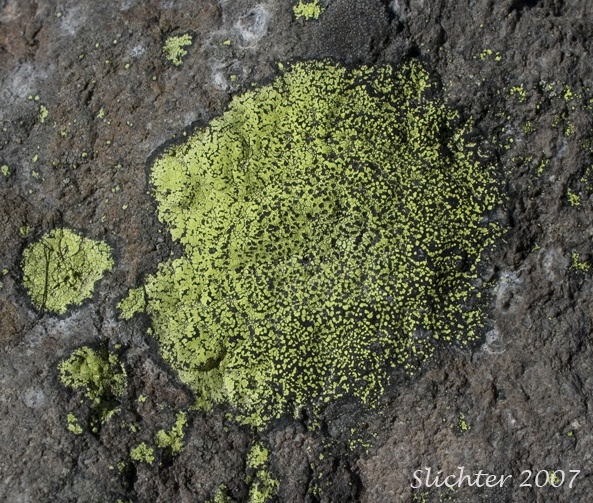
What is the name given to lichen or algae after a primary succession?
a)
pioneer species
b)
volunteer species
c)
founder species
d)
conqueror species
33.
After a volcanic eruption, lava covers the land. What is the order that plants grow to repopulate the area?
a)
Lichens → Shrubs → Grasses → Trees
b)
Lichens → tree → shrubs→Grasses
c)
Grasses → Lichens → Shrubs → Trees
d)
Lichens → Grasses → Shrubs → Trees
34.

The final stage of ecological succession can typically be observed when evidence of a _____________________ is present.

a)

Mature Tree Growth

b)

Climax Community

c)

Pioneer Community

d)

housing community

35.
How would the biodiversity of this ecosystem be affected if the lantern fish disappeared?
a)
The ocean sunfish population would increase.
b)
The large shark population would die out.
c)
The squid would die out.
d)
There would be no change.
36.
What effect will an invasive species have on the carrying capacity of an ecosystem?
a)
The carrying capacity will increase
b)
The carrying capacity for everyone will decrease
c)
The carrying capacity will only decrease for those in competition for same resource
d)
The carrying capacity for all animals will stay the same
37.
If there is 1000 Kcal available in the producers in trophic level 1, how much energy is available in the herbivores in trophic level 2?
a)
10 Kcal
b)
1 Kcal
c)
100 Kcal
d)
1000 Kcal
38.
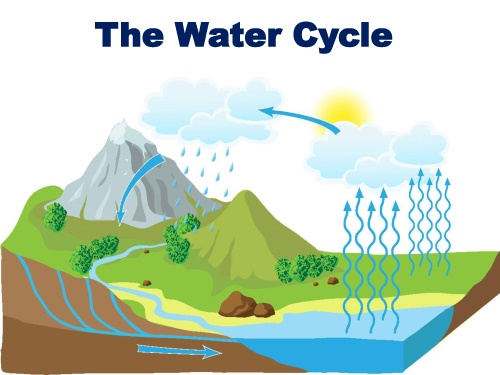
In a picture of a water cycle what part of the cycle do clouds represent? 
a)
evaporation
b)
precipitation
c)
condensation
d)
runoff
39.
in a picture of the water cycle what part does rain represent? 
a)
precipitation
b)
condensation
c)
evaporation
d)
runoff 
40.
Combustion is another word for __________.
a)
Transportation
b)
Respiration
c)
Fossil Fuels
d)
Burning
41.
Which of the following removes carbon from the atmosphere?
a)
Combustion
b)
Respiration
c)
Photosynthesis
d)
Death
42.
Respiration is the process by which animals take in _____ and release _____. 
a)
photosynthesis, air
b)
carbon, oxygen
c)
oxygen
d)
oxygen, carbon dioxide
43.
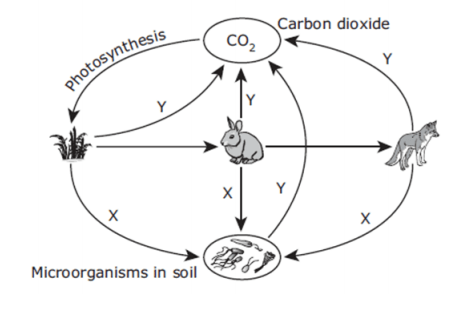
The diagram shows the flow of organic molecules through an ecosystem. What two processes are identified by the labels X and Y?
a)
X : Respiration
Y : Predation
b)
X : Adaptation
Y : Decomposition
c)
X : Fermentation
Y : Nitrogen Fixation
d)
X : Decomposition
Y : Respiration
44.
What is the process of combining nitrogen gas with other elements to make nitrogen into usable compounds?
a)
nitrogen composition
b)
ammonia 
c)
nitrogen fixation
d)
denitrification
45.
Organisms that break down dead plants & animals and release nitrogen back into atmosphere...
a)
bacteria
b)
plants
c)
animals
d)
producers
46.
If the atmosphere is 78% N2, why can't we just get our nitrogen by breathing?
a)
We have no mechanism to break the triple bond of nitrogen between the atoms.
b)
Our lungs would be damaged by the N2.
c)
We need Oxygen for cellular respiration.
d)
The legumes take it up first.