

wayground logo

Free Printable Worksheets

Font size

S
M
L
XL
Worksheets

Evolution Unit Review

Total questions: 29

Worksheet time: 15mins

Name
Class
Date
1.
Scientists who study fossils are called
a)

Pathologists

b)
Paleontologists
c)

Taxonomists

d)
Meteorologists
2.
Which layer is oldest?
a)
A
b)
W
c)
G
d)
Z
3.

In which kind of rock do we usually find a fossil?

a)

sedimentary rock

b)

igneous rock

c)

metamorphic rock

d)

magma rock

4.

An organism that no longer exists on Earth is called _____.

a)

extinct

b)

decayed

c)

evolved

d)

preserved

5.

Which of the following would NOT help an organism become fossilized?

a)

amber

b)

ice

c)

water

d)

snow

6.

Which of these is most like casts, molds, and imprint fossils?

a)

burying your friend in the sand at the beach

b)

watering flowers in your backyard

c)

building a statue out of wet clay

d)

pressing your hands into wet cement

7.

Which time period is the OLDEST time period?

a)

Paleozoic

b)

Cenozoic

c)

Archean

d)

Mesozoic

8.

In evolution, to preserve something means to

a)

provide it

b)

observe it

c)

save it

d)

leave it

9.
Which organisms pictured on the diagram have hair?
a)
prosimians only
b)
prosimians and humans
c)
humans only
d)
prosimians and birds
10.
According to this cladogram, sharks are MOST closely related to which organism? 
a)
Amphibians
b)
Ray finned fish
c)
Crocodiles
d)
Birds
11.
Branching Tree diagrams are constructed by grouping organisms together based on their____________ characteristics.
a)
shared
b)
different
c)
opposite
12.
On the diagram, which feature do all organisms inherit?
a)
A
b)
B
c)
C
d)
D
13.

Which is NOT an example of a vestigial structure?

a)

eyes of a blind salamander

b)

pelvic bones in a whale

c)

thorns on a rose bush

d)

wings on a flightless bird

14.
Scientists compare the limbs of organisms to look for evidence of common ancestry. These limbs provide evidence of common ancestry because they -
a)
perform the same function
b)
are the same size
c)
have the same basic structure
d)
are parts of the same animal
15.
The similarities among early stages of the embryos provide evidence that -
a)
these organisms evolved from a common ancestor
b)
the organisms all retained their gills and tails
c)
the organisms belong to the same species
16.
Drawn observed several different types of finches.  Why are there so many different types?
a)
Finches live in different places, but eat the same food.
b)
Finches live in the same place, but eat different types of food.
c)
Finches live in different habitats and eat different types of food.
d)
Finches are found all over the world.
17.
The differences among a species, like different bird beaks, are called
a)
genes.
b)
variations.
c)
traits.
d)
theories.
18.
Organisms with the most beneficial traits will survive.  This is commonly known as
a)
theory of evolution.
b)
variations.
c)
survival of the fittest.
d)
ecosystems.
19.
This scientist developed the theory of evolution as he studied the finches.
a)
Charles Darwin
b)
Isaac Newton
c)
Albert Einstein
d)
Marie Curie
20.
Why are advantageous traits more likely to be passed onto offspring?
a)
Because they are more likely to survive and reproduce.
b)
Because they come from dominant alleles.
c)
Because they come from recessive alleles.
d)
Because the trait is an acquired phenotype.
21.
Using this picture, what defense is this Hawk Moth displaying?
a)
camouflage
b)
emitting smells
c)
mimicry
d)
panting
22.

The arctic fox and snowshoe hare develop a white coat of fur during the winter months. What statement best describes this behavioral response?

a)

The color of the fur will attract a mate

b)

White fur allows the animals to reflect light and stay warm

c)

Snow falls during the winter and the white fur will camouflage the animals

d)

It becomes colder during the winter, so these animals need more fur to stay warm

23.

Animals use camouflage...

a)

to hunt or hide

b)

for fun

c)

to sleep

24.
How do adaptations help animals?
a)
To escape animals
b)
to hunt for food
c)
to survive in their habitats
d)
All of these are correct
25.

What caused the soot to cover the trees in Great Britain from 1780 to 1830?

a)

burning coal

b)

setting fires

c)

black wind

d)

dead moths

26.

Why did the number of white peppered moths decrease so much by 1895?

a)

they did not blend in with the trees and birds ate them

b)

they tasted better to the birds than the black moths

c)

they were easier to reach on the trees

d)

white moths flew away to find better trees to blend in with
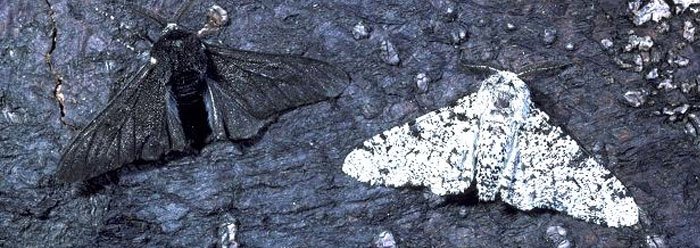
27.
The trees these moths used to live on were white, but have been covered in soot from coal factories. Which moth will be more successful in this environment?
a)
Dark moth
b)
Light moth
c)
Both will be equally successful
d)
Neither will be successful
28.
Since the 1800s humans have stopped burning coal, and the trees have returned to their original color. Which moth will be more successful in this environment?
a)
Dark moth
b)
Light moth
c)
Both will be equally successful
d)
Neither will be successful
29.

A change that increases an organism's change for survival is a(n) ______________________.

a)

mutation

b)

evolution

c)

adaptation

d)

gene
