wayground logo

Free Printable Worksheets

Font size

S
M
L
XL
Worksheets

AP Gov Final Review Tournament

Total questions: 100

Worksheet time: 50mins

Name
Class
Date
1.
The passing of the Voting Rights Act of 1965 is a significant event because it
a)
scaled back the provisions of the 15th Amendment
b)
was used to emancipate south African Americans
c)
was declared unconstitutional by the Supreme Court in Shaw v Reno
d)
was instrumental in increasing the number of African American and other minority voters
2.
Party identification in the United States is most successfully transmitted by which of the following?
a)
workplace
b)
church
c)
educational system
d)
family
3.
Which of the following is NOT an explanation for low voter turnout?
a)
registration requirements
b)
low political efficacy among many voters
c)
laws protecting minority voting rights
d)
frequent elections at the state and local level
4.
In the United States political system, the term Federalism refers to
a)
limits on the powers of the state governments
b)
limits on the powers of the national government
c)
division of powers between the levels of government
d)
legal authority of the courts to hear cases
5.
Rules and regulations created by an agency such as the Federal Communications Commission are called
a)
constitutional law
b)
statutory law
c)
common law
d)
administrative law
6.
Which of the following committees plays a major role in the House in shaping tax policy?
a)
Finance
b)
Ways and Means
c)
Commerce
d)
Appropriations
7.
Which of the following best describes a purpose of the Establishment Clause?
a)
Gives Congress the power to protect civil rights & liberties
b)
Prohibits Congress from establishing a state religion
c)
Empowers Congress to create a national bank
d)
Prevents Congress from prohibiting the possession of guns on school grounds
8.
Which of the following powers is shared by the House of Representatives and the Senate?
a)
Holding trials of impeachment
b)
Establishing federal courts
c)
Approving treaties
d)
Holding confirmation hearings
9.
What is the term for applying the Bill of Rights to the States?
a)
apportionment
b)
application
c)
redistricting
d)
incorporation
10.
Which of the following cases held that the Bill of Rights could NOT be applied to the states?
a)
Baker v. Carr
b)
Reynolds v. Sims
c)
Kelo v. New London
d)
Barron v. Baltimore
11.
Which of the following amendments led the Supreme Court to begin applying the Bill of Rights to the States?
a)
5th
b)
10th
c)
14th
d)
22nd
12.
This Supreme Court Case determined that contraception was protected by the "right to marital privacy" implied in the Bill of Rights...
a)
Kelo v. New London
b)
Griswold v. Connecticut
c)
Barron v. Baltimore
d)
Reynolds v. Simms
13.
Citizens United v. Federal Election Committee
a)
ruled that the McCain-Feingold Act unconstitutional
b)
ruled that money and television ads were considered freedom of speech
c)
ruled that the bill of rights should be applied to corporations
d)
all of the above
14.
What subject is Federalist #10 primarily about?
a)
The Bill of Rights
b)
Factions
c)
The Constitution
d)
The seperation of church and state
15.
Known as the "Privacy Amendment" which amendment says No search and seizure without a warrant and probable cause?
a)
1st
b)
2nd
c)
3rd
d)
4th
16.
Which amendment banned poll tax and literacy tests?
a)
23rd
b)
18th
c)
10th
d)
24th
17.
  Which amendment gave women suffrage?
a)
18th
b)
19th
c)
10th
d)
12th
18.
The number of members in the Senate is:
a)
Based upon population
b)
Equal for all states
c)
Decided upon by the voters
d)
Depends on the ruling party
19.
Who is the presiding officer of the Senate and can be brought in the cast a tie breaking vote if needed?
a)
The Chief Justice
b)
The Vice President
c)
Chairman of the Joint Chiefs
d)
Secretary of State
20.
These types of committees are temporary and deal with special issues that have to be taken care of from time to time. 
a)
Select
b)
Standing
c)
Joint
d)
Judicial
21.
Senators or Representatives who are already holding office are
a)
Constituents 
b)
Lobbyist 
c)
Incumbents
d)
Independents
22.
These committees include members from both the Senate and the House. They are formed occasionally for certain issues.
a)
Standing
b)
Joint
c)
Select
d)
Optional
23.
How old must you be in order to run for President?
a)
25
b)
35
c)
30
d)
40
24.
Who would become president if the President and Vice President can no longer carrying out their duties?
a)
Speaker of the House
b)
Secretary of the State
c)
First Lady
d)
Mr. Radi 
25.
1st Amendment right to free speech is NOT absolute during wartime.
a)
Schenck v. U.S. 
b)
McCulloch v. Maryland
c)
Korematsu v. U.S. 
d)
Miranda v. Arizona 
26.
Japanese internment camps did not violate 14th Amendment and civil rights.
a)
Dred Scott v. Sanford 
b)
Gideon v. Wainwright 
c)
Korematsu v. U.S.
d)
Engle v. Vitale 
27.
Used the elastic clause to justify national Supremacy established under "necessary and proper clause" in regards to banks.
a)
Engel v. Vitale 
b)
McCulloch v. Maryland 
c)
Schenck v. U.S. 
d)
Gideon v. Wainwright 
28.
Upheld the 4th Amendment right against unreasonable search and seizure.
a)
Engel v. Vitale 
b)
McCulloch v. Maryland 
c)
Mapp v. Ohio 
d)
Koramatsu v. U.S. 
29.
Black arm bands worn in school as protest were protected on the first amendment right to free speech.
a)
Tinker v. Des Moines
b)
Mapp v. Ohio 
c)
Schenck v. U.S.
d)
Miranda v. Arizona 
30.
Lawyers in criminal courts are required based on 6th and 14th Amendment rights to due process
a)
Plessy v. Ferguson 
b)
Dred Scott v. Sanford
c)
Miranda v. Arizona 
d)
Gideon v. Wainwright
31.
The Federal Reserve Board is responsible for controlling what?
a)
Taxation
b)
Campaign finance
c)
The federal budget
d)
Interest rates
32.
A Supreme Court decision based on a similar previous case is made based on what concept?
a)
Certiorari
b)
Stare decisis
c)
Amicus curiae
d)
In pauperis
33.
A committee that reconciles different versions of a bill passed in the House and Senate is called a ______ committee.
a)
Conference
b)
Joint
c)
Standing
d)
Select
34.
Which of these correctly describes impeachment?
a)
2/3 of the House
b)
2/3 of the Senate
c)
Simple majority of the House
d)
Simple majority of the Senate
35.
Which court decision stated that aid to church-related schools must be for secular purposes only, and cannot be used to advance or inhibit religion?
a)
Engel v. Vitale
b)
Mapp v. Ohio
c)
Gideon v. Wainwright
d)
Lemon v. Kurtzman
36.
Incorporation doctrine involves
a)
application of the Bill of Rights to the states
b)
the governments power to regulate corporations
c)
the extension of judicial review to state courts
d)
the interpretation of the commerce clause
37.
Where are American civil liberties found?
a)
the Preamble
b)
the Bill of Rights
c)
the Declaration of Independence
d)
Article IV
38.
Which of the following is an exclusive power of the Senate?
a)
Approve treaties
b)
Declare war
c)
Propose an amendment
d)
Set naturalization laws
39.
Which of the following is NOT a voting amendment?
a)
15
b)
19
c)
22
d)
26
40.
Which of the following grants in aid allow states the most power in decision making?
a)
Block Grants
b)
Categorical Grants
c)
Mandates
d)
Programmatic Requests
41.
The "just compensation" clause associated with Eminent Domain is found in which of the following amendments?
a)
1
b)
4
c)
5
d)
6
42.
What was the outcome of Title IX?
a)
High voter registration among minorities.
b)
Greater accessibility for the handicap to local businesses
c)
Increased funding for women's sports in schools
d)
Banned public businesses from refusing services to customers based on race
43.
Which of the following is true of of the case University of California v Bakke?
a)
It dealt with the incorporation of the 4th amendment
b)
It ruled racial quotas for college admissions were unconstitutional
c)
The court issued its ruling in 2016
d)
It ruled that there is no such thing as reverse discrimination
44.
All of the following are true of the Articles of Confederation except
a)
There was no national executive branch
b)
The national government was much more powerful than the states
c)
All of the states had to agree before it could be amended
d)
The national government could not tax
45.
The clause in the United States Constitution that states that federal law will prevail in the event of a conflict between federal and state law is known as the 
a)
Necessary and Proper clause 
b)
Supremacy Clause
c)
equal protection clause 
d)
confrontation clause 
46.
In Roe v. Wade, the majority of Supreme Court justices determined that 
a)
a constitutional right to privacy necessitated making contraceptives legal 
b)
abortions could be performed only during the first twelve weeks of a pregnancy 
c)
homosexuality is unconstitutional
d)
the United States Constitution implies a right to privacy and thus made abortions legal 
47.
Voter turnout tends to be highest among 
a)
college-educated voters 
b)
working-class voters
c)
African American voters 
d)
young voters 
48.
Legislation forbidding flag burning was deemed unconstitutional because it violated the 
a)
First Amendment’s free exercise clause
b)
First Amendment’s protection of expression 
c)
Fourteenth Amendment’s definition of citizenship
d)
First Amendment’s establishment clause 
49.
Which of the following constitutional provisions broadened the power of Congress? 
a)
The necessary and proper clause 
b)
The equal protection clause
c)
The Tenth Amendment
d)
The Ninth Amendment 
50.
The Pocket Veto can be used only when
a)
Congress is in session.
b)
Congress is adjourned.
c)
when a new president is about to take office.
d)
the President forgets about the bill.
51.
The War Powers Resolution was passed as a reaction to
a)
The Korean War
b)
WWII
c)
The War of Northern Agression
d)
The Vietnam War
52.
The president's use of his prestige and visibility to guide or enthuse the American public.  
a)
Lame Duck 
b)
Bully pulpit
c)
cabinet 
d)
electoral college 
53.
Which amendment limits presidents to have two terms?
a)
19
b)
22
c)
21
d)
20
54.
This passage is from the U.S. Supreme Court case Tinker v. Des Moines (1969).
In our system, state-operated schools may not be enclaves of totalitarianism.  School officials do not possess absolute authority over their students.  Students in school as well as out of school are "persons" under our Constitution.  They are possessed of fundamental rights . . . In the absence of a specific showing of constitutionally valid reasons to regulate their speech, students are entitled to freedom of expression of their views. 
Based on this reasoning, what did the U.S. Supreme Court conclude? 
a)
Students have the right to wear armbands in school to express their political beliefs.
b)
Students can express their political views in student newspapers but not in classrooms.
c)
Students will cause too much disruption if they wear armbands to school.
d)
Students have the right to express their political opinions at home but not in school. 
55.
What is Judicial Review?
a)
The Supreme Court shaping polices by addressing social and political issues
b)
The Supreme Court should avoid taking the initiative on social and political questions
c)
A clause stating that no state may deprive a person of life, liberty, or property.
d)
The Supreme Court's power to declare laws unconstitutional 
56.
Which court ruling allowed "separate but equal"
a)
Grutter v. Bollinger
b)
Plessy v. Ferguson
c)
Brown v. Board of Education
d)
Dred Scott v.Sanford
57.
What is an order by the Supreme Court directing a lower court to send up the record in a given case for its review?
a)
Writ of mandamus
b)
amicus curiae
c)
writ of certiorari
d)
docket
58.
What is a court order requiring explanation to a judge why a prisoner is being held in custody?
a)
original jurisdiction
b)
writ of certiorari
c)
writ of mandamus
d)
writ of habeas corpus
59.
What lesson did state courts learn from the 1963 U.S. Supreme Court case Gideon v. Wainwright? 
a)
Minors are entitled to many of the same "due process" rights as adults.
b)
Evidence cannot be presented in a court trial if obtained by police in an unlawful search.
c)
Suspects must be informed of their 5th and 6th Amendment rights prior to police interrogation. 
d)
A person accused of a felony who cannot afford an attorney is entitled to have one appointed by the court. 
60.
Which statement identifies the significance of the U.S. Supreme Court decisions in Brown v. Board of Education (1954)?
a)
It overturned racial segregation in public schools. 
b)
It overturned the earlier decision of Gideon v. Wainwright.
c)
It upheld state laws requiring the payment of poll taxes to vote.
d)
It upheld state laws requiring racial segregation on railroad cars. 
61.
The “rule of four” refers to
a)
the number of Supreme Court Justices that must agree to hear a case
b)
the number of times a litigant can petition an appellate court for review
c)
the percent of committee members that must agree to an amendment to add it to a bill
d)
cases that reach the Supreme Court through a state system rather than through the federal system
62.
Supreme Court ruling eclared that the government had the right to keep Japanese Americans in internment camps due“national security threat”
a)
Korematsu v. United States
b)
Dred Scott v. Sandford
c)
Marbury v. Madison 
d)
Plessy v. Ferguson
63.

Supreme Court ruling freedom of speech can be denied when there is a “clear and present danger”
a)
Marbury v. Madison 
b)
Schenck v. United States
c)
Plessy v. Ferguson
d)
Brown v. Board of Education 
64.
What was the Supreme Court's decision in the Dred Scott case?
a)
That slavery diminished the national character.
b)
That African American rights were protected by the Constitution.
c)
That African Americans did not have the right to sue in federal court because they were not citizens
d)
That slavery should be abolished by executive order
65.

How did the composition of Congress change between 1950 and 2011?

a)

There was no change in the number of ethnic minorities, but the number of women increased

b)

There was no change in the number of women, but the number of African Americans increased

c)

The percentage of African Americans in Congress is similar to the percentage of African Americans in the country as a whole

d)

Although representation does not mirror the population as a whole, there are more minorities and women

66.

What of the following statements best describe the impact of divided government on Congress?

a)

Divided government occurs when the president and Congress disagree about an issue. Therefore, it is more likely that the president will veto legislation

b)

Divided government occurs when the majority of one or both houses of Congress are from a party different from the president’s. This slows the passage of the most far-reaching and costly legislation

c)

Divided government has little effect on the ability of Congress to pass legislation

d)

Divided government occurs when the majority of one or both houses of Congress are from a party different from the president’s. This makes it very difficult for any legislation pass

67.

A filibuster in the Senate can be used to talk a bill to death. A cloture vote can end a filibuster. Taken together, what is the impact of these practices?

a)

Neither political party can control the Senate unless it has at least sixty votes

b)

A party which fifty-one votes can get most of its legislative agenda passed

c)

The Senate rarely passes legislation on controversial issues

d)

Most important decisions are made in committees because it is difficult to pass a bill in the Senate as a whole

68.

What was the main point of disagreement between supporters of the Virginia and New Jersey plans?

a)

whether or not they should keep the Articles of Confederation

b)

how the States should be represented in Congress

c)

whether or not there should be an executive branch

d)

how they would present the completed Constitution to the States

69.

A federal project or grant that is made available in a congressional district or state

a)

Casework

b)

Credit

c)

Funding

d)

Pork Barrel

70.

Senate bills are subject to unlimited debate unless 3/5 of the Senate (60 Senators) votes for _________ to stop it

a)

Filibuster

b)

a Hold

c)

Pigeonhole

d)

Cloture

71.

Gerrymandering is

a)

legislation passed in southern states to limit African American participation in elections.

b)

the drawing of legislative district boundary lines to give the dominant party an advantage.

c)

known to give the minority party an electoral advantage at the expense of the dominant party.

d)

a process that attempts to limit debate on a bill in the Senate.

72.

The Necessary and Proper Clause

a)

has provided the basis for an expanded role of the national government.

b)

has greatly expanded the presidential powers.

c)

was in the original Constitution, but was eliminated as a consequence of the Twenty-Seventh Amendment.

d)

is located in the Constitution in the text of the Tenth Amendment.

73.
Party identification in the United States is most successfully transmitted by which of the following?
a)
workplace
b)
church
c)
educational system
d)
family
74.
The decision in Marbury v. Madison (1803) was important because it -
a)
upheld the constitutionality of the National Bank
b)
restricted Congress's power to use the "elastic clause"
c)
established the Supreme Court's power to judge the constitutionality of laws
75.

Considered as a single group, the Small Business Administration, the Small Business committees in the House and Senate, and small business advocacy groups are an example of...

a)

an iron triangle

b)

a conference committee

c)

a regulatory agency

d)

issues network

76.
Which of the following amendments led the Supreme Court to begin applying the Bill of Rights to the States?
a)
5th
b)
10th
c)
14th
d)
22nd
77.
What subject is Federalist #10 primarily about?
a)
The Bill of Rights
b)
Factions
c)
The Constitution
d)
The seperation of church and state
78.
No search and seizure without a warrant and probable cause.  Which amendment is this?
a)
1st
b)
2nd
c)
3rd
d)
4th
79.
Ban of poll tax as a qualification to vote.  Which amendment is this?
a)
23rd
b)
18th
c)
10th
d)
24th
80.
Women have the right to vote.  Which amendment is this?
a)
18th
b)
19th
c)
10th
d)
12th
81.
Ruled that Separate but Equal was unconstitutional
a)
Brown v Board
b)
Plessy v Ferguson
c)
Grutter v Bollinger
d)
Palko v Connecticut
82.
A Supreme Court decision based on a similar previous case is made based on what concept?
a)
Certiorari
b)
Stare decisis
c)
Amicus curiae
d)
In pauperis
83.
The greatest single source of political socialization is ______.
a)
School
b)
Family
c)
Religion
d)
Peers
84.
Incorporation doctrine involves
a)
application of the Bill of Rights to the states
b)
the governments power to regulate corporations
c)
the extension of judicial review to state courts
d)
the interpretation of the commerce clause
85.
Which amendment has the Supreme Court relied on in deciding to incorporate parts of the Bill of Rights into state laws?
a)
1st
b)
26th
c)
14th
d)
18th
86.
A state has 11 electoral votes. In a presidential election, the Democratic candidate receives 48 percent of that state’s popular vote, the Republican candidate receives 40 percent of the vote, and an independent candidate receives 12 percent of the vote. If the state is similar to most other states, who will the electoral votes most likely be allocated?
a)
The Democratic candidate will receive 5 electoral votes, the Republican will receive 4, and the independent will receive 2.
b)
The Democratic candidate will receive 6 electoral votes and the Republican will receive 5.
c)
The Democratic candidate will receive all 11 votes.
d)
The votes will not be allocated until there has been a runoff election between the Democratic and Republican candidates.
87.

What is the best example of a realigning election?

a)

1953

b)

1968

c)

1932

d)

2008

88.
If you believe that your vote does not really count and that  “public officials don’t care much about what people like me think,” then you are expressing feelings of:
a)
High Political Efficacy
b)
Low Political Efficacy
c)
Political Socialization
d)
Retrospective Voting
89.
Redrawing district lines to favor one party at the expense of the other
a)
Logrolling
b)
Franking privilege
c)
Gerrymandering
d)
Mark up
90.
This is defined as the people who are entitled to vote in an election.
a)
Electorate
b)
Suffrage
c)
Franchise
d)
Voter turnout
91.
Which of these is NOT  a suffrage requirement in the U.S.?
a)
Must be a U.S. citizen
b)
Must be a member of a political party
c)
Must be 18 years old
d)
Must be a resident of the state you are voting in
92.
voting for a candidate because you like his/her past actions in office
a)
retrospective
b)
perspective
c)
prospective
d)
introspective
93.
Which of the following individuals would be most likely to vote in a Republican primary? 
a)
A 25-year-old white male with some high school education who is employed as a laborer in Florida 
b)
A 55-year-old African American saleswoman from Georgia who has a master’s degree 
c)
 A 35-year-old female secretary from New York with an associate’s degree who is a devout Catholic 
d)
A45-year-old white business man from South Carolina who attends church weekly 
94.
In the United States political system, the term Federalism refers to 
a)
limits on the powers of the state governments 
b)
the division of powers between the levels of government
c)
the fundamental basis of law
d)
limits on the powers of the national government
95.
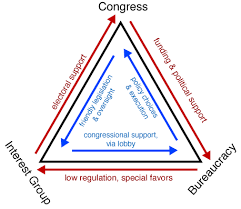
What is the name of the diagram shown in this image?
a)
Steel Union
b)
Coalition Agreement
c)
Iron Triangle
d)
Solid Partnership
96.
Which one of the following is an example of a regulatory agency?
a)
NASA
b)
NSA
c)
USPS
d)
EPA
97.
The most substantial control that Congress exerts on the bureaucracy is through its power to
a)
pass laws.
b)
hire and fire federal judges.
c)
approve an agency's appointees.
d)
decide how much money will be appropriated for agency programs.
98.
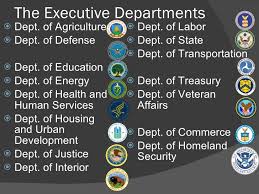
All cabinet departments are headed by a secretary except
a)
Defense
b)
Housing and Urban Development
c)
Health and Human Services
d)
Justice 
99.
a procedure for terminating debate, especially filibusters, in the Senate
a)
Cloture
b)
Whip
c)
Hold
d)
Earmark
100.
The right to keep executive communication confidential, especially if they relate to National Security
a)
Executive privledge
b)
Executive Order
c)
Diplomatic immunity