wayground logo

Free Printable Worksheets

Font size

S
M
L
XL
Worksheets

Water Cycle

Total questions: 82

Worksheet time: 1hrs 29mins

Name
Class
Date
1.

What percentage of Earth's fresh water that is not frozen

a)

97%

b)

1%

c)

100%

d)

3%

2.

Which of the following are types of freshwater that can be used by people?


Select all that are true.

a)

groundwater

b)

ice caps and glaciers

c)

oceans

d)

rivers

e)

lakes

3.

What happens once groundwater reaches a layer of rock in the ground that it cannot pass through?

a)

it is soaked up by that layer of rock and dirt

b)

it creates an aquifer

c)

it creates a reservoir

d)

it evaporates

4.

People get fresh water from

a)

reservoirs

b)

lakes and rivers

c)

pumping groundwater up from aquifers using wells

d)

all of the above

5.

Why does groundwater usually require less treatment than surface water?

a)

The layers of Earth protect groundwater from pollutants.

b)

As groundwater sinks into the ground, the layers of rock act like a natural filter and remove pollutants from the water.

c)

Surface water has more exposure to pollutants in runoff and the atmosphere.

d)

all of the above

6.

What is the energy source for the water cycle?

a)

sun

b)

wind

c)

rain

d)

oceans

7.

What are clouds made of?

a)

dry air

b)

water

8.

What are the main components of the water cycle?

a)

runoff

b)

transpiration

c)

evaporation

d)

condensation

e)

precipitation

9.

What type of precipitation will fall if the temperature is 0 degrees celsius, but the precipitation freezes along the way to Earth's surface?

a)

rain

b)

snow

c)

sleet

d)

hail

10.

Which statement correctly describes how clouds are formed?

a)

Clouds form when a large block of ice is frozen in the sky.

b)

Clouds form when a solid changes directly to a gas through sublimation.

c)

Clouds form when water vapor condenses around tiny specks of dirt in the air.

d)

Clouds form when water vapor evaporates from a lake, river, puddle, or ocean.

11.
What is it called when plants give off water vapor as a waste product?
a)
condensation
b)
evaporation
c)
sublimation
d)
transpiration
12.
During which stage do clouds form?
a)
condensation
b)
evaporation
c)
precipitation
13.
Which stages does liquid water from the ocean turn into water vapor?
a)
condesantion
b)
evaporation
c)
precipitation
d)
run off
14.
Which stage does ground water try to return to the ocean or soak into the ground?
a)
condensation
b)
evaporation
c)
precipitation
d)
run off
15.
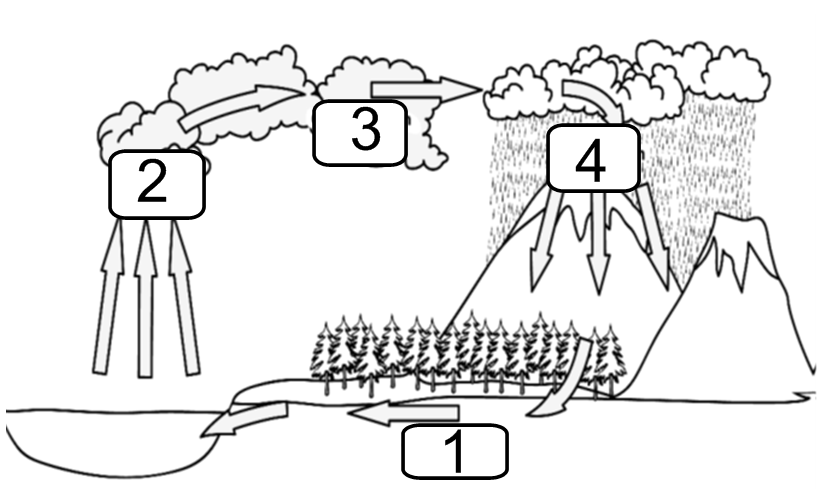
Which stage does the #2 show in the diagram?
a)
condensation
b)
evaporation
c)
precipitation
d)
run off
16.
Which stage does the #3 show in the diagram?
a)
condensation
b)
evaporation
c)
precipitation
d)
run off
17.
what does the #4 show in the diagram?
a)
condensation
b)
evaporation
c)
precipitation
d)
run off
18.
does warm water evaporate quicker than cold water
a)
true 
b)
false
19.
What is the water cycle?
a)
the 3 forms of water
b)
the movement of water on, above, or below the surface of the Earth
c)
when water melts
d)
when clouds form
20.
Which is the opposite of condensation?
a)
runoff
b)
evaporation
c)
precipitation
d)
transpiration
21.
Which best explains why runoff is important?
a)
It returns water to other locations on Earth
b)
It increases the chance of flooding
c)
It makes evaporation occur faster
d)
It increases condensation
22.
What follows evaporation during the water cycle? How does this occur?
a)
Water evaporates into water vapor
b)
Water vapor condenses and forms a  cloud
c)
Water precipitates to the ground
d)
Water runs down into the hydrosphere
23.
The sun will cause water in the puddle to change from
a)
a gas to a liquid
b)
a liquid to a gas
c)
solid to a liquid
d)
a liquid to a solid
24.
A cup of ice sits in the sun.  The ice melts. What change of state will occur NEXT?
a)
from solid to solid
b)
from liquid to solid
c)
from liquid to gas
d)
from gas to liquid
25.
The ______________is the beginning source of energy for the water cycle.
a)
sun
b)
wind
c)
geothermal
d)
volcano
26.
Water begins to evaporate when you add _______ to it.
a)
cold
b)
ice
c)
water cycle
d)
heat
27.
What is the energy source for the water cycle?
a)
the sun
b)
the earth
c)
water
d)
the moon
28.
Which of these is an example of precipitation?
a)
snow
b)
air
c)
clouds
d)
vapor
29.
Which is the opposite of condensation?
a)
runoff
b)
evaporation
c)
precipitation
d)
transpiration
30.
Which best explains why runoff is important?
a)
It returns water to other locations on Earth
b)
It increases the chance of flooding
c)
It makes evaporation occur faster
d)
It increases condensation
31.
Snow, sleet, hail, and rain are all examples of  ________________. 
a)
evaporation
b)
condensation
c)
accumulation
d)
precipitation
32.
What happens after groundwater at the very end/beginning of the water cycle?
a)
Evaporation
b)
Transpiration
c)
Condensation
d)
Groundwater
33.
What is it called when plants give off water vapor as a waste product?
a)
condensation
b)
evaporation
c)
sublimation
d)
transpiration
34.
When water _________, dew forms.
a)
Melts
b)
Evaporates
c)
Condenses
d)
Precipitates
35.
What is the water cycle?
a)
the 3 forms of water
b)
the movement of water on, above, or below the surface of the Earth
c)
when water melts
d)
when clouds form
36.
During which stage do clouds form?
a)
condensation
b)
evaporation
c)
precipitation
37.
Which stages does liquid water from the ocean turn into water vapor?
a)
condesantion
b)
evaporation
c)
precipitation
d)
run off
38.
Which stage does ground water try to return to the ocean or soak into the ground?
a)
condensation
b)
evaporation
c)
precipitation
d)
run off
39.
Which stage does the #2 show in the diagram?
a)
condensation
b)
evaporation
c)
precipitation
d)
run off
40.
Which stage does the #3 show in the diagram?
a)
condensation
b)
evaporation
c)
precipitation
d)
run off
41.
what does the #4 show in the diagram?
a)
condensation
b)
evaporation
c)
precipitation
d)
run off
42.
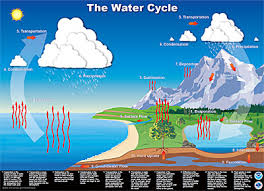
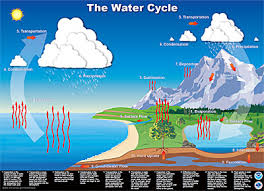
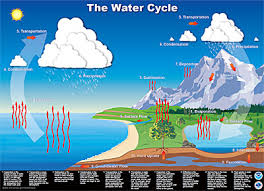
What does this illustration show?
a)
Sunrise
b)
The Water Cycle
c)
Sunset
d)
the recycling of snow
43.
This is what heats up the water to start the  water cycle. 
a)
sun
b)
moon
c)
stars
d)
Mars
44.
Dew also forms directly onto items, as water droplets.  What part of the water cycle is this?
a)
run-off 
b)
condensation
c)
evaporation
d)
precipitation
45.
What is water doing when it is changed to water vapor?
a)
evaporating
b)
condensing
c)
transpiring
d)
freezing
46.
On which kind of day would you expect the most evaporation from the surface of a  pond?
a)
sunny and hot
b)
sunny and cold
c)
rainy and hot
d)
rainy and cold
47.
What is the energy source for the water cycle?
a)
the sun
b)
the earth
c)
water
d)
the moon
48.
Which is the opposite of condensation?
a)
runoff
b)
evaporation
c)
precipitation
d)
transpiration
49.
Snow, sleet, hail, and rain are all examples of  ________________. 
a)
evaporation
b)
condensation
c)
accumulation
d)
precipitation
50.
What is it called when plants give off water vapor as a waste product?
a)
condensation
b)
evaporation
c)
sublimation
d)
transpiration
51.
What comes after evaporation during the water cycle?
How does this occur?
a)
Water evaporates into water vapor
b)
Water vapor condenses and forms a  cloud
c)
Water precipitates to the ground
d)
Water runs down into the hydrosphere
52.
Which best explains why runoff is important?
a)
It returns water to other locations on Earth
b)
It increases the chance of flooding
c)
It makes evaporation occur faster
d)
It increases condensation
53.
Precipitation occurs because 
a)
the droplets evaporate in the air
b)
the droplets are too light for the air to hold
c)
the droplets are too heavy for the air to hold
54.
What is a layer of rock or sediment that holds water?
a)
glacier
b)
well
c)
aquifer
d)
natural spring
55.

What is water vapor?

a)

Water on the land (geosphere)

b)

Water in the water (hydrosphere)

c)

Water in plants

d)

Water in the air (atmosphere)

56.

Where is most water found on Earth?

a)

glaciers

b)

oceans

c)

rivers

d)

lakes

57.

On which kind of day would you expect the most evaporation from the surface of a pond?

a)

warm, sunny

b)

cold, rainy

c)

cold, sunny

d)

rainy, warm

58.
What is condensation?
a)
The part of the water cycle when the sun heats up water, turning it from a liquid into water vapor or steam. It rises from the ground into the air.
b)
The part of the water cycle when the water vapor in the air gets cold. The water turns back into a liquid and forms clouds.
c)
The part of the water cycle when clouds get heavy and can no longer hold the liquid water. This causes the water to fall from the sky to the earth as rain, snow, sleet, or hail.
59.

The process by which water on the ground surface enters the soil.

a)

Evaporation

b)

Rain

c)

Infiltration

d)

Watershed

60.
Water in the form of a gas.
a)
water vapor
b)
dew point
c)
ocean current
d)
humidity
61.

condensation falling onto land in the form of rain, sleet, hail, snow, and mist

a)

condensation

b)

desublimation

c)

evaporation

d)

precipitation

62.
A student looks outside her window after it has rained. She sees many puddles of water. later that same day, the puddles are gone. Which process explains why the puddles are gone? 
a)
accumulation of runoff
b)
precipitation 
c)
evaporation 
d)
condensation 
63.

Which example is a form of precipitation?

a)

Dew

b)

Fog

c)

Frost

d)

Hail

64.

How is transpiration important to the water cycle?

a)

It is the evaporation of water from the leaves of plants back into the atmosphere allowing the cycle to continue.

b)

It results in the deposition of water vapor directly as ice, so water changes states causing the cycle to move to the next phase.

c)

It allows plants to absorb water through their roots which is then precipitated back into the atmosphere.

d)

It permits the diffusion of water from the surface to water tables deep underground which restores groundwater supplies.

65.

In which area would the rate of evaporation be the lowest?

a)

Over the ocean

b)

Over the mountains

c)

Over the rainforest

d)

Over the desert

66.

As a part of the water cycle, water from Earth's surface enters the clouds and finally falls back to the ground in the form of rain. What is the correct sequence of processes water undergoes?

a)

Evaporation, Condensation, Precipitation

b)

Precipitation, Condensation, Evaporation

c)

Condensation, Evaporation, Precipitation

d)

Evaporation, Precipitation, Condensation

67.

What would happen if the Sun is removed from the water cycle?

a)

The water cycle would not include precipitation but would continue with groundwater flow.

b)

The water cycle would no longer occur because the Sun provides the energy for evaporation and transpiration.

c)

The water cycle would no longer occur because the Sun provides energy for the formation of clouds.

d)

The water cycle would not include evaporation and transpiration but would continue with condensation.

68.

How do transpiration and evaporation compare?

a)

During both processes, liquid water changes to water vapor.

b)

During both processes, water vapor changes to liquid water.

c)

During transpiration, liquid water changes to water vapor, and during evaporation, water vapor changes to liquid water.

d)

During transpiration, water vapor changes to liquid water, and during evaporation, liquid water changes to water vapor.

69.

The water cycle is shown in the diagram. What would most likely happen if all evaporation of water stopped?

a)

Runoff would increase.

b)

More clouds would form.

c)

No precipitation would fall.

d)

Moist air would be in the atmosphere.

70.

A student draws a model to represent the precesses involved in the water cycle, as shown. To which process is the formation of clouds related?

a)

Condensation

b)

Evaporation

c)

Freezing

d)

Melting

71.

The image shows various stages in the water cycle. During which stage does water flow back towards the sea as runoff?

a)

W

b)

X

c)

Y

d)

Z

72.

Water forms on the outside of iced tea on a hot day. What process causes the water to form?

a)

Condensation

b)

Evaporation

c)

Precipitation

d)

Transpiration

73.

This diagram shows four phases of the water cycle. Which phase of the water cycle is affected most directly by heat from the sun?

a)

phase L

b)

phase M

c)

phase N

d)

phase O

74.

Dew and first are formed from water. How are dew and frost related?

a)

Dew forms what liquid water vaporizes, and frost forms when water condenses.

b)

Frost forms when liquid water vaporizes, and dew forms when water condenses.

c)

Frost forms at temperatures above freezing, and dew forms at temperatures below freezing.

d)

Dew forms at temperatures above freezing, and frost forms at temperatures below freezing.

75.

Analyze the diagram of the water cycle with processes J, K, L, M, X, and Y labeled. What is significant about the process labeled L?

a)

Condensation is the conversion of water vapor into water droplets.

b)

Precipitation is the release of liquid or frozen forms of water from the atmosphere.

c)

Evaporation is the conversation of surface water into water vapor to return to the atmosphere.

d)

Transpiration is the release of water vapor from plants back into the water cycle.

76.

Analyze the diagram of the water cycle with processes J, K, L, M, Y, and Y labeled. What do the arrows X and Y represent?

a)

Sea and land breezes along the coastline.

b)

Formation of dew as cold air sinks.

c)

Run-off of surface water and movement of ground water toward sea level.

d)

Tidal flooding and erosion of the river bank.

77.

A storm that produces very heavy precipitation passes over Columbia, South Carolina. If the rain falls on a surface that is not porous, what will most likely happen to the rain.

a)

Condensation

b)

Evaporation

c)

Runoff

d)

Transpiration

78.

The flow chart represents the water cycle. What is the next phase in the water cycle as indicated by the question mark?

a)

Condensation

b)

Evaporation

c)

Precipitaion

d)

Run-off

79.

On Earth, what process generates most of the water vapor?

a)

Condensation

b)

Evaporation

c)

Precipitation

d)

Transpiration

80.

Rain and snow are two different forms of precipitation that fall on Earth's surface. Which factor is responsible for there being different forms of precipitation?

a)

Evaporation

b)

Run-off

c)

Temperature

d)

Transpiration

81.

In what layer of the atmosphere does all weather occur?

a)

Exosphere

b)

Mesosphere

c)

Thermosphere

d)

Troposphere

82.

What is water doing when it changes to water vapor?

a)

Evaporating

b)

Condensing

c)

Precipitation

d)

Freezing