wayground logo

Free Printable Worksheets

Font size

S
M
L
XL
Worksheets

Biology EOC review

Total questions: 67

Worksheet time: 1hrs 26mins

Name
Class
Date
1.

All living things are made up of _____.

a)

Cells

b)

Bacteria

c)

Energy

d)

Cels

2.

What is the proper level of Organization

a)

Cells -> Tissue -> Organ -> Organism

b)

Cells -> Tissue -> Organ -> Organ System -> Organism

c)

Tissue -> Organ -> Organ System -> Organism

d)

Bacteria -> Cells -> Organ -> Organ System -> Organism

3.
Name B.
a)
phosophate
b)
glucose
c)
deoxyribose
d)
nitrogen base
4.
What type of punnett square?
a)
codominance
b)
incomplete dominance
c)
complete dominance
d)
sex linked recessive
5.
This cell is undergoing mitosis.  What stage of mitosis is shown?
a)
prophase
b)
metaphase
c)
anaphase
d)
telophase
6.

During what phase of Mitosis do the chromosomes line up in the Middle

a)

Metaphase

b)

Prophase

c)

Telophase

d)

Anaphase

7.

PMAT helps us remember the correct order of the phases of Mitosis. Which of the following has the phases of Mitosis in the correct Order

a)

Interphase, Mitosis, Cytokinesis

b)

Prophase, Metaphase, Anaphase, Prophase

c)

Anaphase, Telophase, Prophase, Telophase

d)

Prophase, Metaphase, Anaphase, Telophase

8.

When only one parent cell is needed to make offspring it is called___________________________.

a)

Sexual reproduction

b)

Asexual reproduction

c)

Meiosis reproduction

d)

Recessive reproduction

9.

Human body cells have _____ chromosomes.

a)

23

b)

12

c)

46

d)

24

10.

Male sex cells are _______ and female sex cells are _______.

a)

yy, XX

b)

XY, XX

c)

YY,XX

d)

XY, YY

11.
What does DNA stand for?
a)
Deoxyribose Nucleic Acid
b)
Denatured Natural Acid
c)
Do Not Accept
d)
I Don't Know
12.
Adenine, Cytosine, Guanine and Thymine are examples of
a)
DNA structure
b)
DNA bases
c)
DNA double helix
d)
Paired bases
13.

What Bases are Purines? (Select all that Apply)

a)

Adenine

b)

Cytosine

c)

Guanine

d)

Thymine

14.

What are the proper complementary base-pairs?

a)

A--T and G--C

b)

A--G and C--T

c)

G--T and A--C

d)

A--C and T--G

15.
How does RNA differ from DNA?
a)
RNA contains uracil and deoxyribose
b)
RNA contains ribose and thymine
c)
RNA contains uracil and ribose
d)
RNA contains adenine and ribose
16.
How would the DNA sequence GCTATA be transcribed to mRNA?
a)
GCUAUA
b)
CGATAT
c)
CGAUAU
d)
GCUTUT
17.
In messenger RNA, each codon specifies a particular
a)
nucleotide
b)
enzyme
c)
amino acid
d)
promoter
18.

What mutation has occurred here?

T-G-A-C-C-A

T-G-A-G-C-A

a)

Substitution

b)

Deletion

c)

Insertion

d)

Frameshift

19.

ATT-TGA-GCC- Original

ATT-GAG-CC - Mutated

The example above is an example of a

a)

Insertion- Frameshift

b)

Deletion- Substitution

c)

Deletion -Frameshift

d)

All of the above

20.
Which of the following would result in a frameshift mutation?
a)
Insertions only
b)
Substitution only
c)
Deletion only
d)
Insertions and Deletions
21.

What organelle reads the mRNA and finds the correct amino acid?

a)

DNA

b)

Nucleus

c)

Ribosome

d)

Chloroplast

22.

How many nucleotides make up a codon?

a)

1

b)

3

c)

5

d)

15

23.
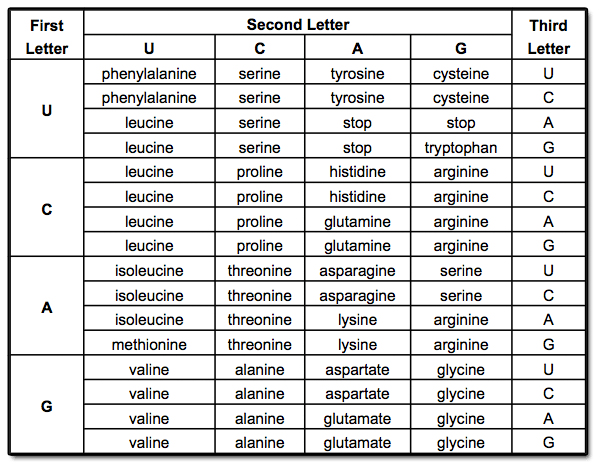
What amino acid is represented by the codon UUA?
a)
Phenylalanine
b)
Tyrosine
c)
Leucine
d)
Stop codon
24.
Which amino acid pairs with the codon AGA
a)
Thr
b)
Arg
c)
Ala
d)
Glu
25.
Movement of materials down the concentration gradient through a protein channel is an example of 
a)
facilitated diffusion
b)
active transport
c)
respiration
d)
osmosis 
26.
Humans are made up of different cells that preform different functions. From which cells do nerve cells develop? 
a)
Muscle cells
b)
Stem cell
c)
Sperm cells
d)
White blood cells 
27.
What are the products of photosynthesis? 
a)
glucose and oxygen
b)
glucose and carbon dioxide
c)
glucose and water
d)
water, carbon dioxide, and energy
28.
Which process uses ATP to move materials across the plasma membrane against the concentration gradient?
a)
passive transport
b)
active transport 
c)
facilitated diffusion
d)
osmosis
29.
What type of growth is shown by the human population? 
a)
Carrying capacity
b)
Logistical
c)
Exponential
d)
Stabilizing 
30.
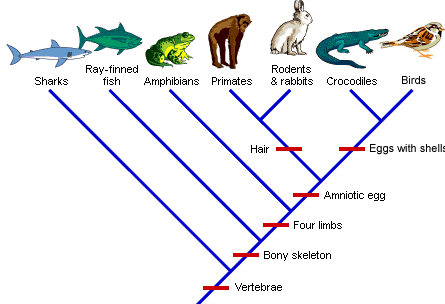
What trait separates sharks from ray-finned fish?
a)
Vertebrae
b)
Bony skeleton
c)
Four limbs
d)
None
31.
According to the cladogram, which organism is most distantly related to the human?
a)
crayfish
b)
grasshopper
c)
perch
d)
frog
32.

According to this cladogram, primates share a common ancestor with

a)

amphibians

b)

rodents and rabbits

c)

crocodiles

d)

birds

33.
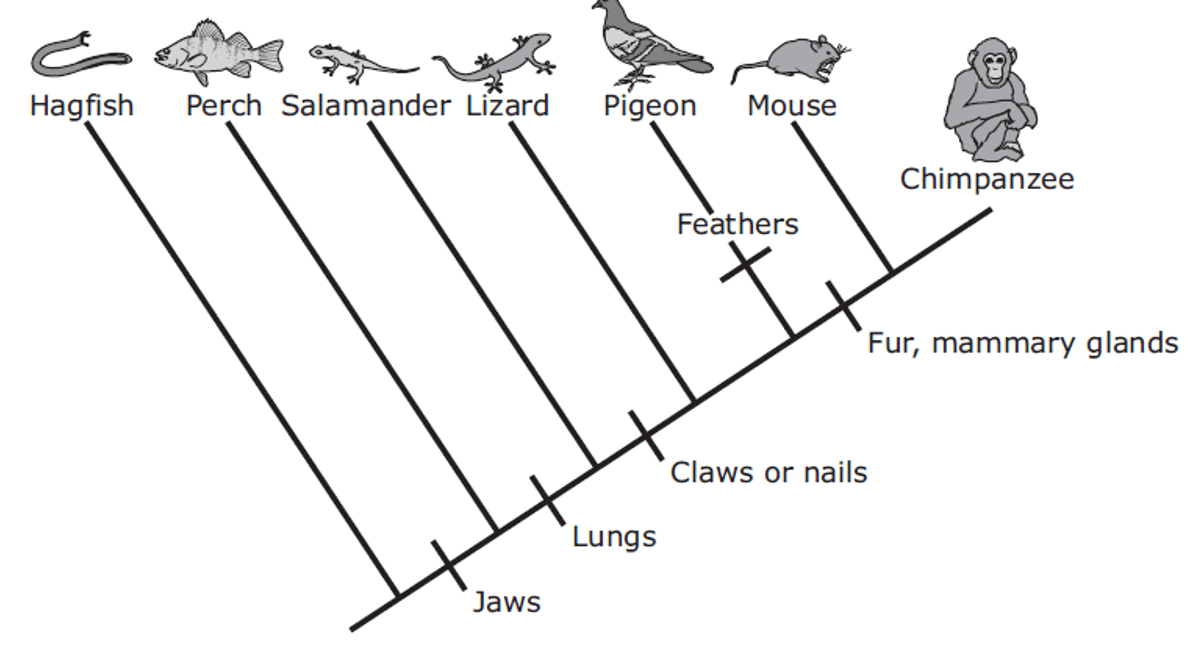
All the animals to the right of the hagfish would have the common characteristic of -
a)
Fur
b)
Claws or nails
c)
Lungs
d)
Jaws
34.
What type of inheritance do two alleles have if their traits blend together? 
a)
Incomplete Dominance
b)
Co-Dominance
c)
Mendelian Inheritance
d)
Homozygous Inheritance
35.
A calico cat shows both the traits for orange fur and black fur. What kind of allele expression is this?
a)
Incomplete Dominance
b)
Co dominance
c)
Independent assortment
d)
Recessive inheritance
36.

What is this an example of?

a)

Codominance

b)

Incomplete Dominance

c)

Complete Dominance

37.

What is this an example of?

a)

Codominance

b)

Complete Dominance

c)

Incomplete Dominance

38.

What are the two types of succession?

a)

Main and Minor Succession

b)

First and Second Succesion

c)

Primary and Secondary Succession

39.

What is the name of the jelly-like substance that is inside the cell?

a)

cytoplasm

b)

ectoplasm

c)

cytokinesis

40.

What cell feature contain digestive enzymes which breaks things down?

a)

lysosomes

b)

mitochondria

c)

chloroplast

d)

nucleus

41.

What cell feature packages and moves things around the cell?

a)

mitochondria

b)

Golgi body

c)

endoplasmic reticulum

d)

cell membrane

42.

The plant cell structure where photosynthesis takes place is called...

a)

chloroplast

b)

vacuole

c)

chlorophyll

d)

mitochondria

43.
Pigment in green plants that captures the energy in sunlight is called _______.
a)
Pigment
b)
Chlorophyll
c)
Stomata
d)
Green Thing
44.
What are the products of photosynthesis?
a)
water and carbon dioxide
b)
oxygen and glucose
c)
oxygen and carbon dioxide
d)
oxygen and water
45.
What are the reactants of photosynthesis?
a)
carbon dioxide and oxygen
b)
water and oxygen
c)
carbon dioxide and water
d)
water and glucose
46.

Main products of the Calvin Cycle

a)

Oxygen, NADP+, ADP

b)

Glucose, CO2, ADP

c)

ADP, NADP+, Glucose

d)

ATP, NADPH, Oxygen

47.

The Calvin Cycle occurs in the

a)

Thylakoid

b)

Grana

c)

Inner membrane of chloroplast

d)

Stroma

48.
Where do the light reactions happen?
a)
mitochondria membrane
b)
thylakoid membrane
c)
stroma
d)
central vacuole
49.

Which of the following is not needed to start the light reaction

a)

H2O

b)

ADP + P

c)

CO2

50.

How many G3P is needed to convert to a one molecule of glucose?

a)

1

b)

2

c)

3

d)

4

e)

5

51.

The goal of cellular respiration is to

a)

make water

b)

make glucose

c)

make ATP

d)

make oxygen

52.

How much ATP does cellular respiration ideally make?

a)

2 ATP

b)

10 ATP

c)

36 ATP

d)

O ATP

53.

Which is the correct chemical equation for aerobic cellular respiration?

a)

C6H12O6 + O2 ----> CO2 + H2O + ATP

b)

C6H12O6 + CO2 ----> O2 + H2O + ATP

c)

ATP + O2 -----> CO2 + H2O + C6H12O6

d)

C6H12O6 + H2O + O2 ------> CO2 + O2 + ATP

54.

Where does AEROBIC respiration occur?

a)

cytoplasm

b)

mitochondria

c)

chloroplast

d)

ribosome

55.

Muscle fatigue results from the accumulation of lactic acid because of

a)

enzyme deficiency

b)

excess number of mitochondria in the cell

c)

oxygen deficiency

d)

inability to metabolize glucose

56.

Which is a product of glycolysis?

a)

2 molecules of pyruvic acid

b)

1 molecule of glucose

c)

NAD+

d)

oxygen

57.

Which of these is broken down into pyruvic acid?

a)

glucose

b)

oxygen

c)

water

58.

After the NAD+ receives electrons, what does it change to?

a)

ATP

b)

NADH

c)

ADP

59.
Folds in the mitochondrion are called:
a)
Cristae
b)
Matrix
c)
Golgi Bodies
d)
Carbuncles
60.
Krebs Cycle takes place in the:
a)
Cytoplasm
b)
Matrix
c)
Ribsome
d)
InterMembrane Space
61.

Where does the electron transport chain occur?

a)

Nucleus

b)

Vacuole

c)

Mitochondria

d)

Nucleolus

62.

How much ATP is gained during the Electron Transport Chain?

a)

34 ATP

b)

36 ATP

c)

32 ATP

d)

30 ATP

63.
An organism that needs to eat other organisms to obtain energy is known as a:
a)
Autotroph
b)
Producer
c)
Consumer
d)
Mutualist
64.
The rabbit in this food web would be considered a:
a)
Decomposer
b)
Producer
c)
Secondary Consumer
d)
Primary Consumer
65.
What is the term for each step in the transfer of energy and matter within a biological community?
a)
energy path
b)
food web
c)
trophic level
d)
food pyramid
66.
The amount of energy that usually transfers from one trophic level to the next...
a)
10%
b)
20%
c)
80%
d)
50%
67.
The largest number of individuals in a species that an environment can support long term
a)
carrying capacity
b)
emigration
c)
immigration
d)
population density