
 Worksheets
CU6: Models of the Atom Through Time
Total questions: 37
Worksheet time: 20mins
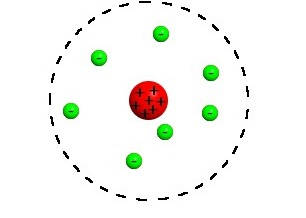
This model was the first to show a nucleus. Electrons surround the nucleus but were not organized into orbits or orbitals.
The "Nuclear Model" of the atom
The "Plum Pudding Model" of the atom
The "Quantum Mechanical Model" of the atom

This model was developed after J.J. Thompson discovered electrons, a particle smaller than an atom. It shows electrons floating freely in a positive area.
The "Plum Pudding Model" of the atom
The "Nuclear Model" of the atom
Democritus's model of the atom
The "Quantum Mechanical Model" of the atom

solid
In the gold foil experiment, most of the particles passed through the gold foil, but some were deflected or bounced back. What did he conclude from this observation?
Atoms are small indivisible spheres.
Atoms are mostly empty space with a small, dense, center.
Atoms have electrons which orbit the nucleus.
Who was the first to propose that matter consist of indivisible particle of matter called atoms?
John Dalton
Aristotle
Democritus
Plato

In the atomic model nicknamed the "plum pudding" model, what do the plums represent?
the nucleus
the atom
the electrons
the positive material
The cathode-ray tube was used to discover the ____.
electron
proton
neutron
nucleus

In Rutherford's famous "Gold Foil" experiment, some particles passed through the foil, some were deflected, and some were bounced straight back. This observation led Rutherford conclude...
gold atoms have a solid nucleus.
gold atoms can conduct electricity.
gold atoms are denser than other metals.
gold's electrons orbit the nucleus at definite distances from the center.
J.J. Thomson discovered electrons, and he also knew that atoms are neutral. From these two facts, Thomson reasoned that the atom must also contain...
positive material.
a nucleus.
neutrons.
orbits.
Which of the following is the best description of J.J. Thomson's model of the atom?
a featureless, indivisible sphere
a sphere of positive material with electrons embedded in it
mostly empty space with electrons randomly orbiting around a positive nucleus
mostly empty space with electrons located in set orbits around a positive nucleus.
Who had an idea that there must be an indivisible particle of matter he called "atomos"?
Who discovered the nucleus of an atom?
Niels Bohr
John Dalton
Which scientist described a positively charged core (“nucleus”) in the middle of a lot of empty space?
Chadwick
Thomson
Rutherford
Bohr
According to the modern concept of the atom, which are located in the nucleus of an atom?
electrons and protons
protons only
neutrons and electrons
protons and neutrons
Researchers discovered a subatomic particle while working with the cathode ray tube. The particle is known as a(n) ____________________.
proton
neutron
electron
In the Bohr model, nicknamed "the solar system model", what are the electrons like?
the sun
the nucleus
the planets
the moon

The atomic model that can be compared with a blueberry muffin or plum pudding was conceptualized by...
Niels Bohr.
JJ Thomson.
Democritus.
Ernest Rutherford.

In the Cathode Ray Tube experiment, magnets were used to bend light beam, resulting in the discovery that the light beam was flowing _______.
protons
electrons
neutrons
Which of the following would be the closest analogy to Dalton's model of the atom?
solar system
plum pudding
marble
a ripple in water standing still
This particle was the first subatomic particle discovered, leading science to discard Dalton's model of the atom.
electron
proton
neutron
photon
JJ Thomson used a cathode ray tube and a magnet to show that there is a subatomic particle with this property:
positive charge
no electric charge
negative charge
wave properties
Which of the following ideas about atomic structure resulted from Rutherford's gold foil experiments?
atoms are made of smaller subatomic particles
electrons exist in distinct energy levels
atoms have mass concentrated in a tiny, positively charged nucleus
electrons can exist as both waves and particles
What analogy best compares to Bohr's model of the atom?
marble
plum pudding
solar system
ripple in water that isn't moving
Where did Thomson say the electrons were in the atom?
Round the outside
Evenly spaced throughout the positively charged atom
At the center of the atom
What happened during Rutherford's gold foil experiment that prompted him to develop a new model?
All of the particles he was shooting at the gold foil went straight through.
All of the particles he was shooting at the gold foil bounced back at the source.
Most of the particles he was shooting at the gold foil passed through but some bounced back towards the source
How do scientists know how atoms are structured?
By looking at them under a microscope
By running experiments that expose their properties
By examining only the largest atoms
By splitting them apart
In most models of the atom, electrons exists where?
in the nucleus
orbiting around the nucleus
What was the last subatomic element to be discovered?
Electrons
Protons
Neutrons

This model is known as the Nuclear model because it is the first model with a/an _____________.
neutrino
neutron with no charge
electron with negative charge
nucleus containing all positive charge and most of the mass

This is a Bohr model. Bohr was the first to show that electrons in an atom are found in different ___________.
orbits
nuclei
electron clouds
plum puddings

Schrodinger's Quantum Mechanical model is the most complicated. He called the places where electrons are most likely to be found _________.
nuclei
orbitals
energy levels
karaoke bars

According to the latest atomic models, how do electrons move?
They move around the nucleus in a hyperactive "spazzy" manner.
They stay still inside the nucleus
They follow nice neat orbits, like the planets around the sun.

Which model of the atom is the most current model?
Dalton's Model
The Plum Pudding Model
The Bohr Model
The Quantum Mechanical Model
The Nuclear Model

What is the meaning of the greek word "atomos"?
Invincible
Invisible
Indivisible
super small
Which of the following is the correct order for the discovery of subatomic particles (first to last)?
electrons, protons, neutrons
protons, electrons, neutrons
neutrons, electrons, protons
electrons, neutrons, protons

