wayground logo

Free Printable Worksheets

NEW

Font size

S
M
L
XL
Worksheets

Forces and Motion

Total questions: 55

Worksheet time: 4hrs 48mins

Name
Class
Date
1.
Which type of force(s) will cause a change in an object's motion?
a)
gravity
b)
zero net force
c)
balanced forces
d)
unbalanced forces
2.
What is the name for a push or pull?
a)
A movement
b)
A force
c)
Speed
d)
Density
3.
friction is a force that acts 
a)
in the same direction as the motion
b)
opposite to the direction of the motion
c)
opposite to the applied forces
d)
the same direction as the applied force
4.
Which one needs a greater net force to move, a kilogram of feathers or a kilogram of iron? 
a)
feathers 
b)
iron
c)
same
d)
depends on their friction
5.
You push on a tree with 20 N of force. If the tree doesn't move, the tree is pushing back on you with _____of force.
a)
20N 
b)
40N 
c)
10N 
d)
70N
6.
What Unit do we Measure Force in? 
a)
Newtons
b)
Joules
c)
Force
d)
Don't know
7.
Which has more Inertia? (so need more force to move) 
a)
Truck
b)
Ant
c)
A cat
d)
A skateboard
8.
In a tug of war the left team pulls with a force of 200N. The right team pulls with a force of 150N.What is the net force?
a)
50N to the left.
b)
350N to the left.
c)
350N to the right.
d)
50N to the right.
9.
A balanced force has 
a)
no net force
b)
some net force
c)
a wee bit of net force
d)
a lot of net force
10.
Any change in an objects speed or direction
a)
Inertia
b)
Force
c)
Acceleration
d)
Reaction
11.
The sum of all forces acting on an object.
a)
Contact Force
b)
Balanced Force
c)
Unbalanced Force
d)
Net Force
12.
Balanced or Unbalanced?
a)
Balanced 
b)
Unbalanced
13.
a force that opposes motion between any surfaces that are touching
a)
velocity
b)
friction
c)
inertia
d)
position
14.
the tendency of an object to resist a change in its motion
a)
acceleration
b)
inertia
c)
mass
d)
frame of reference
15.
During which interval is the object speeding up?
a)
A to B
b)
B to C
c)
D to E
d)
E to F
16.
What is this graph showing?
a)
Constant Speed
b)
Acceleration (speeding up)
c)
Deceleration (slowing down)
d)
No motion
17.
What happens when two forces act in the same direction?
a)
They cancel each other out.
b)
The stronger one prevails.
c)
Their strengths are added.
d)
Their sum divided by the two is the total force.
18.
Which force produces a change in motion?
a)
unbalanced force
b)
balanced force
c)
gravitational force
d)
frictional force
19.
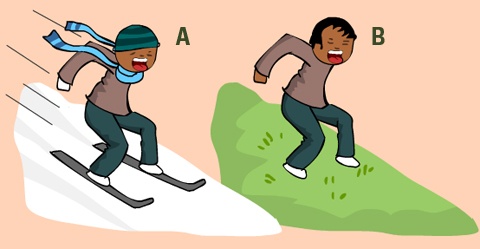
Why is it harder for the boy in Image B to get down the hill?
a)
Motion
b)
Friction
c)
Work
d)
Displacement
20.
Jupiter has about 317 times more mass than Earth. What can you infer from this fact? 
a)
That Jupiter’s gravitational force is much weaker than on Earth’s gravitational force.
b)
That Jupiter’s gravitational force is much stronger than Earth’s gravitational force.
c)
That Jupiter’s and Earth’s gravitational forces are equal.
d)
Mass has no effect on the gravitational force between two objects
21.
If I kick a soccer ball across the field, what vocabulary word tells me why the ball would slow down in the grass?
a)
acceleration
b)
friction
c)
gravity
22.
What is a force that works AGAINST MOTION?
a)
Force
b)
Motion
c)
Gravity
d)
Friction
23.

The change in a objects position is________.

a)

Force

b)

Motion

c)

Reaction

d)

Movement

24.

This motion graph represents:

a)

constant speed

b)

acceleration

c)

object at rest

d)

slowing down

25.
What kind(s) of objects have inertia?
a)
all objects with mass
b)
only objects at rest
c)
only objects in motion
d)
only objects whose motion is being changed
26.

If the net force is 0 the object will ...

a)

CHANGE its motion

b)

STAY the SAME, NOT Move

27.
What force holds the planets in motion around the sun?
a)
Magnetic
b)
Electrical
c)
Gravitational
d)
Air Resistance
28.
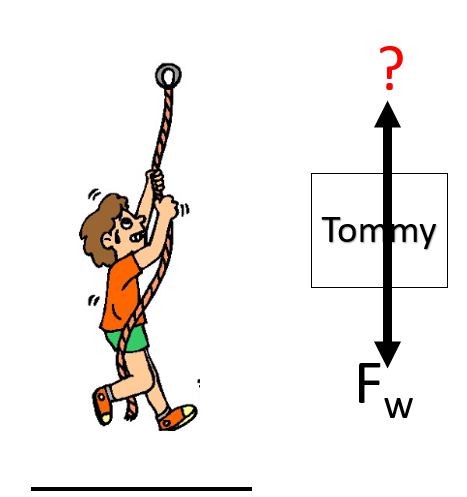
Name the missing force....
a)
weight force
b)
normal force
c)
frictional force
d)
tension force
29.
Name the missing force...
a)
tension force
b)
gravitational force
c)
normal force
d)
applied force
30.

The support force exerted upon an object that is in contact with another stable object.

a)

Gravity

b)

Electrical Force

c)

Normal Force

31.

A force exerted by a compressed or stretched spring upon any object that is attached to it.

a)

Spring Force

b)

Tension Force

c)

Elastic Force

32.

The force that is transmitted through a string, rope, cable or wire when it is pulled tight.

a)

Spring Force

b)

Tension Force

c)

Elastic Force

33.

When a student runs and kicks a ball, they have applied an ___________ force to move the ball.

a)

Balanced

b)

Magnetic

c)

Spring

d)

Unbalanced

34.

When the teacher rearranges the desks in the classroom, she must apply ____________ to push and pull the desks around.

a)

acceleration

b)

force

c)

weight

d)

magnets

35.

Which law of motion says that you must push or pull objects harder if they have more mass?

a)

1st

b)

2nd

c)

3rd

d)

4th

36.

Letting go of a balloon full of air is demonstrating Newton's ______ _______ ________ _________ because the air comes out of the back and the balloon moves forward.

a)

1st law of motion

b)

2nd law of motion

c)

3rd law of motion

d)

13th law of motion

37.

What law is best described by inertia?

a)

1st

b)

2nd

c)

3rd

d)

law of conservation of mass

38.

A person not paying attention while skateboarding hits a rock. The skateboard stops...they don't.

a)

The Law of Inertia (1st law)

b)

The Law of Acceleration (2nd law)

c)

The Law of Conservation of Momentum

d)

Action Reaction Law (3rd law)

39.

What Unit do we Measure Force in?

a)

Newtons

b)

Joules

c)

Force

d)

Kilograms

40.

What is Newton's First Law

a)

F=ma

b)

Every action has an equal and opposite reaction

c)

An object at rest stays at rest, an object in motion stays in motion.

d)

Friction

41.

A 20 kg bike accelerates at 10 m/s2. what was the force

F = m x a

a)

25 Newtons

b)

20 Newtons

c)

200 Newtons

d)

10 Newtons

42.

Newton's third law states that any action will have a(n) _______ and ______ reaction

a)

Equal and similar

b)

Equal and opposite

c)

Equal and different

d)

Greater and opposite

43.

8 N to the left , and 4 N to the right. Find the net force. Is this balanced

a)

12 N Right No

b)

4 N Left No

c)

12 N Right Yes

d)

4 N Left Yes

44.

What law is best described

a)

1st

b)

2nd

c)

3rd

d)

law of motion

45.

What law is best described

Equal and Opposite

a)

1st

b)

2nd

c)

3rd

d)

speed

46.

What law is best described

A magician pulls a tablecloth out from under dishes and glasses on a table without disturbing them.

a)

Newton's 1st Law

b)

Newton's 2nd Law

c)

Newton's 3rd Law

47.
A person is pushed forward into their seatbelt when a car stops
a)
1st
b)
 2nd
c)
2 and 3
d)
3rd 
48.
Newton's third law states that any action will have a(n) _______ and ______ reaction
a)
Equal and similar
b)
Equal and opposite
c)
Equal and different
d)
Greater and opposite
49.
You hit a wall with a stick.  The equal but opposite reaction is _____
a)
the wall pushes against you
b)
the stick pushes against you
c)
you push against the stick
d)
the wall pushes against the stick
50.
Which one is balanced?
a)
top
b)
bottom
c)
both
d)
neither
51.
Why is it harder for the boy in Image B to get down the hill?
a)
Motion
b)
Friction
c)
Work
d)
Displacement
52.
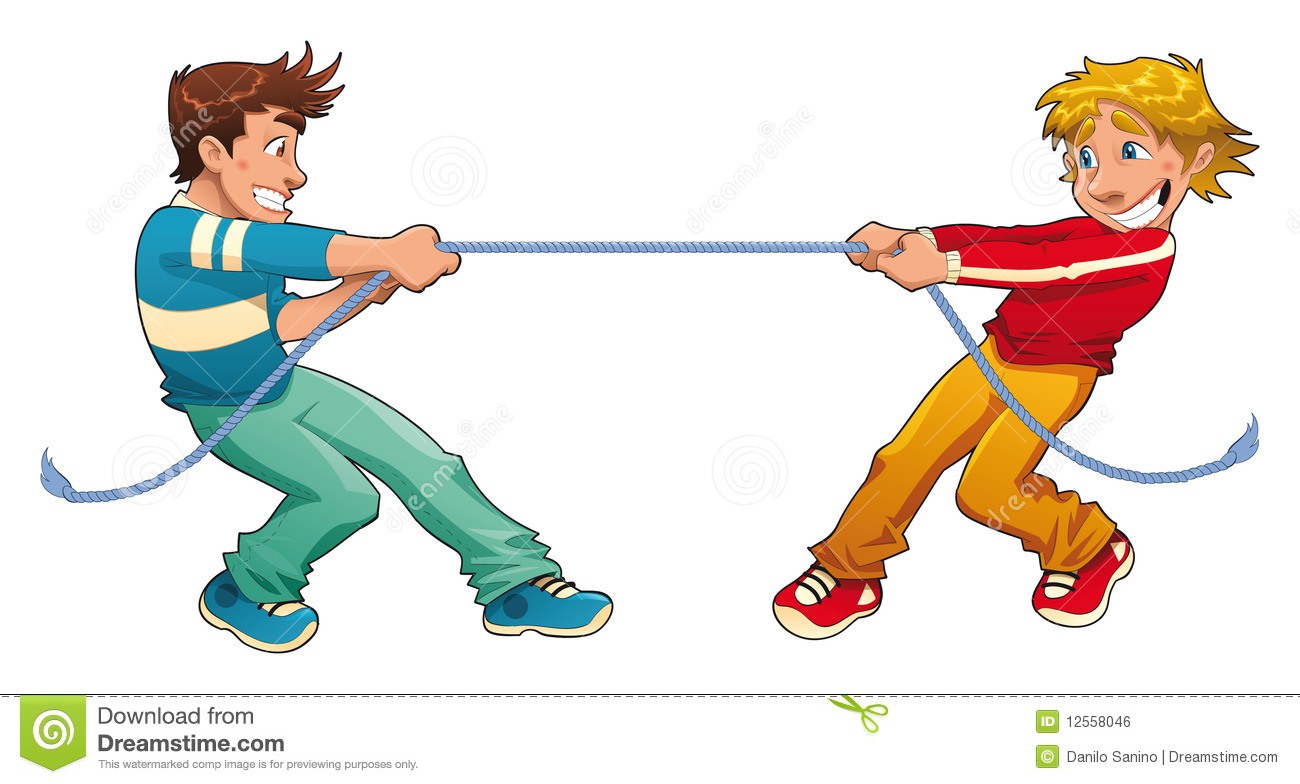
If these boys are pulling with the same amount of force.  What will happen?
a)
The boy in blue will win.
b)
They will not move at all.
c)
The boy in red will win.
d)
Both will fall down.
53.
It takes more force to accelerate the iron man on the left than the iron man on the right because the iron man on the left has more mass. This best describes
a)
Newton's first law, the law of inertia
b)
Newton's second law, the law of acceleration
c)
Newton's third law, the law of action reaction 
d)
The law of universal gravitation
54.
What is the attractive force that exists between all objects that have mass?
a)
Weight
b)
Mass 
c)
Gravity
d)
Viscosity
55.
An automobile you are riding in suddenly stops, but you continue to go forward.
a)
Newton's
1st
Law of Motion
b)
Newton's
2nd
Law of Motion
c)
Newton's
3rd
Law of Motion