

wayground logo

Free Printable Worksheets

Font size

S
M
L
XL
Worksheets

SSA REVIEW LIFE SCIENCE #1

Total questions: 50

Worksheet time: 42mins

Name
Class
Date
1.

This part of a Eukaryotic cell holds the DNA and acts like the "brain" of the cell.

a)

Nucleus

b)

Ribosomes

c)

Endoplasmic Reticulum

d)

Golgi Body

2.

This organelle is found in plant cells and performs photosynthesis.

a)

Cell Wall

b)

Chloroplasts

c)

Central Vacuole

d)

Nucleus

3.

The animal in an ecological relationship that results in another animal being hunted, killed, and eaten…

a)

autotroph

b)

habitat

c)

predator

d)

herbivore

e)

producer

4.

What would you call an ecological symbiotic relationship that is helpful to both organisms involved?

a)
commensalism
b)
niche
c)
mutualism
d)
habitat
e)
parasitism
5.

An ecological symbiotic relationship between two organisms where one benefits and the other is harmed…

a)

parasitism

b)

herbivore

c)

mutualism

d)

carnivore

e)

commensalism

6.

What you would call an ecological symbiotic relationship between two organisms where one benefits, but the other is not helped or harmed?

a)

mutualsim

b)

predator

c)

commensalism

d)

parasitism

e)

herbivory

7.

The name of the process that producers use to make their own food…

a)

respiration

b)

commensalism

c)

food chains

d)

photosynthesis

e)

symbiosis

8.

This is transferred between organisms in a food chain and is represented by arrows…

a)

nutrients

b)

photosynthesis

c)

niche

d)

energy

e)

food web

9.

Another word for a plant or other producer that makes its own food using energy from sunlight…

a)

photosynthesis

b)

autotroph

c)

consumer

d)

carnivore

e)

herbivore

10.

Technically speaking, ALL food chains should end with these types of organisms so that nutrients can be recycled back into the habitat…

a)

parasites

b)

predators

c)

herbivores

d)

symbiotes

e)

decomposers

11.

Where does the energy come from initially for this food chain to work?

a)

Plants

b)
Sun
c)
Deer
d)
Wolf
12.
This process releases chemical energy from sugars and other carbon-based molecules to make ATP when oxygen is present.
a)
photosynthesis
b)
light-independent reaction
c)
cellular respiration
d)
light-dependent reaction
13.
What is one of the reactants of cellular respiration?
a)
energy
b)
glucose
c)
carbon dioxide
d)
water
14.
Which of the following is the correct order of organization in living things from most basic (simple) to most complex?
a)
a.  Organism, cell, tissue, organ, organ system
b)
a.  Organ system, organ, tissue, cell, organism
c)
a.  Cell, tissue, organ, organ system, organism
d)
a.  Cell, organ, tissue, organ, organism, organ system
15.
A group of similar cells that come together to perform a specific function is a/an
a)
organ
b)
organism
c)
organ system
d)
tissue
16.
When a group of organs work together to perform a particular function they create a/an
a)
organ system
b)
organism
c)
tissue
d)
organ
17.
The cell is the building block of all living things.
a)
True
b)
False
18.
A group of organs that work together to perform big jobs for your body is an organ system.
a)
True
b)
False
19.
a deer population has significantly increased, the best hypothesis is 
a)
the deer's main predator has been eliminated
b)
competition increased
c)
decreased water levels of local ponds
d)
organisms that rely on similar food sources migrated to the area
20.
Which event is the best example of competition between species in a pond?
a)
dragonflies landing on lily pads
b)
lizards and snakes lying in the sun
c)
hawks eating mice
d)
frogs and toads eating flies
21.
An organism that lives by breaking apart dead organic matter into simpler parts is...
a)
scavenger
b)
consumer
c)
decomposer
d)
carnivore
22.
Recently, a family of bobcats moved into an area with a large rabbit population. What changes may occur in the ecosystem?
a)
The rabbit population may increase
b)
The rabbit population may decrease
c)
The rabbit population may increase first, then decrease
d)
The rabbit population will remain the same
23.
T - tall and t = short
In the punnett square below, what belongs in the missing square
a)
tt
b)
Tt
c)
Bb
d)
TT
24.
What allele combination should go in the missing box?
a)
AA
b)
Aa
c)
aa
d)
none of these
25.
If B = brown hair and b = blonde hair, what is the probability of brown hair?
a)
25%
b)
50%
c)
0%
d)
75%
26.
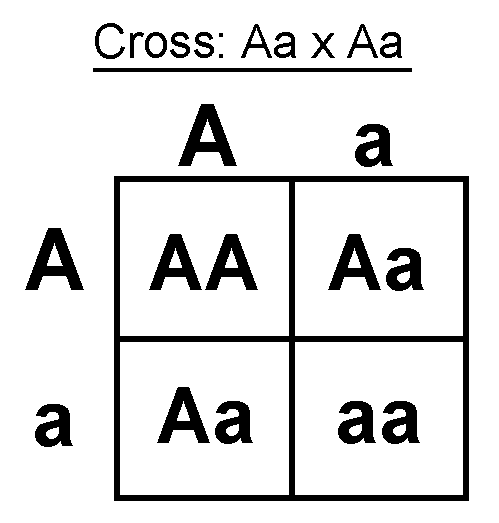
G = green, g = yellow
The genotype for a yellow plant is...
a)
GG
b)
Gg
c)
gg
d)
all of the choices result in yellow
27.
What is the phenotype of the offspring? (A-Brown hair; a-blond hair) 
a)
50 % Brown Hair and 50% Blond Hair 
b)
25 % Brown Hair and 75% Blond Hair 
c)
75 % Brown Hair and 25% Blond Hair 
d)
0% Brown Hair and 100% Blond Hair 
28.

How many alleles does a child get from each parent for a trait?

a)

1

b)

2

c)

3

d)

4

29.

How many individuals are there in the 3rd generation?

a)

1

b)

2

c)

4

d)

6

30.
The daughter cells in mitosis are...
a)
Identical
b)
Unique
31.
The cells produced in meiosis are...
a)
Identical
b)
Unique
32.
Sperm and Egg cells are produced using which process?
a)
Mitosis
b)
Meiosis
c)
Binary Fission
d)
None of these
33.
In mitosis, the two resulting cells are...
a)
Different from the starting cell and identical to each other.
b)
Different from the starting cell and different from each other.
c)
Identical to the starting cell and different from each other.
d)
Identical to the starting cell and identical to each other.
34.
In meiosis, the haploid number of chromosomes in a human sex cell (egg or sperm) is:
a)
46
b)
92
c)
30
d)
23
35.
When a cell divides, what do we call the 2 new cells?
a)
mother cells
b)
father cells
c)
daughter cells
d)
son cells
36.
You inherited...
a)
most of your chromosomes from your mother
b)
most of your chromosomes from your father
c)
a random number of chromosomes from each parent
d)
half your chromosomes from your mother and half from your father.
37.

​ (a)   are always expressed when the connected allele is dominant, even if only one copy of the dominant trait exists. ​ (b)   are expressed only if both the connected alleles are recessive.

Choose from the below words
Dominant traits
Recessive traits
38.
Question Image

​ Match the image with the correct vocabulary word.

a)
1.

DNA

an organic chemical that carries all information of a living thing

b)
2.

Chromosome-

threadlike structures that carry information about the organism in units called genes

c)
3.

Cell-

the smallest unit with the basic properties of lifeand made of molecules

39.

The gender of the oldest child from parents 1 & 2 is​ ​ ​ (a)  

Choose from the below words
male
female
40.

​ (a)   is the transfer or passing of traits from one generation to the next generation.

Choose from the below words
Heredity
Dominant
Recessive
DNA
Gene
41.

​ (a)   is the PASSING of ​ (b)   from parents to offspring. ​ (c)   is WHAT is passed down through generations. ​ (d)   is the study of ​ (e)   .

Choose from the below words

Heredity

Genetics

heredity

Inheritance

traits

42.

A​ (a)   shows its specific trait when both parents pass the

gene to the child.

Choose from the below words
recessive trait
dominant trait
inherited trait
acquired trait
43.

The information in ​ (a)   is passed from parents to offspring when organisms reproduce.

Choose from the below words
DNA
RNA
44.

How many chromosomes are in a human haploid cell?

45.

The purpose of mitosis is ​ ​ (a)   and the purpose of meiosis is ​ (b)   . Mitosis makes ​2 cells that are ​ (c)   and meiosis make ​ (d)   cells that are ​ (e)   .

Choose from the below words
growth and repair
for sexual reproduction
Identical
4
nonidentical
2
46.

Label the stages of mitosis

47.

5.A

Drag and drop the names of the steps of mitosis in order according to the picture.

1. ​ (a)   2. ​ (b)   3. ​ (c)   4. ​ (d)  

Choose from the below words
Prophase
Metaphase
Anaphase
Telophase
48.

At the end of mitosis there are ​ ​ (a)   daughter cells.

Choose from the below words
two
four
one
49.

Mitosis is used for (a)   and meiosis is used for ​ (b)   ​ ​

Choose from the below words
growth and repair
production of sex cells.
50.
What process, and which type of resulting cells are represented?
a)
mitosis, gametes
b)
mitosis, body cells
c)
meiosis, gametes
d)
meiosis, body cells
