Wayground logo

Free Printable Worksheets

Font size

S
M
L
XL
Worksheets

EOC Review - again :)

Total questions: 63

Worksheet time: 4hrs 37mins
Name
Class
Date
1.
If a system of equations has no solution, what does the graph look like? 
a)
intersecting lines
b)
parallel lines
c)
skew lines
d)
intersecting lines
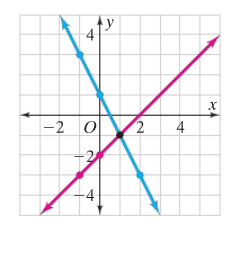
2.
What is the solution?
a)
(1, -1)
b)
(-1, 1)
c)
(0, -2)
d)
(0, 1)
3.
Solve the system of equations.
y = 4x+1
3x + 2y = 13
a)
(1, 5)
b)
(5, 1)
c)
(0.25, 2)
d)
∅
4.
Solve the system of equations: 
a)
( -2, 3, -3)
b)
None of these
c)
( -2, -3, 3)
d)
( -3, 3, -2)
5.
Find the solution:
y = x2 - 4x + 6
y = x + 2
a)
(3, 1) and (6, 4)
b)
(-1, 1) and (4, 2)
c)
(1, 3) and (4, 6)
d)
(1, 4) and (3, 6)
6.

How many solutions does this system of equations have?

a)

one solution

b)

two solutions

c)

three solutions

d)

no solutions

7.

What is the complex conjugate of  4 - 3i?

a)
A.  1/(4-3i)
b)
B. 1/(4+3i)
c)
C.  -4 + 3i
d)
D.  4 + 3i
8.
What is the equation for the axis of symmetry?
a)
y=3
b)
x=3
c)
x=5
d)
x=1
9.
What is the green dot on the parabola called?
a)
maximum
b)
minumum
c)
roots
d)
zeros
10.
Find the y-intercept of f(x) = 2x2 - 2x + 1
a)
2
b)
-2
c)
1
d)
-1
11.
Does y = -4x2 have a maximum or minimum value?
a)
maximum
b)
minimum
12.
What is the vertex of the quadratic function:
y = x2 - 6x + 11?
a)
(3,2)
b)
(-3,-2)
c)
(-3,2)
d)
(3,-2)
13.
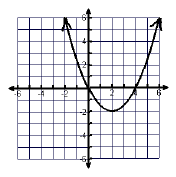
Which of the following is the correct equation for the given graph?
a)
f(x) = (x - 2)2 - 1
b)
f(x) = (x + 2)2 - 1
c)
f(x) = -(x + 2)2 - 1
d)
f(x) = -(x - 2)2 - 1
14.
The axis of symmetry line passes through which point?
a)
y-intercept
b)
any random point
c)
vertex
d)
none of these
15.
What are the x- intercepts?
a)
x= 0 and x= -4
b)
x= 0 and x= 4
c)
y= 0
d)
x= 2
16.
Identify the vertex and whether the graph opens up or down.
a)
(-1, 4); opens up
b)
(-1, 4); opens down
c)
(1, 4); opens up
d)
(1, 4); opens down
17.
What is another name for the x-intercepts of a quadratic?
a)
y-intercepts
b)
zeros
c)
x-axis
d)
none of these
18.
Solve 2(x-1)2 = 32
a)
x= -3, 5
b)
x= -4, 4
c)
x= 3, 5
d)
x= 2, 6
19.
How many zeros does this parabola have? 
a)
3
b)
2
c)
0
d)
1
20.
What does i2 = ?
a)
-1
b)
√-1
c)
1
d)
-√1
21.
Simplify
2i - 7i + 10
a)
-5i+10
b)
5i
c)
9i+10
d)
5i+10
22.
Simplify
3i - (4 + 7i)
a)
-4 + 10i
b)
21 - 12i
c)
4 - 10i
d)
-4 - 4i
23.
Multiply
(2i)(3i)
a)
5i
b)
-5
c)
6i
d)
-6
24.
(x-3)2
a)
x2-6x+9
b)
x2 - 9
c)
x2 + 9
d)
x2 
25.
(3x - 2)(6x + 1)
a)
21x2
b)
18x2 + 9x + 2
c)
9x2 - 9x - 2
d)
18x2 - 9x - 2
26.
Simplify the expression.
(4n4 - 8n + 4) - (8n2 + 4n4 + 1)
a)
-8n2 - 8n + 3 
b)
-7n2 - 8n + 3 
c)
-6n2 - 8n + 3
d)
-7n2 - 4n + 3
27.
Classify by the DEGREE:
3x - 2
a)
1
b)
2
c)
3
d)
4
28.
Classify by the DEGREE:
4x3 - 5x2 + 2x - 1
a)
1
b)
2
c)
3
d)
4
29.
The degree of a polynomial can be determined by the largest powered monomial of the polynomial.  
What is the degree of the polynomial:
f(x) = 3x2 + 4x - 5
a)
Degree 2  (quadratic)
b)
Degree 3 (cubic)
c)
Degree 4 (quartic)
d)
Degree 5 (quintic)
30.
The degree of a polynomial can be determined by the largest powered monomial of the polynomial.  
What is the degree of the polynomial:
f(x) = -5x4 - 3x + 2
a)
Degree 2 (quadratic)
b)
Degree 3 (cubic)
c)
Degree 4 (quartic)
d)
Degree 5 (quintic)
31.
The degree of a polynomial can be determined by the largest powered monomial of the polynomial.  
What is the degree of the polynomial:
f(x) = -4x3 + 5x - 2
a)
Degree 2 (quadratic)
b)
Degree 3 (cubic)
c)
Degree 4 (quartic)
d)
Degree 5 (quintic)
32.

What can we expect the end behavior to be on the graph of the function: f(x)=2x3−x+5f\left(x\right)=2x^3-x+5  

a)

Rises on the left and right

b)

Rises on left, falls on right

c)

Falls on the left, rises on the right

d)

Falls on the left and right

33.

What can we expect the end behavior to be on the graph of the function: f(x)=−3x2+6f\left(x\right)=-3x^2+6  

a)

Rises on the left and right

b)

Rises on left, falls on right

c)

Falls on the left, rises on the right

d)

Falls on the left and right

34.

What can we expect the end behavior to be on the graph of the function: f(x)=−7x5+4x4+5x3−2x2+9f\left(x\right)=-7x^5+4x^4+5x^3-2x^2+9  

a)

Rises on the left and right

b)

Rises on left, falls on right

c)

Falls on the left, rises on the right

d)

Falls on the left and right

35.

Is the degree of the graphed polynomial even or odd?

a)

Odd

b)

Even

36.

Is the degree of the graphed polynomial even or odd?

a)

Even

b)

Odd

37.

Using the graph, what can we assume about the equation?

a)

Degree - Even

Leading Coefficient - Positive

b)

Degree - Odd

Leading Coefficient - Positive

c)

Degree - Even

Leading Coefficient - Negative

d)

Degree - Odd

Leading Coefficient - Negative

38.

Using the graph, what can we assume about the equation?

a)

Degree - Even

Leading Coefficient - Positive

b)

Degree - Odd

Leading Coefficient - Positive

c)

Degree - Even

Leading Coefficient - Negative

d)

Degree - Odd

Leading Coefficient - Negative

39.

Using the graph, what can we assume about the equation?

a)

Degree - Even

Leading Coefficient - Positive

b)

Degree - Odd

Leading Coefficient - Positive

c)

Degree - Even

Leading Coefficient - Negative

d)

Degree - Odd

Leading Coefficient - Negative

40.

Using the graph, what can we assume about the equation?

a)

Degree - Even

Leading Coefficient Positive

b)

Degree - Odd

Leading Coefficient Positive

c)

Degree - Even

Leading Coefficient Negative

d)

Degree - Odd

Leading Coefficient Negative

41.
Based on the end behavior of the polynomial, what best describes the leading coefficient?
a)
a negative real number
b)
 a positive real number
c)
an even real number
d)
an odd real number
42.
Based on the end behavior of the polynomial, what is the degree of the polynomial?
a)
a negative real number
b)
a positive real number
c)
an odd real number
d)
an even real number
43.
Which point does not represent a zero of a polynomial?
a)
(-2, 0)
b)
(-1, 0)
c)
(0, 4)
d)
(2, 0)
44.
Based on the end behavior which option best describes the leading term?
a)
negative coefficient, even degree
b)
negative coefficient, odd degree
c)
negative degree, odd coefficient
d)
negative degree, even coefficient
45.
What are the linear terms of the polynomial function?
a)
(x-2)(x-1)(x+1)(x-2)
b)
(x-2)(x-1)(x+1)(x+2)
c)
(x-2)(x-1)(x+1)(x+2)(x-4)
d)
(x-2)(x-1)(x+1)(x+2)(x+4)
46.
What is the least degree of the polynomial?
a)
2
b)
4
c)
3
d)
5
47.
What are the zeros of the polynomial?
a)
X=5, x=-3(multiplicity of 2)
b)
x=-3, x=5(multiplicity of 2)
c)
x=3, x=-5
d)
x=5
48.
Classify the polynomial by degree.
a)
quartic
b)
quintic
c)
6th degree polynomial 
d)
7th degree polynomial
49.
What is the end behavior as x → -∞ f(x)→ ?
a)
-∞
b)
∞
50.
How many relative extrema(tuning points) are in the picture?
a)
2
b)
3
c)
4
d)
5
51.

Find the inverse function

a)
b)
c)
d)
52.

State if the given functions are inverses.

a)

yes

b)

no

53.

State if the given functions are inverses.

a)

yes

b)

no

54.
Let f(x) = 3x2 - 9x +2.
Is k = -3 a zero of the function?
a)
yes
b)
no
55.
Let f(x) = 4x2 -33x -27.  Is k = 9 a zero of the function?
a)
yes
b)
no
56.
(2x3 + 5x2 + 9) ÷ (x + 3)
a)
2x2 - x + 3
b)
2x3 - x2 + 3x
c)
2x2 + 11x + 33 + 108/x+3
d)
2x2 - 5x + 12
57.
Use synthetic division:
(2x3 - 5x - 7) ÷ (x - 2)
a)
2x3 - 4x2 + 3x - 13
b)
2x3 + 4x2 +3x - 1
c)
2x2 - 4x + 3 - 13/x-2
d)
2x2 + 4x + 3 - 1/x-2
58.
What is the remainder R when the polynomial p(x) is divided by (x-5)?
p(x) = x3 - 5x2 + 2x - 10
a)
0
b)
2x-10
c)
-2x-10
d)
2x+10
59.
What is the proper way to write the answer for the following problem? 
a)
2x3-x2-25x-12
b)
2x4-x3-25x2-12x+0
60.
What is the remainder when      a3 - 4 is divided by a+2? 
a)
-2
b)
-6
c)
-12
d)
0
61.
Which term is missing in this problem?
(2x3 + 5x2 + 9) ÷
(x + 3)
a)
x4
b)
x3
c)
x2
d)
x
62.
Decide if (x-3) is a factor of 3x3+10x2-x-12
a)
Yes, it is a factor!
b)
No, it is not a factor!
63.
Find all the zeros, given that f(-3) = 0
f(x) = 2x3+5x2-6x-9
a)
-1,-3,-3
b)
-1,-3,3/2
c)
3,3,3
d)
-3,2/3,-1