
Font size
 Worksheets
8th Grade MEGA STAAR Review
Total questions: 231
Worksheet time: 2hrs 5mins
A person’s body is thrown outward as a car rounds a curve on a highway.
Newton's 1st Law
Newton's 2nd Law
Newton's 3rd Law
None of them

The Law of Action Reaction
Henry sees a basketball and decides to put in motion. What kind of force does Henry use to move the ball?
small
balanced
equal
unbalanced
Which activity would BEST demonstrate Newton's law of Inertia?
A plate sits on a table top.
A lady pushes a grocery cart.
A child jumps on a trampoline.
A boy swings a baseball bat.
What is the name of Newton's 1st Law of Motion?
Law of Force and Acceleration
Law of Action / Reaction
Law of Inertia
When there is an INCREASE in MASS of an object you will have a DECREASE in ______________.
friction
acceleration
force
gravity
Unblanced forces always accelerate.
True
False
What is the unit of measurment for force?
N
Kg
m/s
m/s2
Lines that show areas that have the same elevation
Aging Lines
Check Out Lines
Contour Lines
Waiting Lines
Close contour lines indicate
steep slope
gradual slope
Spread out contour lines indicate
steep slope
gradual slope
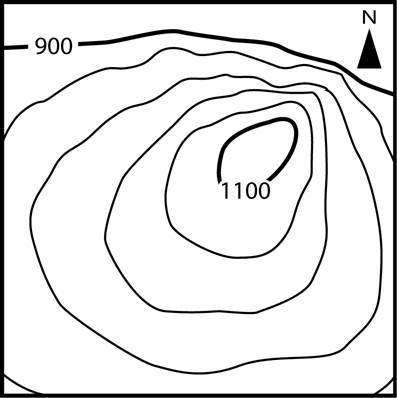
The steepest slope on this hill can be found on the side that is facing which direction?

Boundary between two plates where the plates are sliding past each other
Divergent-
Convergent-
Transform-
Forms where plates are moving away from each other
Divergent-
Convergent-
Transform-
Formed where two sections of Earth’s crust are colliding
Divergent-
Convergent-
Transform-

Most geologists think that the movement of Earth’s plates is caused by _______
convection.
continental drift.
subduction.
conduction.
A place where two plates slip past each other, moving in opposite directions, is known as a _______
transform boundary
divergent boundary.
convergent boundary.
rift valley.
A divergent boundary in the ocean creates what feature?
Mid Ocean Ridge
Rift Valley
Deep Ocean Trench
Subduction Zone
Sudden movement of an object is caused by
it's mass
it's weight
balanced forces
unbalanced forces
When two oceanic plates collide they form all of the following except:
Arch Islands
Volcanoes
Trench
Mid-Ocean Ridge
Rift valleys occur when two
continental plates collide
contiental plates move away from each other
oceanic plates collide
oceanic plates move away from each other
What was missing from Alfred Wegener's hypothesis on continental drift?
Earth's mantel has several layers
Convection currents in the Earth's mantel move the crustal plates
Earth's crust is the thinnest layer of Earth
Pangea proved his hypothesis and nothing was missing.
If an Oceanic and Contiental plates collide what will occur?
A mid ocean ridge will form
The oceanic crust will rise above the continental crust
The oceanic crust will subduct beneath the continental crust
Which is more dense and will subduct beneath another plate?
Oceanic Crust
Continental Crust
What forms at a transform boundary?
a ridge
a valley
a subduction zone
a fault line
As magma rises from a subduction zone what may form?
sea floor spreading
volcanos
rift valley
What forms at a convergent boundary of two continental plates?
sea floor spreading
mid-ocean ridge
folded mountains
volcanic islands
Hawaii is formed by a
convergent boundary
divergent boundary
transform boundary
as it moves over a hot spot
Continental Drift theory lead to the modern day theory of plate tectonics.
True
False
As two oceanic plates move away from each other magma will rise and create new crust, this is called sea floor spreading.
True
False
Check which are true about contour lines on a topographic map:
They connect equal points of elevation
They never cross each other
They show topography of the land shapes and spacing
The V shape formed by the bend in contour lines shows the source of a river or stream.
True
False
Rivers and streams always flow uphill.
True
False
Which would have more errosion from ocean waves
Beach area at sea level
Inland bays
Alfred Wegener's idea of continental drift is the basis for what modern day theroy?
Tidal Arrangement
Plate Tectonics
Magma Conversion
Universal Gravitation
A crack in the middle of a plate allows magma to come through and create volcanic activity. This is known as a
Earthquake
Convergent Boundary
Hot Spot
Which of the following shows a divergent plate boundary?


Arch Islands are the result of
Two oceanic plates converging
Two oceanic plates diverging
Two continental plates converging
Two continental plates diverging
If given mass and acceleration, how would you find the force of an object?
Multiply
Divide
Add
Subtract
The earth receives more direct sunlight in the northern hemisphere when
the northern hemisphere is closer to the sun
the southern hemisphere is closer to the sun.
the northern hemisphere is tilted towards the sun
the southern hemisphere is tilted towards the sun.
What causes earth's seasons
the earth's tilt on it's axis and it's orbital position around the sun
the earth's rotational speed
the earth's revolution speed
The equator almost always receives direct sunlight and has less variation in temperatures thoughout the year.
True
False
How long does it take the Earth to rotate on it's axis ?
6 hours
12 hours
24 hours
What is the longest day of the year in the southern hemisphere?
December 21
March 21
June 21
September 21
What is the longest day of the year in the northern hemisphere?
December 21
March 21
June 21
September 21st
If there is a full moon on July 1st, when is the next possible New Moon?
July 8
July 15
July 21
July 28
If th earth is no longer tilted on it's axis then we would have more seasons.
True
False, there would be no seasons
If Earth's rotation were to speed up
the days would be shorter
the years would be shorter
the days would be longer
the years would be longer

The image above shows the alignment of a Neap Tide. Neap tides have the
greatest amount of difference in high and low tide.
the least amount of difference in high and low tide.
A spring tide has the greatest amount of difference in high and low tides. When does this occur
When the the moon is at a 90 degree angle from the sun and earth
When the sun, earth and moon are lined up in a stragiht line, during new or full moon
When there is a 1st or 3rd quarter moon.
Approximately how much times passes from a New Moon to a Full Moon?
1 week
2 weeks
3 weeks
4 weeks
When the souther hemisphere is tilted towards the sun it is experiencing summer, what is the northern hemisphere experiencing?
Fall
Winter
Spring
After a full moon what are the next three phases?
1st quarter, wanning gibbous, waxing crescent
waning gibbous, 3rd quarter, waning crescent.
waning gibbous, 3rd quarter, new moon
During the spring equinox our day and night hours are equal.
True
False
During which season do we receive the most sunlight hours.
Winter
Spring
Summer
Fall

During which position is it summer?
1
2
3
4

During which position is the northern hemisphere experiencing spring?
1
2
3
4
if I have 50 N of force and 10kg of mass, what would my acceleration be?
2 m/s2
5 m/s2
50 m/s2
What forms at a convergent plate boundary with a subduction zone?
Mid-Ocean Ridge
Trench, Volcano, Mountains
Rift Valley

Which has longer wavelengths?
Radio
Visible
Gamma
X-ray
Stars form in giant clouds of gas and dust. What are these clouds called?
Black Hole
White Dwarf
Super Nova
Nebula
Which component of the universe contains all other components listed below and would have the greatest mass?
Solar system
Nebula
Galaxy
Planetary System
When a mass of hydrogen has enough density, it begins to fuse the hydrogen atoms together. This produces heat and light. What is this classified as?
nebula
star
galaxy
planet
Where did the Sun form?
From a nebula outside of the Milky Way Galaxy
From a large cloud of gas and dust in a nebula called the Milky Way Galaxy
Near the outer edge of the Milky Way Galaxy. After its formation, it interacted with other planets to form comets
The Sun was formed in a nebula in the Milky Way Galaxy.

Which describes the location of star A correctly?
Star A is less bright than the Sun and has a surface temperature above 25,000 K
Star A is brighter than the Sun and has a surface temperature below 25,000 K
Star A is less bright than the Sun and has a surface temperature of above 11,000 K
Star A is brighter than the Sun and has a surface temperature below 11,000 K.

Which type of stars belong to spectral class K and have the lowest luminosity?
Giants
White Dwarfs
Supergiants
Main-Sequence stars
Which of these correctly identifies different objects in the universe according to their size and composition?
A nebula is larger than a galaxy
a solar system contains many stars
a galaxy contains many solar systems
a galaxy is bigger than a universe
Where in the Milky Way is Earth found?
Our Sun is in the middle of the galaxy
about 1 light year from the middle of the galaxy
It varies depending on how it rotates
Near the outer edge of the galaxy
What is the nearest star to planet Earth
Moon
Sun
Sirius
Proxima Centauri
Which describes the Sun and the Milky Way?
The Sun is a medium sized star near the edge of a disc shaped galaxy
The Sun is a massive star near the edge of a disc shaped galaxy
The Sun is a dwarf sized star near the edge of a disc shaped galaxy
The Sun is medium sized star near the middle of a disc shaped galaxy
What can be determined about stars using wavelengths from the electromagnetic spectrum?
distance, chemical compostion
distance, chemical composition, temperature, luminosity
distance, temperature, luminosity
chemical composition, temperature

Our Sun is classified as an average star. This places it in the middle of which type of star on the HR diagram?
Main sequence
White dwarf
Red giant
Super giant

Which stars have the greatest luminosity according to this HR diagram?
Hot white dwarf
Hot main sequence star
Cool super giant
Cool giant

Which galaxy is the largest in the local group?
Milky Way
Andromeda
Triangulum
Le Gentil

How far is Proxima Centauri from the Earth ?
4.3 km
43 km
43 trillion km
430 trillion km

How long would it take light from Proxima Centauri to reach Earth?
1 year
4.3 years
43 years
10 trillion
It takes light approximately 8 minutes and 20 seconds for light from the Sun to reach Earth. Which is true about Earth's distance from the Sun
The Sun is much less than 1 light year from Earth
The Sun is 1 light year from Earth
The Sun is 8.33 light years from Earth
The Sun is so hot it burns
Why does our Sun, an average sized star, appear so much brighter than other more massive stars?
The Sun is lit
The Sun is closer to Earth than other stars
The Sun is made of different elements
The Sun is prettier so it shines brighter
2. Subatomic particles that have a negative charge
electrons
atoms
protons
neutrons
3. The number 16 for the atomic element sulfur is the
ionic number
atomic mass
isotope
atomic number
4. An elements in group 18 are non reactive, stable, and inert because
they have 3 valence electrons and a full outer shell
they have no valence electrons and a full outer shell
they have 8 valence electrons and a full outer shell
5. Which of these determines the reactivity of the element on a periodic table?
The number of protons
The number of neutrons
The number of electrons
The number of valence electrons
Which of the following would change the name of the element if one was added or removed from the atom?
neutrons
protons
valence electrons
electrons
The elements Potassium, Vanadium, Manganese and Calcium are examples of
Members of a period
Members of a family
Molecules
Gases
The atom that has an atomic mass of 12 has ____________ protons.
6
8
1
4

Which of these is the most reactive non-metal element?
Atom 1
Atom 2
Atom 3
Atom 4
Elements to the right of the stair step on the periodic table are
Metals
Non Metals
Metalloids
Elements on the stair step on the periodic table are
Metals
Non Metals
Metalloids
Which of the following are properties of non-metals? (Check all that apply)
Brittle
Dull
Shinny
Bad conductor of heat and electricity
Higher Melting Point
Which of the following are properties of metals? (Check all that apply)
Brittle
Dull
Shinny
Good Conductors of Heat and Electricity, and higher melting point
Malleable
Which characteristic is most closely related to the reactivity of an element?
Number of Protons
Number of Neutrons
Number of Valence Electrons
An element that would react the same as Helium (He)
would have the same number of valence electrons on the outter energy level
would be in the same period as helium
would have 8 valence electrons on the outter energy level
In order to determine if two atoms are the same element, what must be the same for each?
Number of Protons
The charge of the atom
Number of electrons
The size of the atom
An atom would loose the least amount of mass if it lost it's
protons
neutrons
electrons
What is the mass number of an atom if it has 20 protons, 22 neutrons, and 20 electrons?
20
22
40
42
Which image shows the correct structure of an atom?


What determines the identity of one element from another?
Number of Electrons
Number of Protons
Number of Neutrons
What do elements in Group 2 on the periodic table have in common?
They have the same atomic number
They have the same mass
They have the same number of energy levels
They have the same number of valence electrons
An atom of a certain element has 54 protons, 54 electrons and a mass number of 128. How many neutrons does the atom have?
54
74
108
128
What is the mass number of an atom that has 5 protons, 5 electrons, and 11 neutrons?
5
6
16
21
Where would you find elements of the same chemical properities and reactivity on a periodic table?
In the same group/family
In the same period

Which of these atoms are in the same group on the periodic table and have the same number of valence electrons (select all that apply)?
Atom 1
Atom 2
Atom 3
Atom 4
Which of these atoms is the least reactive?
Atom 1
Atom 2
Atom 3
Atom 4

Which of these sections on this periodic table include metals?
A
B
C
D
Which of these statments below describes the element Carbon (C) found on the periodic table? (Click all that apply)
Carbon has 6 Protons
The atomic number for Carbon is 6
The atomic mass for carbon is 12
Carbon has an atomic number of 12
Carbon is a Metal
How many Nitrogen atoms are in Al(NO3)3 ?
3
6
12
13
How many atoms are there of each element in Al2(SO4)3?
6 Aluminium, 3 Sulfer, 12 Oxygen
2 Aluminum, 3 Sulfer, 12 Oxygen
2 Alumninum, 3 Sulfer, 7 Oxygen
How many elements are in NaSO4?
1
2
3
How many Nitrogen are in (NH4)3PO4?
1
2
3
Na2SO4 -------> 2Na + SO4
Which of the following are the products?
Na2SO4
2Na + SO4
Na2SO4 -------> 2Na + SO4
How many total atoms of Sodium (Na) are there on the reactant side of the formula?
1
2
3
4
In an open system experiement, why would there be less mass in the product than the reactant?
The reactants were combined into only one product
One of the products was a gas that escaped into the air.
All of the products are liquids
What is the best evidence that a chemical reaction has occured?
the shape changes
oxygen is present
a new substance is formed
it is made up of more than one element
CaCl2 + Na2SO4 --------> Ca(SO4) +NaCl
110g + 142g --------> ?? + 116
110
142
136
252
Which observation is evidence of a chemical reaction?
hot water added to the pan
liquid solution changed color
hot water cooled
baking soda dissolved in the water
Is the following formula balanced?
H2O2 --------> 2H + 2O
Yes
No
Which two of these are NOT evidence of a chemical reaction?
Production of a gas (bubbles)
Phase change (solid to liquid)
Crystals dissolving
Precipitate forms
How many atoms are in C10H12
10
12
22
Which of the following are compounds? Click all that apply.
H2O
H2O2
He
Fe2O3
Fe
The total mass of the reactants must equal the total mass of the product.
True
False
Milk turning sour is due to a chemical change.
True
False
Which of the following are elements only? Click all that apply.
H2O
H2O2
He
Fe2O3
Fe
Which of the following are evidence of a chemical reaction?
gas is produced
crystals dissolve
a precipitate forms
temperature change
The mass movement of heated paticles into an area of cooler particles.
Convection
Climate
Environment
The atmospheric conditions that occur from season to season and year to year with in a specific region.
weather
climate
convection
The uneven heating of the earth's surface directly affects the weather.
True
False

High pressure systems create what type of weather?
nice sunny day
hurricanes
thunderstorms
Low pressure systems move counter clockwise.
True
False
Air masses sink, making it difficult for clouds to form
Low Pressure System
High Pressure System
Low pressure systems form which of the following: (check all that apply)
Clear Sunny Weather
Hurricanes
Stormy weather
Why is the ocean warmer at the equator?
The equator is closer to he sun.
The equator receives more direct sunlight
The equator has higher sea levels
Convection in ocean currents occurs when warm waters which are heated by the sun, loose their heat and then sink as they become cooler and more dense.
True
False
Warm ocean currents move towards the equator and cold currents move toward the equator.
True
False

Hurricanes form during certain times of the year when a low pressure system occurs over warm ocean waters.
True
False
Which symbol below indicates that cold air is sinking and pushing warmer air upward?


High pressure systems that push cold air downward often accumulate unstable moist air ahead of it causing severe storms.
True
False
Energy from the sun is transfered by which of the following?
Convection
Conduction
Radiation
Energy from the sun heats up the oceans and then is distributed throughout the Earth by distribution of convection currents.
True
False
Althought deep currents in the ocean are affected by convection, what affect surface level currents?
Low pressure weather systems
Global Winds
Salinity of the water
A boundary that happens when two air masses collide but do not mix.
ecosystem
climate
thunderstorms
front
Which symbol below indicates that cold air meets with warm air and neither move causing a stationary front?
Which symbol below indicates that warm air is trapped by cold air creating an occluded front?

If you see this symbol approaching Houston on a weather map, what type of weather can you expect in the next 24 hours?
decease in temperatures
increase in temperatures
Meterologiest can easily forcast the direction and path of a hurricane.
True
False
The force of a hurricane dimishes as it moves over land because of loss of warm waters to fuel it's energy.
True
False
The winds of a hurricane alwsy move in a counter clockwise direction in the northern hemisphere.
True
False
Areas like Florida receive warmer weather in the winter because
Florida is closer to the equator
Florida is closer to the warm gulf stream ocean currents
Florida receives less direct sunlight.
The best way to reduce dead zones in our oceans is to:
Add bacteria to eat the algea
Add more fishing boats to those areas
Stop fertilizer and waste from enering rivers and streams
Artificial reefs form in the ocean when we sink a shipwreck. How does this occur?
the fuel from the ship becomes food for the marine life
the ship releases oxygen from the surface when it lands
It provides a hard surface for marine life to attach to
Storms that form over the colder ocean waters create more violent storms.
True
False


The islands that have formed off the Texas Gulf are
sand dunes
lagoons
barrier islands
sea stacks


Click on the picture to answer the question. What is true about a food web?
It is just 1 path of energy.
It is all possible energy paths.

According to the image, what is the producer?
plant
insect
mouse
snake

What level on the energy pyramid contains the most energy?
producer level
primary consumer level
secondary consumer level
tertiary consumer level

The word "primary" means "first."
If that's true, what does primary consumer mean?
Hint: look carefully at the food chain!
the first organism in a food chain
the first organism that consumes something else for energy

According to the image, what is the primary consumer in the food chain?
plant
insect
mouse
snake

According to the image, what is the secondary consumer?
plant
insect
mouse
snake

What kind of organisms are usually at the top of the food chain?
producers
herbivores
omnivores
carnivores
Which of the following is abiotic?
a tree
grass and other vegitation
a hawk
precipitation
Some limiting factors that affect populations include lack of food, lack of water, lack of living space, and the spread of disease.
True
False
Tell if the item is an abiotic factor or biotic.....
Water
Abiotic
Biotic
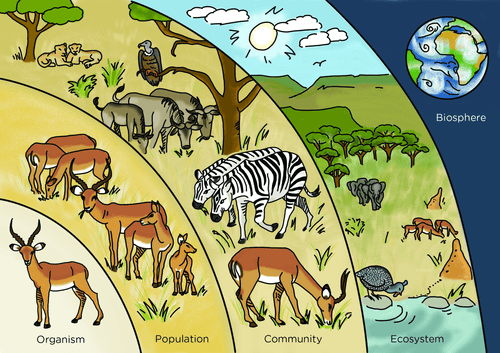
The living world is organized in levels. Biotic and abiotic factors also can be arranged into levels of biological organization. Put the words below in order from the least complex to the most complex
Community, Organism, Biome, Population, Biosphere, Ecosystem
Organism, Population, Community, Ecosystem, Biome, Biosphere
Organism, Biome, Population, Community Biosphere, Ecosystem
What do herbivores eat?
Animals
Plants and Animals
Plants
Dead Animals
What do omnivores eat?
Animals
Plants and Animals
Plants
Dead Animals

What is the hawk in the food web?
Producer
Primary consumer
Secondary consumer
Tertiary consumer
How much energy is transferred between trophic levels?
25%
20%
10%
90%
Which of these is an autotroph?
Consumer
Producer
Decomposer

The bar graph below shows the number of species in
four pond ecosystems.
Based on this information, which ecosystem is likely
to be the most stable?
A
B
C
D

Which of the following organisms compete for the same food source?
grasshoppers and grains
rabbits and mice
mice and grasshoppers
foxes and owls

Which of the following organisms DO NOT compete for the same food source?
grasshoppers and rabbits
hawks and blue jays
owls and hawks
caterpillars and rabbits
As a predator population increases what will happen to the prey population?
It will decrease
It will increase
It will remain the same
Why is it illegal to release non-native animals in the wild?
a non native can reduce the amount of food available for native animals
they are too tame to survive
there will be no food for it to eat
If a invasive pest invades an area and kills other organisms living in that areas what is likely to be true?
it has no natural enemeis to regulate it
it has become a tertiary consumer
it has become an autotrophic organism
If the snake population were removed what would happen to the other populations. in the food web?
The mice and rabbits would increase
The mice and rabbits would decrease
The hawk poulation would increase
Short term changes immediately affect a population.
True
False
Long term changes quickly affect a population over a short period of time.
True
False, they happen gradually

If a polar bear is at the top of an energy pyramid, and is a carnivor, what will he most likely NOT eat on the energy pyramid?
Producers
Primary Consumers
Secondary Consumers
Both Primary and Secondary Consumers
If a chemical spill affected the process of photosynthesis, then would it lead to a decrease in plant populations?
Yes
No
What can you tell about organisms that survive an immediate short term change?
They have adaptations to allow them to survive new coniditions
They will eventually die from the short term effects.

What do the deer eat most in this graph
Grass and feed
Weeds and shrubs
feed and crops
Pond succession is caused by a long-term natural process.
True
False

In the image above which area has more biodiversity?
Zone 1
Zone 2
Zone 3
Omnivores eat producers and primary consumers. What type of consumer might they compete with?
Carnivores and producers
Herbivores and carnivores
Producers and decomposers
Decomposers and herbivores
If an environment change occurs and reduces a food for a consumer, how might this affect the consumer's population?
The consumer population would decrease because they would not have enough food
The consumer population would increase rapitdly because they would have enough food.
The consumer population would stay the same .
In order for a plant to live in a freshwater and saltwater environment it would nedd to be able to filter excess salt.
True
False

How many organisms only eat plants?
1
2
3
The living world is organized in levels. Biotic and abiotic factors also can be arranged into levels of biological organization. Put the words below in order from the least complex to the most complex
Community, Organism, Biome, Population, Biosphere, Ecosystem
Organism, Population, Community, Ecosystem, Biome, Biosphere
Organism, Biome, Population, Community Biosphere, Ecosystem
What can you tell about organisms that survive an immediate short term change?
They have adaptations to allow them to survive new coniditions
They will eventually die from the short term effects.
Dark colored animals in a dark grass field survive better because
they are able to hide from their predators
because they are able to been seen easier for predators to find
because lighter colored organisms are able to reproduce more easily
If organisms in a coral reef were destroyed, what would happen to the coral reef?
other organisms would move in to the reef area
the reef would expand do to less living organism taking up space
the reef would be gin to deteriorate adn decrease without biodiversity to maintain stability
the temperature of the surrounding waters would decrease the number of organisms living in the reef
How does camaflage help an organism adapt and survive? (choose the best answer)
helps them find a habitat
helps them resist disease
helps them avoid predators
helps them defend their offspring
Which of these is most likely to cause a change in genetic traits in an population of ground-swelling lizard species?
mutations that are not passed onto the offspring
an unusually dry summer
introduction of an invasive predator that preys on bright colored-lizards
fast moving wildfire that burns the canopy of the trees in the ecosystem


What type of organisms does the cell theory apply to
bacteria
multicellular organisms
plants and animals
all of the above



