wayground logo

Free Printable Worksheets

Font size

S
M
L
XL
Worksheets

Section 14.6 Taxonomy Phylogeny and Cladistics Quiz for CK12

Total questions: 30

Worksheet time: 40mins

Name
Class
Date
1.

Which is the correct order?

a)

Kingdom Phylum Order Class

b)

Class Order Family Genus

c)

Domain Phylum Kingdom Species

d)

Order Family Species Genus

2.

You find a species that seems to be unicellular and is eating smaller cells around it. It has organelles and a nucleus. Which kingdom is it MOST likely a part of?

a)

Fungi

b)

Bacteria

c)

Protists

d)

Plants

3.

Who first proposed binomial nomenclature as a way of classifying organisms?

a)

Carolus Linnaeus

b)

Aristotle

c)

Charles Darwin

d)

Louis Pasteur

4.

Which of the following scientific names is written correctly? Assume all are in italics!

a)

Homo Sapien

b)

Homo sapien

c)

homo sapien

d)

Homosapien

5.
Which of the following organisms are LEAST closely related?
a)
organisms that share a domain
b)
organisms that share a family 
c)
organisms that share a genus 
d)
organisms that share a species 
6.
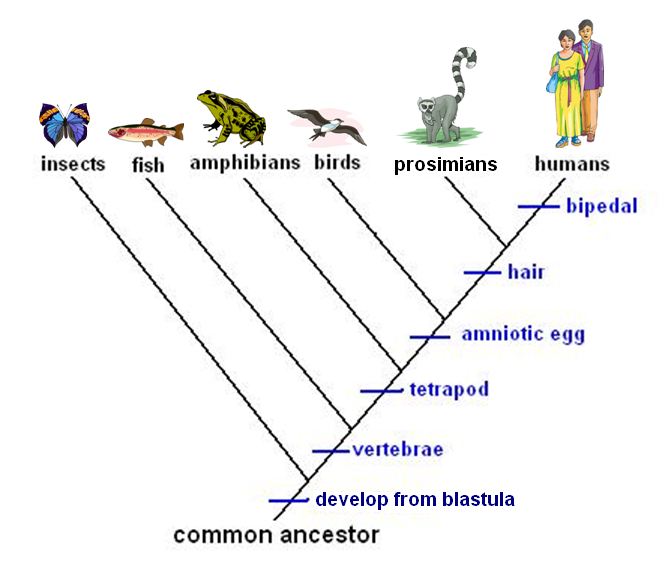
Which organisms pictured on the cladogram have hair?
a)
prosimians only
b)
prosimians and humans
c)
humans only
d)
prosimians and birds
7.
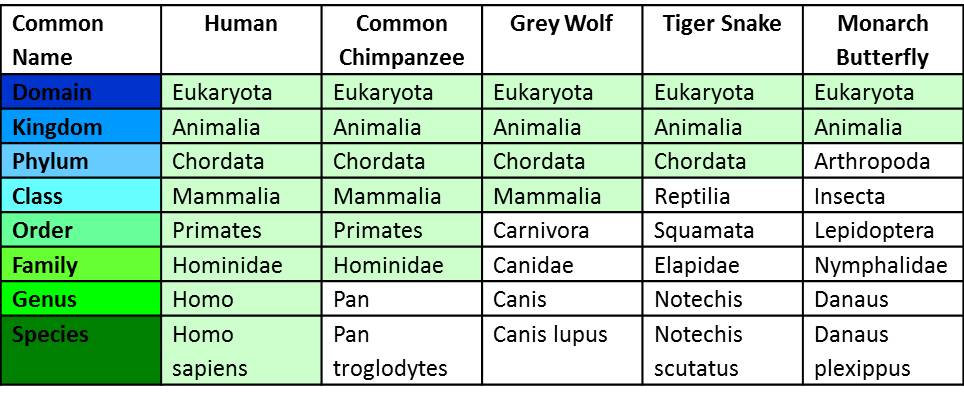
Which organism in the table is least closely related to the chimpanzee?
a)
human
b)
grey wolf
c)
tiger snake
d)
monarch butterfly
8.
An illustration and a dichotomous key are given. What is the correct classification for this organism?
a)
Class Insecta
b)
Order Amblygygi
c)
Order Araneae
d)
Order Scorpiones
9.
A student discovers an arachnid with a segmented abdomen, long legs, and a tail with no stinger. The student uses the dichotomous key below to identify it. Which arachnid has the student found?
a)
Whip Scorpion
b)
Wind Scorpion
c)
Daddy long legs
d)
Scorpion
10.
Which group(s) of organisms do not have vertebrae?
a)
lampreys and lancelets
b)
lampreys and tuna
c)
lancelets only
d)
salamanders, tuna, and lampreys
11.
The written set of choices leading to an organism's name is a(n)
a)
Cladogram
b)
Instructions
c)
Dichotomous key
d)
Binomial nomenclature
12.

Phylogeny is...

a)

The study of classification of different species

b)

The study of the evolutionary history of a species

c)

The study of prehistoric life

d)

The study of the distribution of different species

13.

Places on a phylogenetic tree where organisms share a common ancestor are called...

a)

Nodes

b)

Branches

c)

Taxa

d)

Species

14.

All life is classified into _______ domains based on common characteristics.

a)

2

b)

3

c)

4

d)

5

15.
What is a species?
a)
A group of organisms that can mate with each other and produce fertile offspring. 
b)
A group of organisms that genetically are very different from each other. 
c)
A group of organisms that can mate and produce offspring even if those offspring are infertile.
d)
Indivual organisms that live in the same environment. 
16.

What traits do the leopard and the turtle share? (3)

a)

hair

b)

amniotic egg

c)

four walking legs

d)

jaws

17.
  Notice the similarities of a shark and dolphin.  If these similarities developed by  common life experiences and not by common ancestry, which of the following vocabulary words would best describe them?
a)
a.  Vestigial Organ
b)
  b.  Embryological Similarities
c)
c.  Homologous Structures
d)
d.  Analogous Structures
18.
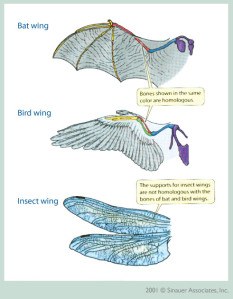
  The diagram shows an image of a Pterosaur wing, bat wing, and bird wing.  These are all different organisms, but share similar wing structures.  If these structures are similar due to common ancestry, which of the following best describes them?
a)
a.  Vestigial Organ
b)
b.  Embryological Similarities
c)
c.  Homologous Structures
d)
d.  Analogous Structures
19.
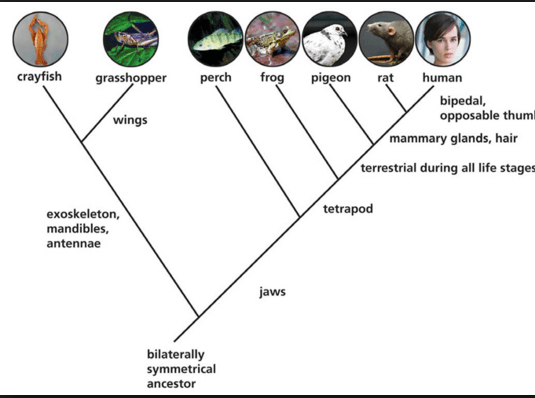
According to the cladogram, which organism is most distantly related to the human?
a)
crayfish
b)
grasshopper
c)
perch
d)
frog
20.

What is the common ancestor of Letters A, B, C, D, E?

a)

1

b)

2

c)

3

d)

4

21.
A branching diagram that represents the proposed phylogeny or evolutionary history of a species or group 
a)
Cladogram 
b)
Cladistics
c)
Phylogeny
d)
Taxonomy
22.

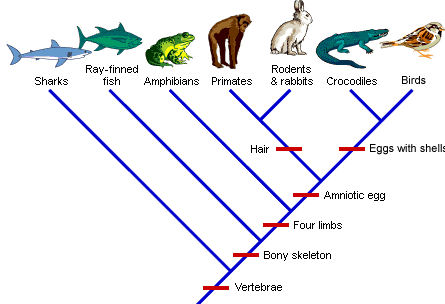
According to this cladogram, primates share a common ancestor with

a)

amphibians

b)

rodents and rabbits

c)

crocodiles

d)

birds

23.

In the cladogram, what type of information would go in

the area labeled B (hash lines)?

a)

shared characteristics

b)

DNA analysis

c)

common ancestors

d)

organisms

24.

In the blank cladogram, what type of information would go on the lines labeled A?

a)

derived characteristics

b)

common ancestors

c)

DNA analysis

d)

organisms

25.

According to this image, which two domains of life are most related?

a)

Bacteria & Archaea

b)

Archaea & Eukarya

c)

Eukarya & Bacteria

26.

Which of these animals does not have/produce an amniotic egg?

a)

Turtle

b)

Leopard

c)

Lamprey

d)

All three of these animals produce the amniotic egg

27.
A method that classifies organisms according to the order that they diverged from a common ancestor 
a)
Cladogram 
b)
Dichotomous Key
c)
Molecular Clock
d)
Cladistics
28.

Placement where two organisms split in a cladogram.

a)

Root

b)

Node

c)

Outgroup

d)

Clade

29.

A common ancestor and all of its descendants are found in their own ________, showing that they are closely related.

a)

Root

b)

Node

c)

Outgroup

d)

Clade

30.

The cladogram shows the relationships of five species I to V.

Which species is/are most closely related to IV?

a)

A. V only

b)

B. II and III

c)

C. III and V

d)

D. II, III and V