
 Worksheets
Science 1206 Physics Review
Total questions: 77
Worksheet time: 1hrs 3mins
Scott travels north 5 miles and then goes west 3 miles before coming straight back south 2 miles. What is his distance?
10 miles
7 miles
8 miles
6 miles
Billy runs 400 meters to Andy's house, turns around, and runs 400 meters back home. What is Billy's distance?
0 meters
400 meters
800 meters
1600 meters
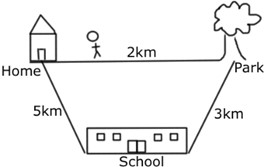
Jerry walked from home to school, then from the school to the park. What is his total distance?
2 km
5 km
8 km
10 km
Number of Significant Digits: 462
1
2
3
4
Number of Significant Digits: 807
1
2
3
4
Number of Significant Digits: 0.307
1
2
3
4
Number of Significant Digits: 0.045
1
2
3
4
Number of Significant Digits: 0.06300
1
2
3
4
What is the equivalency for cm and m?
1000 cm = 1 m
100 m = 1 cm
1000m = 1cm
100 cm = 1 m
Round 700.0 to two significant digits
70
700
7.0
7.0 x 10²
___ refers to how fast an object is moving.
Speed
Velocity
Acceleration
Motion
___ refers to the rate at which an object changes position.
Speed
Velocity
Acceleration
Motion
Which is an example of speed?
A car driving 55 miles per hour south.
A bicyclist traveling 10 meters per hour toward the next town.
A roller coaster is traveling 10 meters per second.
A rocket blasting off at 2,500 meters per second toward space.
Calculate the speed of a dog running through a field if he is covering 23.7 meters in 54 seconds.
0.43 m/s
1,279.8 m/s
1.21 m/s
4.08 m/s
What is the speed of a baseball that travels 49 meters in 2.4 seconds?
20.42 m/s
117.6 m/s
0.05 m/s
13.33 m/s
If a jogger runs for 2,541 meters in a time of 43.6 minutes, what was the speed of the jogger?
0.97 m/s
2.1 m/s
3.44 m/s
6.32 m/s
What is the velocity of a car that traveled a total of 75 kilometers north in 1.5 hours?
50 km/hr north
50 km/hr south
112.5 km/hr
112.5 km/hr north
Velocity has a negative /positive sign for _________, but speed does not.
magnitude
direction
meters
time
How far does a lorry move if it is travelling at 12m/s for 180s?
2160 m
0.06 m
15 m
21.6 m
How long does it take a car to travel 40m at 12m/s?
4.8 s
480 s
3.33 s
33.3 s


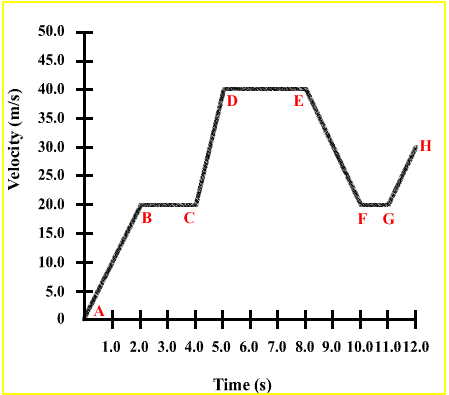


The area under a velocity-time graph represents (a) .

Calculate the distance travelled in section B.
(a)

Calculate the distance travelled in section C.
(a)

Explain the motion from 0-1s
Stationary
Constant speed
Constant acceleration
Non-constant acceleration
Explain the motion from 3-5s
Stationary
Constant speed
Constant acceleration
Non-constant acceleration
Explain the motion from 7-8s
Stationary
Constant speed
Constant acceleration
Constant deceleration
Explain the motion from 8s onwards. The blue line runs along the x-axis. Hint: What is the velocity from 8s onwards.
Stationary
Constant speed
Constant acceleration
Constant deceleration

Explain the motion
Stationary
Constant speed
Constant acceleration
Non-constant acceleration

The acceleration from 3-5s is (a) m/s2.
The acceleration from 0-1s is (a) m/s2.
The deceleration from 5-7s is (a) m/s2.
Calculate the total distance traveled in the first 1s.
(a)
Calculate the total distance traveled in the first 3s.
(a)

At what time does the object switch directions?
15 minutes
40 minutes
10 minutes
30 minutes
Which of the following graphs don't show an object moving in the positive direction?


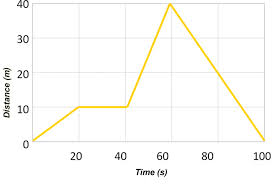


Match the description to the graph:
"The car is coming back."


Match the description to the graph:
"The car is traveling at a constant speed."

Segment B-C The bus is _________________.
at rest
returning (to original position)
moving forward

22m
5m
10m
-10m

4 m/s
-3 m/s
0 m/s
-5 m/s
To determine how far from the detector an object is located on a Position-time graph I should...
Look at the vertical axis at that time
Look at the steepness of the line (slope)
Look at if the slope is positive or negative
Look at the direction of the curvature, if any
To determine which way an object is moving on a Position-time graph I should...
Look at the vertical axis at that time
Look at the steepness of the line (slope)
Look at if the slope is positive or negative
Look at the direction of the curvature, if any

Describe the signs of velocity and acceleration of an object given by this Position-time graph.
velocity = negative, accel = negative
velocity = positive, accel = negative
velocity = negative, accel = positive
velocity = positive, accel = positive

Describe the signs of velocity and acceleration of an object given by this Position-time graph.
velocity = negative, accel = negative
velocity = positive, accel = positive
velocity = negative, accel = positive
velocity = positive, accel = negative

Describe the motion of an object given by this Position-time graph.
speeding up
slowing down
constant speed
not moving

Describe the acceleration of an object given by this Position-time graph.
positive acceleration
negative acceleration
no acceleration

Describe the motion of an object given by this Position-time graph.
not moving then moving backward
moving forward then not moving
moving backward then not moving
moving forward then backward

Given the Position-time graph below, during which interval is the object going the fastest?
0 s to 2 s
2 s to 4 s
4 s to 5 s

Given the Position-time graph below, which way is the object moving at 3 seconds?
forward
backward
not moving

What is the starting point of the object?
2 m
4 m
10 m
20 m

What is the average velocity of this object? Use slope equation.
+ 0.5 m/s
-0.5 m/s
+ 2 m/s
-2 m/s

Which one of the following graphs describes an object that is moving at a constant speed to the left (- direction)?
a.
b.
c.
d.
Which one of the following graphs describes an object that is moving at a constant speed to the right (+ direction)?
a.
b.
c.
d.

Which one of the following graphs describes an object that is moving to the right and slowing down?
a.
b.
c.
d.

