
 Worksheets
Energy, Power and Work 2022 Review
Total questions: 55
Worksheet time: 55mins

What kind(s) of energy is(are) in a person climbing a ladder?
Potential
Kinetic
Both
Need the mass of the person to determine.

As a pendulum swings from its highest to lowest position, what happens to its kinetic and potential energy?
The PE and KE increase and decrease together
The PE decreases while the KE increases
Impossible to know without knowing the mass
The PE and the KE decrease and increase together.

According to the Law of Conservation of energy, the amount of energy before and after a reaction must be the same. Which statement below is true?
The total amount of energy is conserved
The total amount of energy is less after a reaction
The total amount of energy is more after a reaction
Need the mass of the object to determine if energy is conserved.
When velocity triples, kinetic energy increases by ______ times. KE =1/2mv2
9
3
1.5
4.5

What is the Total Mechanical Energy at point A?
500,000 J
400,000 J
200,000 J
50,000 J
What is the Kinetic Energy at point B?
500,000 J
400,000 J
300,000 J
50,000 J
What is the Kinetic Energy at point C?
500,000 J
400,000 J
300,000 J
50,000 J
What is the Kinetic Energy at point D?
500,000 J
250,000 J
300,000 J
50,000 J
What is the GPE at point E?
500,000 J
250,000 J
300,000 J
100,000 J
What is the GPE at point F?
500,000 J
250,000 J
300,000 J
0 J
What is the KE at point F?
500,000 J
250,000 J
300,000 J
0 J
When something is dropped, what type of energy transfer takes place?
Kinetic -> Gravitational Potential
Gravitational Potential -> Kinetic -> Sound
Electrical -> Chemical
Heat -> Nuclear
If two marbles are rolled down a ramp from some height towards a container the _______ marble will move the container farther because it possess more _________ energy as it approaches the end of the ramp.
heavier, kinetic
heavier, potential
lighter, kinetic
lighter, potential

The rollercoaster has both PE and KE, but where will it have more PE than KE?
1
2
3
4
5
A book has 200J of potential energy and then it falls onto the floor. After it hits the floor and is sitting still, what happened to the energy?
It has disappeared.
It goes into the floor and book as thermal energy and sound.
It changes to chemical potential energy.
It turns into gravity.

The skateboarder shown above has a potential energy of 2,800 J and kinetic energy of 0J at a height of 4 meters. How much total mechanical energy will she have after 2 seconds? Neglect friction and air resistance.
2000J
1600J
1400J
2800J
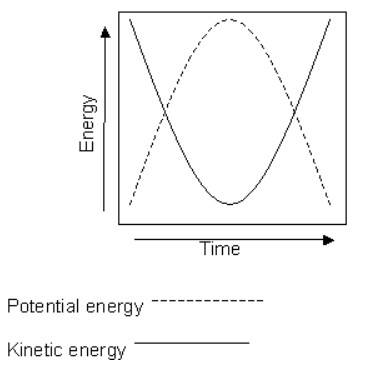
This graph depicts what type of relationship between kinetic and potential energy?
Non-Linear
Linear
Inverse
Poly-atomic


What kind of energy does an object possess when it's resting on top of the hill?
Potential Energy
Chemical Energy
Kinetic Energy
All of the above
What is the formula for Kinetic Energy?
KE = mass x velocity
KE= 1/2 x mass x velocity 2
KE = mass x gravity x height
KE = mass x velocity / 2

What happens when the ball goes from the highest position to the lowest position
PE and KE increases and decreases together
Impossible to know without knowing the mass of the object
the PE decreases while KE increases
You do work only when you exert a force on an object and move it
What energy is stored and waiting to be used?
Kinetic Energy
Potential Energy


What is the unit for energy?
joule
newton
watt
m/s/s

Which of the following is NOT a representation of the correct units for energy?
J
N∙m
kg∙m2/s2
W

Mechanical energy is the sum of an object’s kinetic energy and any potential energies.
True
False
What are two things required for work to be done? Check all that apply.
Force
Distance
Constant Speed
Momentum
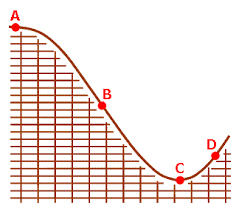
At which point on the roller coaster is the kinetic energy at its maximum?
A
B
C
D
Two balls, a bowling ball and a baseball, are both traveling with a velocity of 10 m/s. Which ball has the greater kinetic energy?
The bowling ball
The baseball
They have the same
Neither has kinetic energy
A water balloon is launched off a building. Where in its trajectory does it have the most kinetic energy?
As soon as it is released
At the peak of its trajectory
Just before it hits the ground
Once it comes to rest on the ground
A roller coaster whose average speed is 32 m/s is at the top of a 72m hill and weighs 966N. At the top of the hill the coaster car has ___________________ energy.
only kinetic energy
only potential energy
mostly kinetic energy
both kinetic and potential energy
How could you increase the gravitational potential energy of an object without changing its mass and gravity?
Make the object larger
Lower the object towards the ground
Raise the object farther off the ground
Allow the object to roll on the ground

