wayground logo

Free Printable Worksheets

Font size

S
M
L
XL
Worksheets

Final Review

Total questions: 109

Worksheet time: 1hrs 12mins

Name
Class
Date
1.
In the 1930s, how did the US respond to the rise of fascism in Europe?
a)
By invading Germany and Italy
b)
By forming military alliances
c)
By joining the League of Nations.
d)
by passing a series of neutrality laws.
2.
Executive Order 9066, issued by President Roosevelt, authorized which of the following actions?
a)
deployment of US military forces to the Pacific theater
b)
conscription of adult male citizens into the armed forces
c)
creation of the Manhattan Project, first US nuclear weapon
d)
forced internment of US citizens of Japanes, Italian, and German ancestry.
3.
How did the US Government respond to early reports of the Holocaust during WWII?
a)
began accepting refugees from Europe
b)
did not change immigration policies to accept Jewish refugees
c)
began a propaganda campaign to bring awareness of Holocaust
d)
leaders spoke out in support, but little action was taken
4.
Korematsu vs United States, why did the Supreme Court decide internment was constitutional?
a)
strong evidence of Japanese sabotage on the West Coast
b)
Many Japanese Americans refused to serve in the armed forces
c)
This type of action was necessary during national emergency
d)
Most Japanese Americans were not United States citizens
5.
What was the effect of the United States' use of atomic weapons in the war in the Pacific?
a)
The use of atomic weapons resulted in a massive "kamikaze"-style counter-offensive from the Japanese military.
b)
It gave the U.S. military a base from which it could launch an invasion of mainland Japan.
c)
It brought about the unconditional surrender of Germany and stopped the Soviet Union from occupying Berlin.
d)
It brought about the unconditional surrender of Japan and ended the Second World War.
6.
What was a next step taken by the Nazi's against the Jewish people after the Nuremburg Laws were passed?
a)
Jewish people were forced to emigrate with most of their belongings
b)
Jewish people forced to act as slaves in non-Jewish homes
c)
They quickly ended Jewish  rebellions to overthrow Nazis
d)
Jewish synagogues and businesses are attacked in riots
7.
Why did the US enact the Lend-Lease Act?
a)
To stay out of World War II
b)
To divide land acquired from the Japanese.
c)
To supply iron and oil to Japan.
d)
To let England borrow weapons in the early 1940s.
8.
The goal of the Double V Campaign was Victory for the Allies in Europe and Victory over which social issue?
a)
discrimination and inequality in the United States
b)
government censorship and propaganda
c)
the gender wage gap in the United States
d)
the suspension of civil liberties during wartime
9.
One of the greatest baseball players of all time, who helped professional sports become popular. 
a)
Babe Ruth
b)
Woodrow Wilson
c)
Charles Lindbergh
d)
Henry Ford
10.
A great jazz musician who helped the 1920s become known as the "Jazz Age"
a)
Henry Ford
b)
Babe Ruth
c)
Louis Armstrong
d)
Langston Hughes
11.
Famous African American poet who lived in Harlem and was a part of the Harlem Renaissance
a)
Louis Armstrong
b)
Langston Hughes
c)
Charles Lindbergh
d)
Woodrow Wilson
12.

The movement of African Americans from the south to the north and Midwest is called

a)

the Harlem Renaissance

b)

the Great Migration

c)

the Great Depression

d)

the Italian Renaissance

13.

How did Prohibition change life in the United States?

a)

children stopped drinking alcohol

b)

African Americans moved north

c)

Women gained their independence

d)

Organized Crime increased because of illegal alcohol sales

14.

Affordable automobiles led to what changes in the United States in the 1920's?

a)

Drinking at speakeasies increased

b)

Americans had more freedom and roads were paved

c)

Americans began walking more

d)

Americans were outraged by the high prices of cars

15.

Which of these descriptions fits life in the Roaring Twenties?

a)

a time of prosperity, social change, artistic rebirth and organized crime

b)

a time of technological breakthroughs and online gaming

c)

a time of conflict and economic hardships

d)

the rise of imperialism and international conquest

16.

This Jazz Age Artist was known for playing the trumpet in songs like "When the Saints go Marching in" and "What a Wonderful World."

a)

Duke Ellington

b)

Bessie Smith

c)

Louis Armstrong

d)

George Gershwin

17.

Identify the historical figure shown in the photo.

(a)  
18.
A system of government that exerts complete control over its citizens; individuals have no rights and all opposition to the government is suppressed
a)
Monarchy
b)
Totalitarianism
c)
Democracy
d)
Communism
19.
Why did the League of Nations actually help the rise of dictators between the World Wars?
a)
They supplied them with equipment and money
b)
False, the League of Nations was a successful organization
c)
They had no real power/authority to stop them
d)
They were lazy and didn't care
20.
A political movement that promotes an extreme form of nationalism, a denial of individual rights, and a dictatorial one-party rule
a)
Fascism
b)
Communism
c)
Socialism
d)
Democracy
21.
The German brand of Fascism
a)
Communism
b)
Nazism
c)
Totalitarianism
d)
Marxism
22.
Giving in to an aggressor to keep peace
a)
Appeasement
b)
Fascism
c)
Isolationism
d)
Pacification
23.
What is the policy of building up armed forces in aggressive preparedness for war?
a)
Militarism
b)
Nationalism 
c)
Imperialism
d)
Alliances
24.
What caused the U.S. and German relations to deteriorate in 1915?
a)
German invasion of Belgium
b)
German blockade
c)
Sinking of the Lusitania
d)
German embargo on U.S. goods
25.
Who was Vladimir Lenin?
a)
Communist leader of Russia
b)
Socialist arrested in the US
c)
Democratic presidential candidate
d)
Head of the Committee of Public Information
26.

What did Stalin and Hitler agree to do when they signed the Nazi Soviet Pact?

a)

Agreed to not go to war with Poland

b)

Split Poland between them

c)

Agreed to attack the United States

d)

None of the above

27.

What was the name of the secret assignment to create the atom bomb?

a)

the New York Project

b)

Operation Overlord

c)

the Manhattan Project

d)

Operation Barbarossa

28.

After the battle of _______ the Japanese navy was unable to launch anymore offensive operations.

a)

Iwo Jima

b)

Okinawa

c)

Coral Sea

d)

Midway

29.

On October 29th, 1929 the stock market took an all time drop with millions losing their life savings this is known as

a)

Black Wednesday

b)

Black Tuesday

c)

Black Saturday

d)

Stock Monday

30.

Click ALL of the following that could apply to the effects of the Great Depression

a)

Bank failures

b)

Unemployment rises

c)

Rise of Banks opening

d)

Life Savings lost

31.

Which of the following BEST describes farmers during the Great Depression

a)

Many farmers found success through out the depression selling their items to other countries

b)

Many farmers found success through out the depression selling their items to hungry Americans

c)

a drought and low prices forced many farmers into poverty and foreclosures

32.

After President Hoover failed to help the public, who ran for election on the slogan a New Deal for Americans?

a)

Franklin D Roosevelt

b)

Harry S Truman

c)

Calvin Coolidge

d)

Herbert Hoover

33.

FDR wanted to be able to control all parts of the government including the Supreme court, he tried doing this by attempting to...

a)

Abolish the Supreme court

b)

Take away judges

c)

Give more power to the courts

d)

Pack the Supreme Court with his judges

34.

Which economic factor contributed most directly to the start of the Great Depression?

a)

low worker productivity

b)

high income taxes

c)

decreasing tariff rates

d)

buying stocks on margin

35.

What tool - passed during the Hoover Administration - designed to protect American manufacturers actually ended up creating a worldwide depression?

a)

New Deal

b)

Hawley-Smoot Tariff

c)

2nd New Deal

36.

The Bonus Army incident in 1932 best illustrates the idea that

a)

F.D.R.'s relief programs were unsuccessful.

b)

many felt that Herbert Hoover was not handling the Depression well.

c)

protests by veterans during the Depression were effective.

d)

the U.S. Army had increased in size and power during the Depression.

37.
What was the Dust Bowl?
a)
A severe drought with high winds that scattered the soil of farms of the Eastern States
b)
A severe drought with high winds that scattered the soil of farms of the Great Plains
c)
A severe drought with high winds that scattered the soil of farms of the Western States
38.
What was a popular board game during the Great Depression?
a)
Sorry
b)
Life
c)
Candy Land
d)
Monopoly 
39.
Which government agency gives benefits to people when they are retired or unemployed?
a)
Federal Deposit Insurance Corporation
b)
Securities and Exchange Commission
c)
Tennessee Valley Authority
d)
Social Security Admistration
40.
The ____ was an agency formed to insure bank deposits up to a certain amount.
a)
Social Security
b)
SEC
c)
FDIC
d)
Tennessee Valley Authority
41.

How did the Marshall Plan aim to contain the spread of communism?

a)

It built up the western European armed forces.

b)

It helped rebuild and strengthen European economies.

c)

It forced Americans to take loyalty oaths to avoid losing their jobs.

d)

It created a military alliance among western European and North American nations.

42.

Which choice best describes the Second Red Scare ?

a)

the use of military force to put down civil unrest in American cities

b)

the use of accusations, blacklisting, and investigations against suspected communists

c)

the effort to expand civil rights protections to more groups of Americans

d)

the use of unethical searches and unfounded proclamations of a planned communist revolution in America  by Attorney General A Mitchell Palmer

43.

Why did the United States not share the plan to develop the atomic bomb with the Soviet Union during World War II?

a)

The Soviet Union already had an atomic bomb.

b)

The United States did not trust the Soviet Union.

c)

The Allies would have been against its development on moral grounds.

d)

Scientists were unsure if they would be successful.

44.

What is NATO?

a)

A military alliance between Western European Countries, the U.S. and Canada.

b)

A military alliance between Western European Countries, the Soviet Union and China.

c)

A military alliance between Eastern European Countries, Including the Soviet Union and its satellite nations.

d)

A military alliance between Eastern European Countries.

45.

Which of the following terms refers to the indirect but hostile conflict between the U.S. and Soviet Union that began at the end of WWII and lasted until 1991?

a)

Iron Curtain

b)

Soviet-Communist War

c)

Korean War

d)

Cold War

46.

What is significant about the 38th parallel?

a)

It divides Western and Eastern Europe, this line is also described as the Iron Curtain

b)

The division between North and South Korea

c)

The division between China and North Korea, also known as the Iron Curtain.

d)

The 38th parallel was the location of all communist satellite nations.

47.

The launch of Sputnik I intensified Cold War tensions and caused the —

a)

United States to increase spending on technology, education and weapons to compete with the Soviet Union

b)

Soviet Union to move missiles and warships to Cuba in order to threaten the United States

c)

United States to send troops and aid to East Berlin to free it from Soviet control

d)

Soviet Union to threaten Europe with nuclear attack if Soviet airspace were violated

48.
He was the communist leader of North Vietnam
a)
Diem
b)
Johnson
c)
Ho Chi Minh
d)
Castro
49.
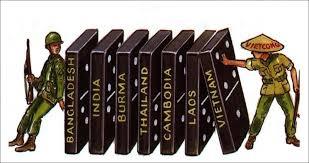
The idea that if South Vietnam fell to communism, other nations would soon follow...
a)
Vietnamization 
b)
Communism
c)
Domino Theory
d)
Imperialism
50.
What were the problems of fighting in Vietnam?
a)
Identifying the enemy 
b)
Jungle/Location provided cover and a place to transport enemy supplies
c)
Weather and climate
d)
all of these
51.
Which side ended up winning the war, if not militarily, politically due to the lack of support of the civilian population?
a)
United states
b)
South Vietnam
c)
North Vietnam
d)
North korea
52.
What rule was Vietnam unified under 
a)
Democratic
b)
Communist
c)
Socialist 
d)
Monarchy
53.
Shifting the burden of actual combat from American troops to S. Vietnamese forces.
a)
Vietminization
b)
Vietcong
c)
Internationalism
d)
Linkage
54.
What provided congressional support for escalating military action in Vietnam? 
a)
Cuban Missile Crisis
b)
Battle Of Midway
c)
Gulf of Tonkin Resolution 
d)
Bay of Pigs Invasion
55.
How did the US military attempt to take away the Vietcong's ability to hide in the jungle?
a)
They used napalm to burn the jungle down.
b)
They used agent orange to kill the plants in the jungle.
c)
both napalm and agent orange
d)
none of the options
56.

What happened to the Protesters at the Democratic Party Convention in 1968?

a)

They were all arrested

b)

The Police attacked them

c)

It rained and they went home?

d)

They made speeches in the Convention

57.

What event inspired the student protests at Kent State University?

a)

Invasion of Cambodia

b)

Tet Offensive

c)

Use of Agent Orange

d)

Operation Linebacker

58.

How many students were killed by the National Guard at Kent State in 1970?

a)

2

b)

4

c)

6

d)

8

59.
What building was broken into during the Watergate Break-in?
a)
The Capitol Building
b)
The White House
c)
Republican Headquarters
d)
Democratic Headquarters
60.
What communist nations did president Nixon extend relations to during his Administration?
a)
Cuba
b)
China
c)
Soviet Union
d)
Both China and Soviet Union
61.
Which word means, "easing/lessening of tension?"
a)
Inflation
b)
Detente
c)
Stagflation
d)
Constipation 
62.
During the investigation, the Supreme Court ordered Nixon to hand over what piece of incriminating evidence?
a)
Tape recordings
b)
Transcripts of his conversations
c)
Contracts of different CREEP members
d)
Receipts of the hotels Nixon had stayed
63.
In August 1974, Richard Nixon becomes the first president to do what?
a)
Resign
b)
Die while in office
c)
Flee the country
d)
Own a cat
64.
What is the legacy of the Vietnam War for the U.S.?
a)
It was the longest and least successful war in American history
b)
It was long and hard, but did contain communism
c)
our soldiers were welcomed home as heroes
d)
The Soviets slowed their efforts to spread communism
65.
Stagflation is 
a)
high inflation and economic growth
b)
low inflation and economic growth
c)
high inflation and low economic growth
d)
high inflation and low unemployment
66.
Which president was successful in negotiating a peace agreement between Israel and Egypt.
a)
Richard Nixon
b)
Gerald Ford
c)
Jimmy Carter
d)
Ronald Reagan
67.
US EMBASSY ATTACKED. HOSTAGES TAKEN.
a)
IRAN-CONTRA AFFAIR
b)
CAMP DAVID ACCORDS
c)
IRANIAN HOSTAGE CRISIS
d)
OPEC
68.
The biggest foreign policy failure during the presidency of Jimmy Carter was...
a)
granting a presidential pardon to Richard Nixon
b)
the fall of China to communism under Mao Zedong
c)
his inability to negotiate the release of US hostages in Iran
d)
the near nuclear war over Soviet missiles in Cuba
69.
Which situation in the 1970s caused the US to reconsider its dependence on foreign energy resources?
a)
meetins with teh Soviet Union to limit nuclear weapons
b)
oil embargo by the Organization of Petroleum Exporting Countries (OPEC)
c)
war in Afghanistan
d)
free-trade agreements with Canada and Mexico
70.
Which action did President Ford take in an attempt to end the national controversy over the Watergate affair?
a)
pardoning Nixon
b)
declaring a war on poverty
c)
declining to run for election
d)
asking Congress to impeach President Nixon
71.
The Iranian Hostage Crisis end ended 
a)
during Reagan's inauguration
b)
it did not, they are still hostages
c)
during the U.S. invasion of Iran
d)
when OPEC ended the oil embargo
72.
Idea to fix stagflation with massive tax cuts
a)
REAGANOMICS
b)
PEACE THROUGH STRENGTH
c)
BIG STICK DIPLOMACY
d)
INFLATION
73.
Selling weapons to Iran to free hostages and using the money to fund war in Central America
a)
Iran-Contra Affair
b)
Watergate Affair
c)
Reagonomics
d)
Camp David Accords
74.
What was the Strategic Defense Initiative?
a)
a series of military actions to root out communism in Central America
b)
a coalition of nations that volunteered to police the Middle East
c)
a plan to defend Eastern Europe in the event of a Soviet attack
d)
a program to use laser technology to defend America against missiles
75.

In the Iran-Contra Affair, __ sold weapons to __, then used the money from that sale to provide support for anti-Communist rebels fighting in __.

a)

Iran, Nicaragua, United States

b)

Nicaragua, United States, Iran

c)

United States, Iran, Nicaragua

76.

Which of these programs did Reagan NOT cut funding to

a)

School Lunches

b)

Medicaid

c)

Welfare

d)

Military

77.

Which of the following is MOST CORRECT about Reagan's economic policies

a)

They were successful BUT they increased the national debt by 2 trillion dollars

b)

They were extremely successful.

c)

They were unsuccessful AND they increased the national debt by 2 trillion dollars

d)

They helped to end the disparity between rich and poor Americans

78.
President Bush and the United Nations sent in troops in January 1991, their goal was the restore peace in Kuwait. What was the name of this conflict, which lasted six weeks?
a)
World War II
b)
Vietnam War
c)
Persian Gulf War
d)
This means war
79.
The Cold War ended in 1991, when which country fell?
a)
China
b)
Kuwait
c)
Soviet Union
d)
Cuba
80.
What was the name of Iraq's Dictator, who ordered the invasion of Kuwait in August 1990, for which the US forced their withdraw in the 1991 Gulf War?
a)
Anwar Sadat
b)
Osama Bin Laden
c)
Mumamar Quadafi 
d)
Saadam Hussein
81.
A trade agreement that removed restrictions between the US, Canada, and Mexico. 
a)
Palestinian Liberation Organization (PLO)
b)
North American Free Trade Agreement (NAFTA)
c)
Oil Crisis of 1979
d)
North Atlantic Treaty Organization (NATO)
82.
Reagan's Vice President, Republican who was elected President in the election of 1988.
a)
George HW Bush
b)
Bill Clinton
c)
George W Bush
d)
Jimmy Carter
83.
The longest period of economic growth happened during who's administration?
a)
Nixon
b)
Roosevelt
c)
Clinton
d)
Bush
84.
What international treaty organization was expanded include new nations?
a)
NATO (North Atlantic Treaty Organization)
b)
WTO (World Treaty Organization)
c)
Collective Treaty Security Organization 
85.
Clinton facilitated negotiations between what 2 Middle East nations? 
a)
Iran and Palastine
b)
Mexico and Canada
c)
France and Russia
86.
What political party took control of the House of Representatives for the first time in 40 years, leading to Clinton's conservative policy choices?
a)
Republicans
b)
Democrats
c)
Libertarians
d)
Fascists
87.
What happened to Clinton after he lied under oath about his relationship with White House intern Monica Lewinsky?
a)
He was fired
b)
He resigned
c)
He was impeached
d)
He was promoted
88.

Clinton was impeached but not convicted for -

a)

working with the Russians to secure his 1st term as president

b)

lying under oath about his relationship with an intern.

c)

covering up a break in at the DNC headquarters

d)

for firing the Secretary of War

89.

Who was the Vice President of the United States under Bill Clinton?

a)

Richard Cheney

b)

Joseph Biden

c)

Dan Quayle

d)

Al Gore

90.
Timothy McVeigh detonated a bomb in an office building in what city in 1995?
a)
Oklahoma City
b)
Kansas City
c)
Jackson City
d)
Johnson City
91.
What iconic school shooting took place during Clinton's presidency?
a)
Columbine
b)
Sandy Hook
c)
Virginia Tech
d)
University of Texas
92.

Dramatic increase in birth rate, especially in the years following WWII. This was due to so many people working and making a better living.

a)

Baby Boom ­

b)

Baby Gap

c)

GI Bill

d)

Transistor

93.

Commission made by LBJ after the assassination of John F. Kennedy.The point was to investigate if someone paid for the assassination of Kennedy. This concluded that Oswald killed Kennedy on his own.

a)

Black Commission

b)

Warren Commission ­

c)

Justice Commission

d)

Johnson Commission

94.

The Supreme Court recognized as a Constitutional

right in its 1966 decision that requires suspects be informed of their Fifth & Sixth Amendment rights "prior to interrogation" if their statements are to be used against

them in court.

a)

Roe Decision

b)

Wade's Rule

c)

Miranda Rule­

d)

Equal Rights

95.

Brown V. Board of Education

a)

Court ruled that segregation was unconstitutional

b)

Supreme Court decision which legalized state ordered segregation so long as the facilities for blacks and whites were equal.

c)

All state laws prohibiting abortions were made unconstitutional based on a woman's right to privacy

d)

Ruled that a defendant in a felony trial must be provided a lawyer free of charge if the defendant cannot afford one.

96.

This act made racial, religious, and sex discrimination by employers illegal and gave the government the power to enforce all laws governing civil rights, including desegregation of schools and public places.

a)

Civil Rights Act of 1964

b)

Voting Rights Law 1975

c)

Civil Rights Law of 1988

d)

Civil Service Act of 1960

97.

The 24th Amendment prohibits Congress and States from...?

a)

Allowing citizens to license, produce, supply, or possess substances which are recognized as mind altering.

b)

Verifying the owner's right to their own creative work.

c)

Using any method to keep someone from voting based on ethnicity.

d)

­Abolishing an earlier quota system based on national origin and

established a new immigration policy.

98.

American civil rights lawyer, who became the first black justice on the Supreme Court of the United States.

a)

Thurgood Marshall

b)

Malcom X

c)

Dr. Martin Luther King Jr.

d)

Earl Warren

99.
Court case that created "Separate-but-equal" doctrine.
a)
Sweatt v. Painter
b)
Brown v. Board of Education
c)
Plessy v. Ferguson
d)
Mendez v. Kirby ISD
100.
Who was arrested for refusing to give up their seat on a bus?
a)
Charlayne Hunter
b)
Harriet Tubman
c)
Rosa Parks
d)
Rebecca L. Felton
101.
An organization formed in 1960 to coordinate sit-ins and other protests and to give young blacks a larger role in the civil rights movement.
a)
affirmative action
b)
de facto segregation
c)
Student Nonviolent Coordinating Committee 
d)
National Organization for Women 
102.
Act that eliminated the so-called literacy tests that had disqualified many voters.
a)
Voting Rights Act of 1965
b)
Civil Rights Act of 1964
c)
Brown vs. the Board of Education
d)
Roe Vs. Wade
103.
What Black Nationalist group was once led by Malcolm X?
a)
Nation of Islam
b)
SNCC
c)
CORE
d)
Black Panthers
104.
Segregation caused by private action & not legislation
a)
de facto segregation
b)
de jure segregation
c)
affirmative action
d)
ex post facto segregation
105.
The main goal of the freedom riders was to 
a)
pressure the federal government to enforce the law banning segregation on interstate buses
b)
inspire students to protest in Birmingham against Jim Crow
c)
encourage Congress to pass Kennedy's civil rights agenda
d)
desegregate urban bus systems in the south
106.
Where did President Eisenhower send the 101st Airborne to enforce integration of a public high school?
a)
Little Rock, Arkansas
b)
Tuscaloosa, Alabama
c)
Birmingham, Alabama
d)
Jackson, Mississippi
107.
What strategy did the NAACP adopt in its fight for civil rights?
a)
massive resistance
b)
attacking racism in the courts
c)
direct nonviolence
d)
sit-ins
108.
The Selma March is also known as ____. 
a)
Bloody Sunday
b)
Black Sunday
c)
Bloody Tuesday
d)
Black Tuesday
109.
Who did the Southern Christian Leadership Conference elect as its first leader?
a)
Rosa Parks
b)
Jackie Robinson
c)
Martin Luther King Jr.
d)
Thurgood Marshall