wayground logo

Free Printable Worksheets

Font size

S
M
L
XL
Worksheets

Minerals, Rocks, & Soil Test Review

Total questions: 70

Worksheet time: 45mins

Name
Class
Date
1.
The color of a mineral in powder form is called the mineral's 
a)
hardness
b)
specific gravity
c)
luster
d)
streak
2.
How do you test the hardness of a mineral? 
a)
Throw it against a wall
b)
Step on it
c)
Scratch Test
d)
Kick it until it breaks
3.
A mineral's resistance to being scratched is called?
a)
streak
b)
luster
c)
hardness
d)
heft
4.
What does inorganic mean?
a)
Something that is living
b)
Something that is dead, but was once living
c)
Something that was never living
5.
A mineral breaks into pieces like are shown in the picture. How would you describe its breakage?
a)
Fracture
b)
Cleavage
c)
Glassy
d)
Waxy
6.
A mineral breaks into pieces like are shown in the picture. How would you describe its breakage?
a)
Fracture
b)
Cleavage
c)
Glassy
d)
Waxy
7.
Which of the following is NOT a characteristic of minerals? 
a)
inorganic
b)
made up of crystals 
c)
naturally found on Earth
d)
organic
8.

Check all the minerals with a black streak

a)

pyrite

b)

quartz

c)

mica

d)

horneblende

9.

Which mineral from the table is the softest?

a)

calcite

b)

quartz

c)

mica

d)

feldspar

10.

Which of the following is the LEAST reliable way to identify a mineral?

a)

color

b)

density

c)

hardness

d)

streak

11.

You have a mineral with a density of 3.56 g/cm3. Based on the chart what mineral do you have?

a)

halite

b)

calcite

c)

quartz

d)

topaz

12.

You have a mineral with a density of 2.16 g/cm3. Based on the chart what mineral do you have?

a)

halite

b)

calcite

c)

quartz

d)

topaz

13.

Based on the Mohs Hardness Scale, which of the following has the minerals in order of increasing hardness?

a)

topaz, quartz, fluorite, calcite

b)

calcite, fluorite, quartz, topaz

c)

fluorite, calcite, topaz, quartz

14.

If an igneous rock cools off quickly on the Earth's surface, then its mineral crystals will be...

a)

Small mineral crystals that you can barely see.

b)

Large crystals that are easy to see.

c)

No crystals, it will have bits of plant and bones.

d)

No crystals, it will contain sand.

15.

What type of igneous rock is shown in this picture?

a)

Intrusive Igneous Rock

b)

Extrusive Igneous Rock

16.

What type of igneous rock is shown in this picture?

a)

Intrusive Igneous Rock

b)

Extrusive Igneous Rock

17.

How can you determine if an igneous rock is intrusive or extrusive?

a)

You can tell by the size of the rock crystals.

b)

You can not tell.

c)

You can tell by the color of the rock.

18.
Any rock formed when another rock is changed by heat or __________ is a metamorphic rock.
a)
pressure
b)
arrangement
19.
Metamorphic rock can form out of other metamorphic rock.
a)
true
b)
false
20.
Geologists classify metamorphic rocks according to the __________ of the grains making up the rocks.
a)
pressure
b)
arrangement
21.
Metamorphic rocks form from ___.
a)
igneous rocks
b)
other metamorphic rocks
c)
sedimentary rocks
d)
all types of rocks
22.
__________  metamorphic rocks have mineral grains that are not arranged in distinct bands.
a)
Conglomerate
b)
Non-foliated
c)
Foliated
d)
Permeated
23.
Which texture best describes the rock above?
a)
porphyritic 
b)
nonfoliated
c)
foliated
d)
clastic
24.
Rock made of layers of compressed sediments
a)
metamorphic rock
b)
igneous rock
c)
sedimentary rock
d)
school house rock
25.

What are the types of sedimentary rock?

a)

Igneous; Metamorphic; Sedimentary

b)

Clastic; Igneous; Sedimentary

c)

Chemical; Clastic; Inorganic

d)

Organic; Clastic; Chemical

26.
This rock is made of large bits of gravel cemented together. What type of sedimentary rock is it?
a)
Clastic
b)
Chemical
c)
Organic
27.

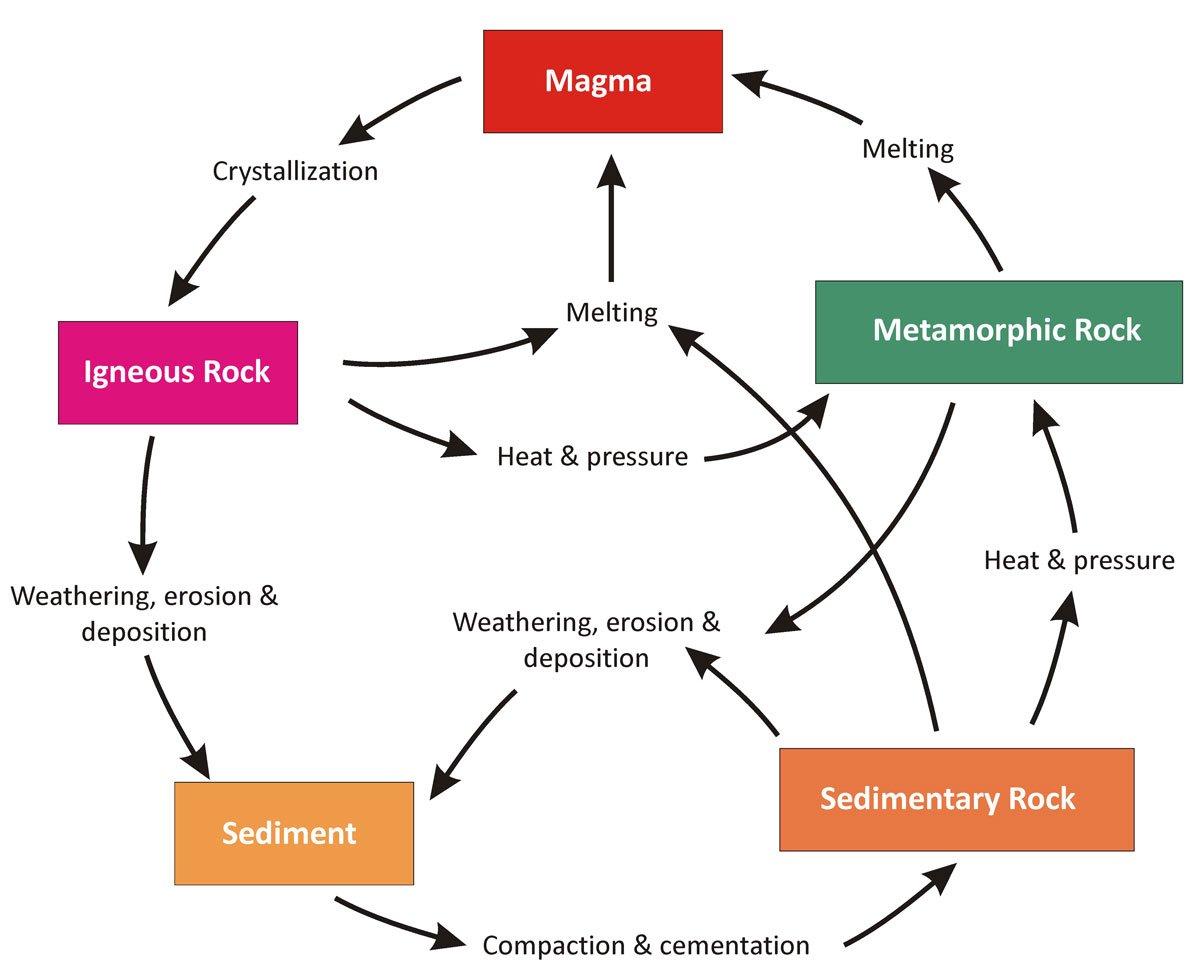
Which formation process do most sedimentary rocks follow?

a)

cementation, compaction, deposition, erosion, weathering

b)

erosion, weathering, compaction, cementation, deposition

c)

weathering, erosion, deposition, compaction, cementation

28.

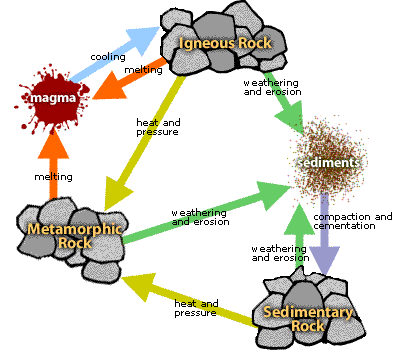
What type of rock would be in box 2?

a)

igneous

b)

sedimentary

c)

metamorphic

29.

What type of rock would be in box 5?

a)

igneous

b)

sedimentary

c)

metamorphic

30.

What type of rock would be in box 7?

a)

igneous

b)

sedimentary

c)

metamorphic

31.

What process is represented by the arrow labeled 11?

a)

melting

b)

cooling

c)

heat and pressure

d)

weathering and erosion

e)

Deposition, Compaction, & Cementation

32.

What process is represented by the arrow labeled 13?

a)

melting

b)

cooling

c)

heat and pressure

d)

weathering and erosion

e)

Deposition, Compaction, & Cementation

33.

What process is represented by the arrow labeled 4?

a)

melting

b)

cooling

c)

heat and pressure

d)

weathering and erosion

e)

Deposition, Compaction, & Cementation

34.

What process is represented by the arrow labeled 10?

a)

melting

b)

cooling

c)

heat and pressure

d)

weathering and erosion

e)

Deposition, Compaction, & Cementation

35.

What process is represented by the arrow labeled 1?

a)

melting

b)

cooling

c)

heat and pressure

d)

weathering and erosion

e)

Deposition, Compaction, & Cementation

36.

Geologists have classified rocks into three major groups of rocks which are:

a)

inorganic, organic and chemical rocks

b)

igneous, sedimentary and metamorphic rocks

c)

metamorphic, chemical and non chemical rocks

d)

sedimentary, inorganic and igneous rocks

37.

Which type of rock are most fossils found?

a)

sedimentary rock

b)

metamorphic rock

c)

igneous rock

d)

fossils

38.

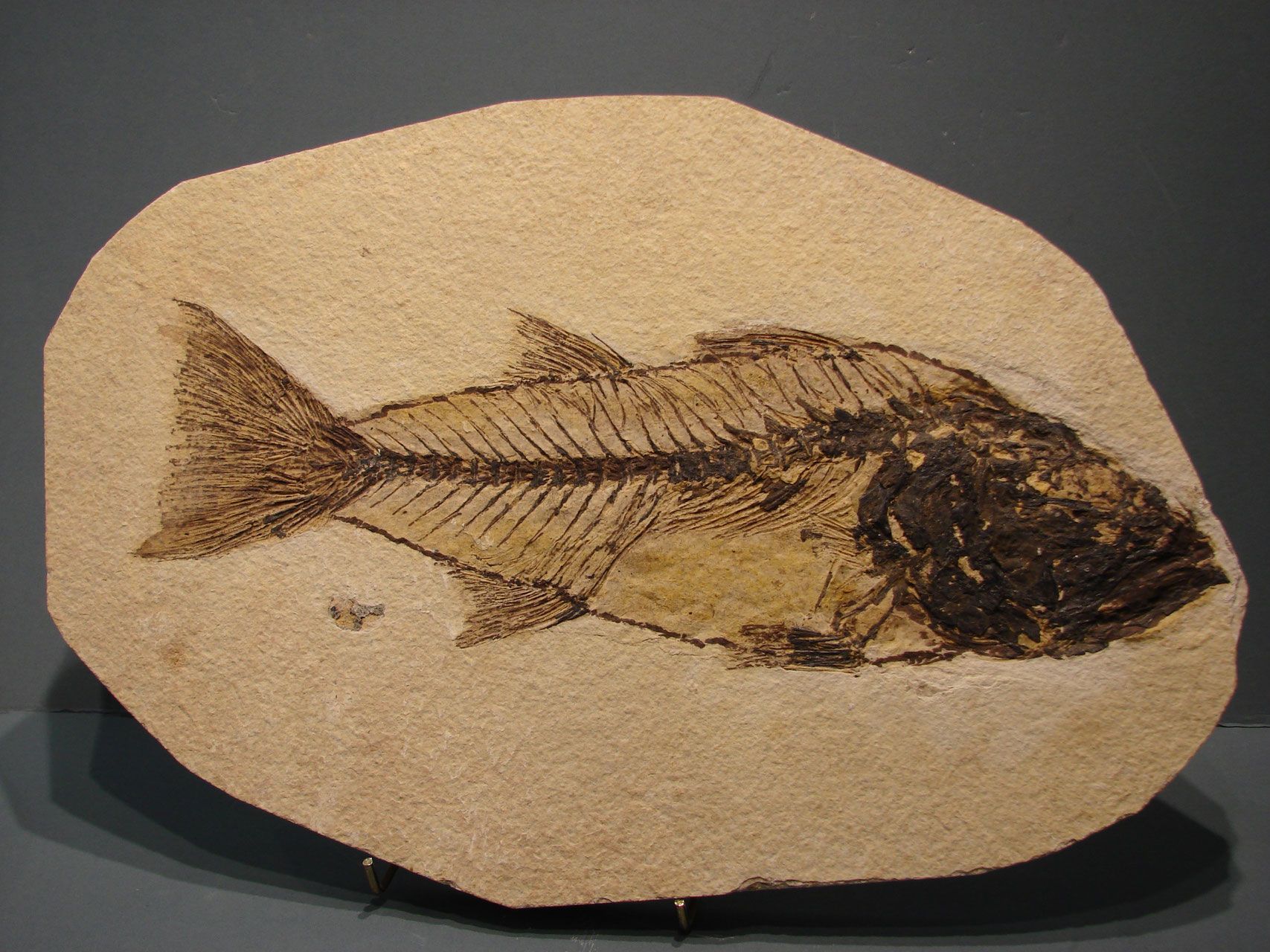
If a scientist found a fish fossil in the desert, what can they infer?

a)

An animal ate the fish.

b)

The water covered the area long ago.

c)

Today's fish looks the same

d)

The fish is endangered.

39.

Scientist study the fossil record to learn about ALL of the following EXCEPT

a)

what color dinosaurs were.

b)

what past environments on Earth were like.

c)

how life has changed over time.

d)

how the Earth's surface has changed over time.

40.
Which layer formed first?
a)
Rock Layer W
b)
Rock Layer X
c)
Rock Layer Y
d)
Rock Layer Z
41.

What type of rock is in this picture?

a)

sedimentary

b)

metamorphic

c)

igneous

42.
The process by which rock materials are broken down by the action of physical or chemical processes
a)
Weathering 
b)
Erosion
43.
The breakdown of rock into smaller pieces by physical means; common causes are ice, wind, water, gravity, plants, and animals
a)
Mechanical Weathering 
b)
Chemical Weathering
44.
The process by which rocks break down as a result of chemical reactions/ common causes are water, weak acids, and air
a)
Mechanical Weathering 
b)
Chemical Weathering
45.
The grinding and wearing a way of rock surfaces through the mechanical action of other rock or sand particles
a)
Erosion
b)
Leaching
c)
Abrasion
46.
A loose mixture of small mineral fragments, organic material, water, and air that can support the growth of vegetation
a)
Soil
b)
Soil Conservation
c)
Humus
47.
The layer of rock beneath the soil
a)
Parent Rock
b)
Bedrock
c)
Rock Bed
d)
Rip Rap
48.
The organic material formed in soil from the decayed remains of plants and animals  
a)
Worms
b)
Humans
c)
Humus
49.
Horizontal soil layers
a)
Profiles 
b)
Horizons
c)
Soils
50.
The process by which wind, water, ice, or gravity transport soil and sediment from one location to another
a)
Weathering
b)
Erosion
51.
A method to maintain the fertility of the soil by protecting the soil from erosion and nutrient loss
a)
Soil 
b)
Soil Conservation
c)
Soil Erosion
d)
Saving the Dirt
52.
Bobby observed that a metal trash can was covered with rust.  What type of weathering caused the rust on the trash can?
a)
Mechanical weathering 
b)
Wind weathering
c)
Chemical weathering
d)
Erosion weathering
53.
What is likely to cause cracks on the sidewalk?
a)
Repeated freezing and thawing of water
b)
Tree roots or plant roots growing bigger
c)
Both and A and B
d)
Neither A or B 
54.
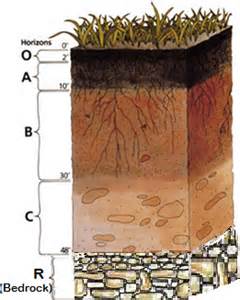
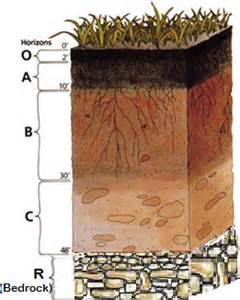
What is the name of Horizon 1?
a)
Subsoil 
b)
Topsoil
c)
Bedrock 
d)
Parent Rock
55.
What is the name of Horizon 2?
a)
Subsoil 
b)
Topsoil
c)
Bedrock 
d)
Parent Rock
56.
What is the name of Horizon 4?
a)
Subsoil 
b)
Topsoil
c)
Bedrock 
d)
Parent Rock
57.
Which horizon is made up of partially weathered rocks?
a)
Horizon A
b)
Horizon B
c)
Horizon C
d)
Horizon D or R
58.
In which horizon is most of the HUMUS?
a)
Horizon A
b)
Horizon B
c)
Horizon C
d)
Horizon D or R
59.

The softer a rock's composition is the slower it will weather, the harder a rock's composition the faster it will weather.

a)

True

b)

False

60.
Abrasion causes
a)
physical weathering.
b)
chemical weathering.
c)
both chemical and physical weathering.
d)
Neither chemical or physical weathering.
61.
Acid rain causes
a)
physical weathering.
b)
chemical weathering.
c)
both chemical and physical weathering.
d)
neither chemical or physical weathering.
62.
Freezing causes
a)
physical weathering.
b)
chemical weathering.
c)
both chemical and physical weathering.
d)
neither chemical or physical weathering.
63.
Physical and chemical weathering differ because
a)
only chemical weathering produces new materials.
b)
only physical weathering creates smaller pieces of rock.
c)
only physical weathering involves water.
d)
chemical weathering is faster than physical weathering.
64.
Caves are most likely to form from the chemical weathering of which kind of rock?
a)
Granite
b)
Limestone
c)
Basalt
d)
Sandstone
65.
Formed by cooling & solidification of lava
a)
Sedimentary
b)
Metamorphic
c)
Extrusive Igneous
d)
Intrusive Igneous
66.
Formed by cooling & solidification of magma
a)
Sedimentary
b)
Metamorphic
c)
Extrusive Igneous
d)
Intrusive Igneous
67.
Formed by compacting & cementing of sediments
a)
Sedimentary
b)
Metamorphic
c)
Extrusive Igneous
d)
Intrusive Igneous
68.
Formed by heat and pressure
a)
Sedimentary
b)
Metamorphic
c)
Extrusive Igneous
d)
Intrusive Igneous
69.
Has wavy bands.
a)
sedimentary rock
b)
metamorphic rock
c)
extrusive igneous rock
d)
intrusive igneous rock
70.
Has large crystals because of slow cooling
a)
sedimentary rock
b)
metamorphic rock
c)
intrusive igneous rock
d)
extrusive igneous rock