
 Worksheets
Investigation #1-3 Diversity of Life Test Study material
Total questions: 67
Worksheet time: 9hrs 38mins

In what organelle is the genetic material found inside?
Endoplasmic Reticulum
Golgi Complex
Nucleolus
Nucleus

What organelle is called the "powerhouse" of a cell?
Endoplasmic Reticulum
Nucleus
Mitochondria
Nucleolus

Using this image, what organelle is C?
Cell Wall
Mitochondria
Large Cell Vacuole
Chloroplast

What is the function of the vacuole?
Sac that stores water, nutrients, and waste products
Sac filled with digestive chemicals
The jelly-like substance within the plasma membrane
stack of membranes that packages chemicals

Where does photosynthesis occur?
mitochondria
stomata
xylem
chloroplast

I make proteins for the cell. What am I?
ribosome
mitochondria
chloroplast
lysosome

What can only be found in plant cells?
Cell membrane
Vacuole
Chloroplast
Mitochondrion
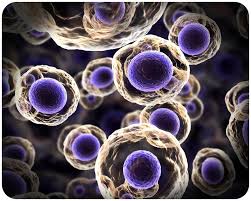


This type of complex cell can be a plant or an animal.
Eukaryotic Cell
Prokaryotic Cell
Bacteria
Blood cell

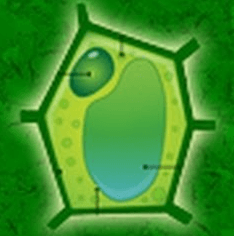

I am fluid filled within the cell
Mitochondrion
Vacuole
cytoplasm
Cell membrane

In what organelle does the food making process in plants take place?
Endoplasmic Reticulum
Vacuole
Chloroplasts
Mitochondria

What is the name of the genetic material that is inside the nucleus?
ER
SER
DNA
ATP

This organelle takes sunlight and turns it into energy for plant cells.
lysosome
chloroplast
mitochondria
nucleus

I am the outermost layer of an animal cell.
cell wall
fur
cell membrane
cell skin

What is the function of the lysosome?
Stores protein.
Makes energy for the cell to use.
Transports macromolecules to other parts of the cell.
Digests waste products and macromolecules.

This organelle stores food, water, and wastes for a cell.


This organelle is the control center of the cell.

The organelle shown in number 3 is the membrane in which materials can be moved around in the cell.
Cell Membrane
Cytoplasm
Endoplasmic Reticulum (ER)
Mitochondria

This organelle is a jelly-like substance which flows inside the cell.


All the parts of a cell are called?
Organelle
Cell
Ribosome
Cell Membrane

This is a (an)
animal cell
plant cell
protist
flower

Which type of cell?
animal cell
plant cell
both

What structure in a plant cell enables the cell to capture energy from the Sun?
cell wall
chloroplast
mitochondrion
central vacuole

What is one way in which all living things on Earth are alike?
All living things have hair.
All living things are made of cells.
The cells of all living things have chloroplast.
All living things can move.
Which of the following statements is part of the cell theory?
All living things are made up of one or more cells.
Cells are the basic units of living things.
All cells come from pre-existing cells.
All of these
All living things are made up of cells, cells are the smallest unit of life, all cells come from preexisting cells.
Cell Theory
Golgi Body
Vacuole
Life
What structure in a plant cell enables the cell to capture energy from the Sun?
cell wall
chloroplast
mitochondrion
central vacuole
Which type of cell can make its own food?
animal
plant

This is a picture of a (an)
Animal Cell
Protist
Plant Cell
Multicellular organism

Which statement describes what happens during asexual reproduction of single-celled organisms like paramecia?
The mother cell divides and is replaced by two or three daughter cells.
All of the cell structures of the mother cell divide in half during reproduction.
The daughter cells have different genetic material as the mother cell.
After the mother cell splits in two, each daughter cell is exactly the same size and shape as the mother cell.
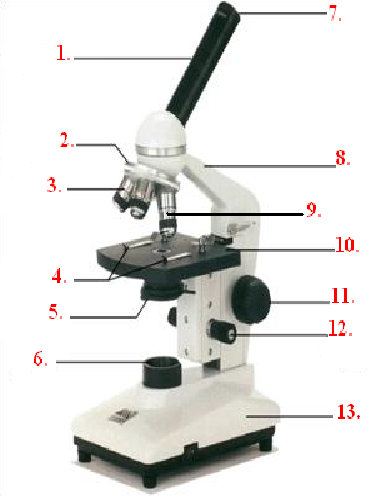
Eye Piece
Objective Lens
Base
Arm


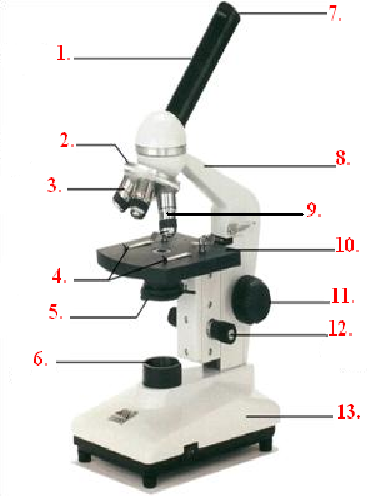
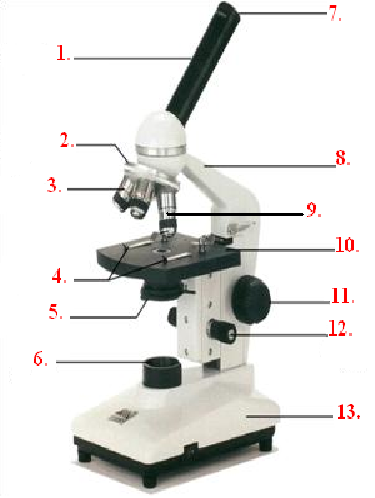
Fine Focus

Course Focus


Light Source


which part of the microscope do you look through
eyepiece
objective lens
light
stage opening
which parts of the microscope do you carry it by
base and arm
lens and light
both adjustment knobs
stage and stage clips
when focusing the scope on scanning power, which adjustment knob do you use first
fine adjustment
coarse adjustment
the scopes are always in focus so this is not necessary
It doesn't matter which one you use first
when focusing the scope on high power, what should you use to focus the image
fine adjustment
coarse adjustment
the scopes are always in focus so this is not necessary
you can use both
which part of the scope is used to adjust the amount of light passing through the scope
body tube
diaphragm
base
fine adjustment knob
This part of the microscope allows the user to rotate between scanning, low, and high power
body tube
diaphragm
revolving nose piece
fine adjustment knob
when you start using a microscope, start by focusing the image on____________________________.
the lowest power possible
the highest power possible
it doesn't matter which power
the middle power
This part of the microscope holds the slide in place on the stage.
Body tube
Stage clamp
Scanner
Nose piece
This flat platform holds the microscope slide up.
Arm
Diaphragm
Stage
Nose piece

The lens closest to the specimen that first receives the rays from the specimen (the object)
EYE PIECE
SUBSTAGE
BODY TUBE
OBJECTIVE LENS
Something that once showed all the characteristics of life but no longer does and never will again:
dormant
nonliving
dead
living
Something that has never shown the characteristics of life and never will:
dormant
nonliving
living
dead
Something that isn't currently showing the characteristics of life but will when provided with the correct conditions:
living
nonliving
dead
dormant
Something that is currently showing all the characteristics of life:
living
nonlivng
dead
dormant



