wayground logo

Free Printable Worksheets

NEW

Font size

S
M
L
XL
Worksheets

Plants

Total questions: 67

Worksheet time: 46mins

Name
Class
Date
1.
How do plants get their energy?
a)
through a reaction called chlorophyll 
b)
by a process called photosynthesis 
c)
by absorbing mineral nutrients from soil 
d)
by eating other organisms 
2.
Three main things plants need to survive. 
a)
sunlight, oxygen, soil
b)
soil, carbon dioxide, sunlight 
c)
sunlight, air, soil 
d)
sunlight, air, water 
3.
The source of energy plants use to make food
a)
photosynthesis 
b)
air 
c)
sunlight 
d)
soil 
4.
What two materials are used in photosynthesis?
a)
carbon monoxide and water 
b)
carbon dioxide and soil 
c)
carbon dioxide and oxygen
d)
carbon dioxide and water 
5.
Glucose is ... 
a)
salt 
b)
sugar 
c)
air 
d)
water
6.
Plants are considered producers because 
a)
they produce carbon dioxide 
b)
they produce their own water 
c)
they produce sunlight 
d)
they produce their own food 
7.
Stomata is found in the _______. 
a)
stems 
b)
roots 
c)
leaves 
d)
flower 
8.
_______ are tubes that carry nutrients to other parts of the plant. 
a)
stomata 
b)
roots 
c)
xylem 
d)
xylophone 
9.
The green pigment in leaves that captures the energy from the sun. 
a)
borophyll 
b)
chlorophyll 
c)
photosynthesis 
d)
leaves 
10.
Which of the following methods is used by plants to disperse their seeds widely?
a)
sticking on animal fur
b)
traveling through an animal's digestive system 
c)
wind
d)
all of the above 
11.
Where does carbon dioxide for photosynthesis come from?
a)
soil 
b)
air 
c)
sun 
d)
water 
12.
Where does water for photosynthesis come from?
a)
only from the soil 
b)
only from the air 
c)
only from the rain 
d)
both the soil and air 
13.
What two substances are produced during photosynthesis?
a)
sugar and carbon dioxide 
b)
sugar and carbon monoxide
c)
sugar and water
d)
sugar and oxygen 
14.
Which plant part is responsible for capturing sunlight and carrying out photosynthesis?
a)
leaves 
b)
stem
c)
flower
d)
roots 
15.
All plants need roots to obtain nutrients in order to live and grow. 
a)
true 
b)
false 
16.
What do plants release during photosynthesis that is essential for life?
a)
sugar 
b)
carbon dioxide
c)
oxygen 
d)
water 
17.
In what plant cell part/structure is water stored?
a)
chloroplast
b)
cell wall
c)
vacuole 
d)
cytoplasm
18.
The leaf's cuticle
a)
stores water
b)
reduces evaporation
c)
transports water in the leaf
d)
absorbs water for the leaf
19.
What produces egg and sperm cells during the life cycle of a plant?
a)
gamete
b)
gametophyte
c)
sporophyte
d)
zygote
20.
What happens in the phloem?
a)
water moves up from the roots
b)
food moves down from the leaves
c)
food moves up from the roots
d)
water moves down to the roots
21.
Germination will not happen unless a seed
a)
is dispersed far from the plant that produced it
b)
absorbs water
c)
uses its stored food
d)
grows stamens and a pistil
22.
What part of a woody stem forms rings that indicate a tree's age?
a)
xylem
b)
phloem
c)
cambium
d)
inner bark
23.
The energy that powers photosynthesis comes from
a)
water
b)
chemicals
c)
oxygen
d)
the sun
24.
Gases pass in and out of a leaf through the 
a)
stomata
b)
phloem
c)
xylem
d)
cuticle
25.
What part of a plant transports water and nutrients from the root to the plant's stem and leaves?
a)
root hairs
b)
phloem
c)
xylem
d)
cuticle
26.
All of the following is a root function, except
a)
water absorption
b)
food storage
c)
plant anchoring
d)
food production
27.
Root hairs help a plant
a)
transport food to the root
b)
absorb water and nutrients
c)
protect the root
d)
store food
28.
_________________ are scientists who study plants.
a)
botanists
b)
ecologists
c)
zoologists
d)
chemists
29.

Vascular Tissue is most like which of these?

a)

Paper Towels

b)

Beakers

c)

Straws

d)

Leaves

30.

Which of these are Non-Vascular Plants

a)

Cypress Trees

b)

Moss

c)

Ferns

d)

Daffodils

31.

Angiosperms...

a)

Reproduce with spores

b)

Reproduce with Leaves

c)

Lack Xylem

d)

Produce Seeds in fruit

32.

How do Non-Vascular plants move water into cells?

a)

With Xylem (Vascular Tissue)

b)

Osmosis/Diffusion

c)

Chloroplast

d)

Stomata

33.

Autotrophs....

a)

Make their own Food

b)

Consume Food

c)

move around a lot

d)

Hunt their prey

34.

Phototropism is....

a)

a plants' response to Gravity

b)

a plants' response to Water

c)

a plants' response to Light

d)

a plants' person business

35.

Deciduous means

a)

Plants loose their leaves

b)

Plants keep their leave

c)

Plants die during the winter

d)

Plants respond to light

36.

Cones can be found on which of these plants

a)

Non-Vascular

b)

Vascular Seedless

c)

Gymnosperms

d)

Angiosperms

37.
Why are flowers very colorful (and why do they produce odor?)
a)
So people buy them
b)
To make gardens look good
c)
To attract pollinators
d)
To attract sunlight
38.
Male reproductive parts of a plant....
a)
Petals and ovary
b)
Ovary and ovule
c)
Anther and filament
d)
Stigma and style
39.
In which part of the flower is pollen found?
a)
Filament
b)
Anther
c)
Ovary
d)
Xylem
40.
How else can pollen be moved besides pollinators?
a)
Sunlight
b)
Wind
c)
Snow
d)
Hail
41.
After fertilization the ovule will....
a)
Be carried away by a pollinator
b)
Be blown away by the wind
c)
Will grow into a new plant
d)
Develop into a fruit that contains seeds
42.
What is the female part of the plant called?
a)
Stigma
b)
Pistil
c)
Stamen
d)
Style
43.
What is #1 pointing to?
a)
ovary
b)
petal
c)
stigma
d)
stamen
44.
In what part of the flower does fertilization take place?
a)
anther
b)
stigma
c)
ovary
d)
filament
45.
What is the sticky part of the flower that catches pollen?
a)
style
b)
stigma
c)
ovary
d)
petal
46.
What part of the flower will turn into a seed?
a)
ovary
b)
anther
c)
ovule
d)
filament
47.
A plant's leaves turned toward the light. This is an example of _______.
a)
Phototropism
b)
Gravitropism
c)
Thigmotropism
d)
Hydrotropism
48.
Sally planted seeds last year but they did not sprout until this spring. This is an example of ______.
a)
dormancy
b)
fertilization
c)
germination
d)
photosynthesis
49.
The transfer of pollen from the anther to the stigma.
a)
pollination
b)
germination
c)
photsynthesis
d)
reprodution
50.
The colorful flower structure that attracts pollinators.
a)
sepals
b)
pistils
c)
anthers
d)
petals
51.
What is this a picture of?
a)
Pistil
b)
Stamen
c)
Stigma
d)
Ovule
52.
Which gas is removed from the atmosphere during photosynthesis?
a)
hydrogen
b)
oxygen
c)
nitrogen
d)
carbon dioxide
53.
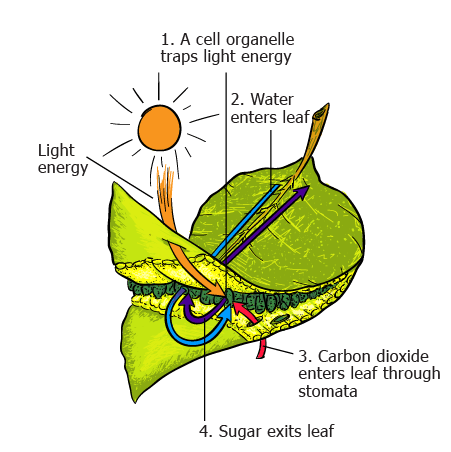
Look at the image
What substances and organelle work together to absorb sunlight to perform photosynthesis in this example?
a)
cell wall and chloroplast
b)
mitochondria and water
c)
vacuole and carbon dioxide
d)
chloroplast and chlorophyll
54.
Xylem and phloem are examples of _ tissue
a)
Spores
b)
Nonvascular
c)
Seeds
d)
Vascular
55.
Which gas leaves a stomata?
a)
Oxygen
b)
Nitrogen
c)
Helium
d)
Carbon Dioxide
56.
Which has true roots, stems, and leaves?
a)
Vascular Plants
b)
Nonvascular Plants
57.

Plants:

a)

are multi-cellular organisms

b)

make their own food through photosynthesis

c)

cannot move

d)

are a member of kingdom Plantae

e)

All of the above

58.

Stamens are:

a)

the female reproductive organ of a flower that produces pollen

b)

the male reproductive organ of a flower that produces nectar

c)

the male reproductive organ of a flower that produces pollen

d)

none of the above

59.

The Stigma is:

a)

the part of a flower that receives pollen during pollination and on which the pollen grain germinates

b)

the part of the flower that pollen sticks to

c)

located on top of the pistil

d)

all of the above

60.

The Pistil is:

a)

the male reproductive organ of a flower that can be fertilized by pollen

b)

the female reproductive organ of a flower that can be fertilized by pollen

c)

the male reproductive organ of a flower that can be fertilized by nectar

d)

none of the above

61.

Fruit is

a)

a plant structure that contains seeds and grows from a flowering plant

b)

a nutritious part of the plant that can be consumed

c)

seeds are usually dispersed by animals

d)

all of the above

62.

A Stem is:

a)

a plant structure that contains a young plant, food supply, and protective coating

b)

a plant organ that takes in water and nutrients from the soil

c)

the part of a plant that grows away from the roots; supports leaves and flowers

d)

none of the above

63.

Roots are:

a)

a plant structure that contains a young plant, food supply, and protective coating

b)

the part of a plant that grows away from the roots; supports leaves and flowers

c)

a plant organ that takes in water and nutrients from the soil

d)

none of the above

64.

Seeds are

a)

a plant structure that contains a young plant, food supply, and protective coating

b)

a plant organ that takes in water and nutrients from the soil

c)

the part of a plant that grows away from the roots; supports leaves and flowers

d)

none of the above

65.

a Cotyledon is:

a)

The first leaf or one of a pair of leaves developed by the embryo within a seed.

b)

The first leaf or one of a pair of leaves developed by the stigma within a grain of pollen.

c)

The first leaf or one of a pair of leaves developed by the stamen within a seed.

d)

none of the above

66.
Plants that do NOT have true roots, stems and leaves and get their water through osmosis are.... 
a)
vascular plants 
b)
nonvascular plants 
67.
The waxy covering of a leaf is called ...
a)
stem 
b)
angiosperm 
c)
cuticle 
d)
petal