

wayground logo

Free Printable Worksheets

Font size

S
M
L
XL
Worksheets

Semester 2 Review

Total questions: 73

Worksheet time: 3hrs 48mins
Name
Class
Date
1.
The flow of electricity in a circuit-
a)
current
b)
flow
c)
circuit
2.
____________ stops the flow of electricity.
a)
A conductor
b)
An insulator
c)
A magnet
3.
The unit for current is the 
a)
Volt
b)
Ohm
c)
Electron
d)
Amp
4.
In a ________ circuit there are multiple paths for the current to take.
a)
Series
b)
Parallel
5.
In a _________ circuit, if one bulb goes out then the entire circuit doesn't work.
a)
Series
b)
Parallel
6.
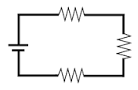
What type of circuit is pictured?
a)
series
b)
parallel
7.
What kind of circuit is this?
a)
Series
b)
Consecutive
c)
Parallel
d)
Training
8.
The tendency for a material to oppose the flow of electrons, changing electrical energy into thermal energy and light.
a)
Voltage
b)
Current
c)
Resistance
d)
Circuit 
9.
If two charges repel each other, the two charges must be
a)
Positive and neutra
b)
Positive and negative
c)
positive and neutral
d)
negative and negative
10.
Which ranking is correct?
a)
A < B
b)
J < H < I
c)
F < G < E
d)
D < C
11.
Electric field lines are drawn
a)
In a radial direction, from negative to positive.
b)
In a radial direction, from positive to negative.
c)
In a tangent direction, from positive to negative.
d)
In a tangent direction, from negative to positive.
12.
gravitational potential energy is defined as
a)
the energy an object has due to its height above the ground
b)
the energy an object has due to its motion
c)
the energy a spring has due to its stretch
d)
the chemical energy stored in the molecules of atoms
13.
the equation for gravitational potential energy is 
a)
PEg = mgh
b)
PEg= 1/2kx2
c)
PEg= Fd
d)
PEg = 1/2mv2
14.
Kinetic Energy is defined as
a)
Energy stored due to its location
b)
Energy of motion
c)
Energy stored in the bonds of molecules
d)
Heat energy
15.
The equation to find kinetic energy is
a)
KE=1/2mv2
b)
KE=mgh
c)
KE=1/2kx2
d)
KE=Fd
16.
A 70 kg runner has a velocity of 5 m/s. Her kinetic energy is
a)
875 J
b)
175 J
c)
1750 J
d)
350 J
17.
Which of the following objects has the most kinetic energy?
a)
A 20 kg toddler running at 5 m/s
b)
A 50 kg toddler running at  30 m/s
c)
A 90 kg toddler running at 30 m/s
d)
A 100 kg  toddler running at 2 m/s
18.
A 5 kg ball is lifted 12 m above the ground. It's gravitational potential energy is
a)
60 J
b)
600 J
c)
17 J
d)
2.4 J
19.
You drop a 5 kg ball from a height of 2 m. Just before it reaches the ground, what type of energy does it have?
a)
Potential Energy
b)
Kinetic Energy
c)
Nuclear Energy
d)
Chemical Energy
20.
You drop a 5 kg ball from a height of 2 m. Just before it reaches the ground, how much kinetic energy does it have?
a)
10 J
b)
100 J
c)
7 J
d)
20 J
21.
You drop a 5 kg ball from a height of 2 m. Just before it reaches the ground, what is the ball's velocity?
a)
6.32 m/s
b)
40 m/s
c)
4.47 m/s
d)
100 m/s
22.

Which of the is the equation for calculating work?

a)

W = Fd

b)

W = ma

c)

W = mv

d)

W = mc2

23.

Work is defined as applying a force on an object that displaces the object in the direction of the applied force. Which of the following IS NOT an an example of work being done on an object?

a)

A waiter walking with a tray of food that he is holding with his hand under the tray.

b)

A horse pulling a plow through a field.

c)

A shopper pushing a cart down the aisle of a grocery sture.

d)

A weightlifter lifting a barbell above his head.

24.

Which of the following is an instance where a force hinders the displacement.

a)

A car skidding to a stop on a roadway surface.

b)

A student rolling a bowling ball down a bowling lane alley.

c)

A pitcher throwing a baseball.

d)

a man pushing a crate across a loading dock.

25.

An instance where a force hinders a displacement is called __________________ work.

a)

negative

b)

false

c)

faux

d)

opposite

26.

Negative work means that energy is being removed from the object.

a)

True

b)

False

27.

An object is speeding up when: (Choose All That Apply)

a)

it is gaining kinetic energy.

b)

it is losing kinetic energy.

c)

it is gaining gravitational potential energy.

d)

it is losing gravitational potential energy.

28.

The sum of the kinetic and potential energy in a system is known as the system's _____________________ energy.

a)

mechanical

b)

chemical

c)

thermal

d)

combined

29.

How much kinetic energy (K) does a baseball with a mass of 0.143 kg have if it is travelling at a velocity of 41.1 m/s?

HINT: K = mv2/2

a)

120.8 joules

b)

89.7 joules

c)

108.3 joules

d)

156.6 joules

30.

What is the maximum gravitational potential energy that this 1.3 kg ball can have in this situation?

HINT: Ug = mgh, where g = 9.8 m/s2

a)

2.55 joules

b)

1.65 joules

c)

3.15 joules

d)

3.94 joules

31.

If a ball tossed into the air has a maximum gravitational potential energy of 5.75 joules, what is its maximum kinetic energy in the same toss?

a)

5.75 joules

b)

11.14 joules

c)

2.88 joules

d)

7.93 joules

32.

A 1.0 kg ball is stationary at the top of a hill that is 10.0 meters in height. The ball rolls down the hill. What is its gravitational potential energy at the bottom of the hill?

a)

0 joules

b)

98 joules

c)

49 joules

d)

38 joules

33.

Which of the following is correct according to the work-energy theorem?

a)

The net work on an object causes a change in the kinetic energy of the object.

b)

Work is equivalent to the magnitude of the force applied to the object times the displacement of the object in the direction of the force.

c)

Energy is the ability to do work.

d)

The work done on an object is equivalent to the mass of the object times the acceleration that a force causes to occur.

34.

True or False: The time for a complete back-and-forth swing of a pendulum is its frequency.

a)

True

b)

False

35.

The number of cycles that are completed per second is called the ________ and is measured in _________.

a)

frequency, Hertz

b)

wavelength, meters

c)

amplitude, meters

d)

period, seconds

36.

The period of a pendulum is 10 s. What is its frequency?

a)

10 Hz

b)

1 Hz

c)

0.5 Hz

d)

0.1 Hz

37.
Frieda the fly flaps her wings back and forth 100 times each second.  The period of her wings flapping is:
a)
100 s
b)
0.01 s
c)
0.01 Hz
d)
100 Hz
38.
A tennis coach paces back and forth along the sideline 10 times in 60 seconds.  The frequency of her pacing is:
a)
0.167 Hz
b)
6.0 Hz
c)
0.167 s
d)
6.0 s
39.

A pendulum makes 33 complete back and forth cycles of vibration in 11 seconds. Its period is

a)

3.0 s

b)

3.0 Hz

c)

0.33 s

d)

0.33 Hz

40.
A pendulum makes 33 complete back and forth cycles of vibration in 11 seconds.  It's frequency is:
a)
3.0 s
b)
3.0 Hz
c)
0.33 s
d)
0.33 Hz
41.
A boy notices that 45 complete waves travel past him in ninety seconds.  What is the frequency of these water waves?
a)
100 m
b)
1 Hz
c)
0.5 Hz
d)
1m/s
42.
One end of the rope is vibrated to produce a wave with a wavelength of .25 m.  The Frequency of the wave is 3.0 Hz.  What is the speed of the wave?
a)
3.00 m/s
b)
2.50 m/s
c)
.75 m/s
d)
1.25 m/s
43.
 A wave has frequency of 50 Hz and a wavelength of 10 m. What is the speed of the wave?
a)
500 m/s
b)
50 m/s
c)
5 m/s
d)
0.5 m/s
44.
 A wave has frequency of 5 Hz and a speed of 25 m/s. What is the wavelength of the wave?
a)
25 m
b)
125 m
c)
5 m
d)
25 m/s
45.
A wave has wavelength of 10 m and a speed of 340 m/s. What is the frequency of the wave?
a)
34 m/s
b)
3400 Hz
c)
3400 m/s
d)
34 Hz
46.
As the distance between two magnets increases (they get farther apart), the force between them:
a)
Increases
b)
Decreases
c)
Stays the Same
47.
If you cut a magnet in half, what happens to the poles?
a)
One half gets the North Pole, the other half gets the South Pole
b)
Both halves get only a North Pole
c)
Both halves get only a South Pole
d)
Both halves get a North pole and a South Pole
48.

In un-magnetized materials the electrongs are __________ aligned.

a)
super
b)
slightly
c)
randomly
d)
always
49.
The strongest part of a magnet is...
a)
the bars.
b)
the force field.
c)
the poles. 
d)
the middle.
50.

What causes magnetism?

a)

the sun

b)

moving neutrons

c)

moving charges

d)

friction

51.
If you place the North pole of a magnet next to the South pole of another magnet, they will:
a)
Attract
b)
Repel
c)
Do nothing
d)
Shatter
52.
What is responsible for the Magnetic Field around Earth?
a)
The Earth's crust
b)
The Earth's molton iron core
c)
The Earth's mantel
d)
The Sun
53.
A refrigerator magnet is an example of a:
a)
magnetic material
b)
permanent magnet
c)
horseshoe magnet
d)
temporary magnet
54.
A paper clip is an example of a:
a)
magnetic material
b)
permanent magnet
c)
bar magnet
d)
insulator
55.
What would we call a nail that can pick up a paperclip because it is touching a magnet?
a)
temporary magnet
b)
poles
c)
force
d)
detector
56.
What will happen when these magnets are brought close together?
a)
They will attract each other.
b)
They will repel each other.
c)
Both magnets will turn to the left
d)
Both magnets will turn to the right
57.
A Charging system producing 14.5 Volts with a current flow of 43.5 Amps, what is the circuit resistance
a)
58 Amps
b)
0.33 Amps
c)
13 Amps
d)
1 Amp
58.
How many Volts would it take to push 1 Amp through a resistance of 1 Ohm
a)
10 volts
b)
1 volt
c)
48 volts
d)
5 volts
59.
If the current through a circuit is 2 A and the resistance of a light bulb in the circuit is 10 Ohms, what is the voltage difference across the light bulb?
a)
5 V
b)
12 V
c)
0.2 V
d)
20 V
60.
What would the circuit resistance be if a 7.5 Amp draw was present with the engine running and the charging system producing 15 Volts
a)
15 Ohms
b)
4 Ohms
c)
0.3333 Ohms
d)
2 Ohms
61.

Fred kicks a ball with a force of 20N to George, who is 5M away.

How much work was done to the ball?

a)

25 J

b)

15 J

c)

100 J

d)

4 J

62.


If you push a cart with a force of 60 N for 2 m... how much work have you done?

a)

30 J

b)

62 J

c)

120 J

d)

15 J

63.

How much time is needed to produce 720 Joules of work if 90 watts of power is used? 

a)

0.125 s

b)

8 s

c)

64800 s

d)

80 s

64.

You do 90 joules of work in 30 seconds. How much power have you generated?

a)

30 W

b)

3 W

c)

120 W

d)

270 W

65.
How often a wave occurs is the wave's __________________
a)
crest
b)
frequency
c)
wavelength
d)
resting point
66.
The distance between 2 corresponding parts of a wave  (example- crest to crest) is its _____________________
a)
trough
b)
frequency
c)
amplitude
d)
wavelength
67.
What are the highest parts of a transverse wave called?
a)
amplitude
b)
trough
c)
resting point
d)
crest
68.
What number represents the wavelength?
a)
1
b)
2
c)
3
d)
4
69.
What number represents the amplitude?
a)
1
b)
2
c)
3
d)
4
70.

Which color has the longest wavelength?

a)

Yellow

b)

Red

c)

Green

d)

Purple

71.
The frequency of infrared waves is..
a)
1012 Hz
b)
1020 Hz
c)
104 Hz
d)
1015 Hz
72.

Wavelength and frequency have a (a)   relationship.

73.

Frequency and Energy have a (a)   relationship.
