
 Worksheets
Columbian Exchange
Total questions: 35
Worksheet time: 54mins
Which is not part of the Old World?
Africa
Asia
Europe
North & South America
When did the Columbian Exchange take place?
Before AD Rome
During the European Dark Ages
After WW2
After 1492
Which group benefits the most under the economic theory of mercantilism?
Mother countries gain wealth
Individuals gain wealth
Businesses gain wealth
colonies gain wealth
Goods left markets in Europe and were traded for slaves in Africa. Slaves were traded in the Americas for resources. Resources were brought back to Europe.
Christian Conversion
Triangle Trade
East/West Exchange

What four continents border the Atlantic Ocean?
Asia, Australia, North America, South America
North America, South America, Antarctica, Australia
North America, South America, Europe, Africa
Europe, Asia, Africa, Australia
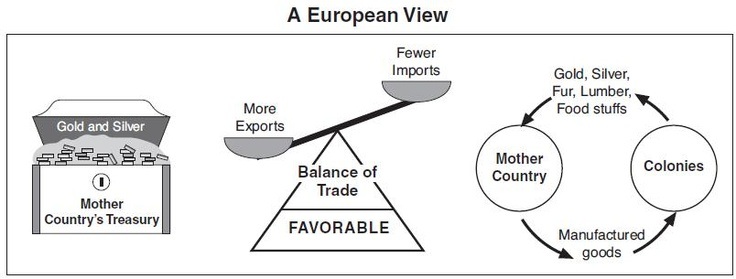
What is mercantilism?
A system where a mother countries gains money and power from natural resources that come from its colonies.
where colonies trade gold and silver with each other.
Wars that start over money.
Plantation colonies trading slaves for money.
The Columbian Exchange was _________________.
The movement of peoples, agricultural commodities, diseases, and cultures.
The movement of money from one country to another.
The movement of people and culture to Columbia.
The movement or exchange of currency from one country to another.
The enslavement and forced transportation of 12-15 million black Africans to the Americas between the 15th and 19th centuries
Transatlantic Slave Trade
The Atlantic Passage
Atlantic Tradeway
The Pacific Trade Route
Which term is not used as another name for the Transatlantic Slave Trade
Triangular Trade
The Columbian Exchange
The Middle Passage
The Atlantic Trade Route
The main religion in Latin America brought over by the Spanish and Portuguese
Catholicism
Judaism
Islam
Buddhism
What happened to the population of many indigenous Americans due to Europe's invasion and colonization of Latin America?
The population decreased significantly due to diseases and warfare
The population increased significantly due to diseases and warfare
The population didn't change much
The population increased significantly due to the new crops and animals
I am an Italian sailor, who sailed for Spain and I looked for a faster water route to Asia.
Bartolome de Las Casas
Amerigo Vespucci
Christopher Columbus
Henry Hudson

Which of the following is a negative impact that the Columbian Exchange had on the native peoples of the Americas?
The spread of disease killed millions of people.
Agriculture spread to more regions.
The use of the horse caused native peoples to leave.
Native peoples were no longer allowed to use their languages.
Europeans established global trade networks that brought maize to Europe, chili peppers to India, and wheat to the Americas.
Which were consequences of the Columbian Exchange
Increased trade
Disease
War
Slaves
What percentage of the Caribbean natives died within 100 years of the beginning of the Columbian exchange?
25%
60%
99%
85%
This famous Spanish conquistador conquered the Aztec civilization.
Francisco Pizarro
Hernan Cortez
Amerigo Vespucci
Christopher Columbus
The New World was named after this explorer.
John Cabot
Amerigo Vespucci
Hernan Cortez
Christopher Columbus
What were the 3 major motivating factors for Explorers?
Gold, Silver, Treasure
God, Glory, Gold
God, Glory, Gallantry
Honor, Justice, Reinhardt!
Who were the first group to reach the America's?
The English
The French
The Vikings
The Conquistadors
Which of these is true about the Latin American social class system?
If you were a mix of Spanish and Native American, you were at the bottom of the pyramid
If you were born in Latin America and white, you were at the top of the pyramid
If you were born in Africa, you were on the 2nd level of the pyramid
If you were born in Spain and white, you were at the top of the pyramid

