
 Worksheets
Sci9 Electricity - Unit Review
Total questions: 72
Worksheet time: 2hrs 24mins
Which of the following is not a requirement of a circuit?
load (bulb)
wires (connectors)
battery (power source)
switch

In order for the circuit to be complete, you must have a ________________________ for electricity to flow on.
wire
closed path
open path
switch

What is voltage?
the rate of flow of charge
the difference in charge between 2 points
the amount of available charge
the resistance to flow
What is resistance?
the rate at which a charge is flowing
the material's tendency to resist flow of charge
the difference of charge between 2 points
it is futile
What is the unit we use to measure electric current?
ampere (amp)
ohm
volt
newton

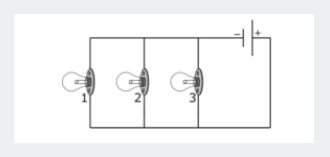
When more light bulbs are added they all remain bright.
Different currents flow through each resistor.


This is known as ohm's law.....
V = I + R
V = I ÷ R
V = I - R
V = I × R

Which is the electrical symbol for a wire?


Which is the electrical symbol for one battery?


Which is the electrical symbol for 2 batteries?

The flow of electrons produces
static electricity
electric current

What does this instrument measure? How should it be connected in a circuit?
This instrument measures current. It should be connected in parallel.
This instrument measures current. It should be connected in series.
This instrument measures potential difference. It should be connected in parallel.
This instrument measures electromotive force. It should be connected in series.

The instrument used for measuring electric current is
galvanometer
ammeter
voltmeter
potentiometer

Which one represent the circuit diagram of this picture?


is the opposition to the flow of charges in a material.
Resistance
Voltage
Time
Current
What would happen if in a circuit the voltage is increase?
The time would increase
The current would increase
The current would decrease
The current would stay the same
What would happen if in a circuit, the resistance increases but the voltage stays the same?
The current would decrease
The current would increase
The voltage would decrease
The voltage would increase
In order to electrical current to flow through a wire the wire must be connected in a ____________ that includes a source of electrical current.
averager matter
Complete loop
In an incomplete loop
Interrupted Circuit

If lamp 1 is unscrewed from its holder, what will happen to lamp 2?
It will get brighter
It will stay the same brightness
It will go out
Nothing will happen

If lamp 2 is unscrewed from its holder, what will happen to lamp1?
It will stay lit
It will go out
It will get dimmer
It will dissapear
What is the resistance of a lightbulb that experiences 9 Volts and 3 amps of current?
1/3 ohms
3 ohms
27 ohms
9 ohms
What is the voltage of a circuit with 4 ohms of resistance and 3 amps of current?
12 V
21 V
4/3 V
3/4 V
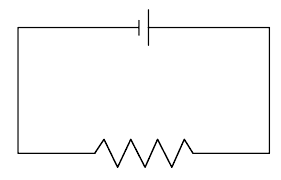


The lamps in a string of decorative lights are connected in parallel across a constant-voltage power source. What happens if one lamp burns out? (Assume negligible resistance in the wires leading to the lamps.)
The brightness of the lamps will not change appreciably.
The other lamps get brighter equally.
The other lamps get brighter, but some get brighter than others.
The other lamps get dimmer equally.
The other lamps get dimmer, but some get dimmer than others.

A 9-V battery is hooked up to two resistors in series using wires of negligible resistance. One has a resistance of 5 Ω, and the other has a resistance of 10 Ω. Several locations along the circuit are marked with letters, as shown in the figure. Which statements about this circuit are true? (There could be more than one correct choice.)
The current is exactly the same at points A, B, C, and D.
The current at A is greater than the current at B, which is equal to the current at C, which is greater than the current at D.
The current at A is greater than the current at B, which is greater than the current at C, which is greater than the current at D.
The potential at B is equal to the potential at C.
The potential at D is equal to the potential at C.

Identical ideal batteries are connected in different arrangements to the same light bulb, as shown in the figure. For which arrangement will the bulb shine the brightest?
A
B
C

If the light bulb in the middle burned out, what would happen to the other two?
The light bulb to the left would stay lit, but the one to the right would turn off.
They would both stay lit.
The light bulb to the right would stay lit, but the one to the left would turn off.
They would both turn off.
How do you find Voltage?
I ÷ R
R ÷I
I×R
I ×W
How do you find Resistance?
I ÷ V
V÷I
V ×I
I ×W
How do you find Current?
I ÷ V
V÷I
V ×R
V ÷ R
What are the two types of electricity?
Static and electrons
Current and voltage
Series and parallel
Static and current
What 3 things does a circuit need for current to flow?
energy source, energy user, wires
energy source, switch, wires
energy source, energy user, switch
energy user, switch, wires

Which light globe(s) would never light up?
A
B,C,D
A,B,C,D
None
Voltage is the measure of the...
difference in electrical energy between 2 parts of a circuit
amount of electric charge that flows through a circuit
In a series circuit, how is the brightness of a light globe affected when another globe is connected?
It gets brighter
It stays the same
It gets dimmer
It goes out
Why are Christmas lights wired in parallel?
It is cheaper to make
You can make longer strands
It uses less electricity
If a light breaks, the others keep working

zig zag
Resistor
Ammeter

An incomplete circuit is shown.
To complete the circuit, a wire should be placed from?
point D to point C
point B to point C
point A to point D
point B to point D

This circuit has a battery, buzzer, and switch.
When the switch is closed, the buzzer sounds because?
the switch gives energy to the battery
the buzzer is made of special plastic
the wires are cooled by the surrounding air
the electricity can flow in a complete path

Does this statement best describe a parallel or a series circuit?
When more light bulbs are added to the circuit, all the light bulbs dim because the voltage or the electric potential energy of each electron leaving the battery is split between the lights (loads).
parallel circuit
series circuit
applies to both series and parallel circuits
How many path(s) does an electron have to follow in a parallel circuit?
has only one path for current to travel
does not allow electricity to travel through it
has more than one path for current to travel
One of the advantages of _________ circuits is that they ensure all components (loads) in the circuit experience the same voltage (push behind the electrons) as the battery.For instance, all bulbs in a string of lights have the same brightness.
series
parallel
both series and parallel

