wayground logo

Free Printable Worksheets

Font size

S
M
L
XL
Worksheets

Physics Final Exam Semester 2

Total questions: 72

Worksheet time: 2hrs 31mins

Name
Class
Date
1.

When an object gains electrons it becomes __________

a)

Neutral

b)

Positively charged

c)

Negatively charged

2.

After a balloon is rubbed against wool, the two objects will ________ each other because they have ___________ charges

a)

attract; like

b)

attract, opposite

c)

repel; like

d)

repel; opposite

3.

Which statement is true of a positively charged object?

a)

Positively charged objects do not contain any electrons.

b)

Positively charged objects do not contain neutrons or electrons.

c)

There is a lack of electrons on a positively charged object.

d)

The protons and the electrons are both positively charged on such objects.

4.
When distance increases, electrostatic force ____________; we call this relationship ____________ proportional
a)
decreases;directly
b)
decreases;inversely
c)
increases;inversely
d)
increases;directly
5.
What happens to the force between two charged objects when you double the distance between them?
a)
2X
b)
1/2X
c)
4X
d)
1/4X
6.
What happens to the force between two charged objects if you double the distance between them and double the magnitude of one charge?
a)
4X
b)
6X
c)
1/2X
d)
1/6X
7.
If each of the charges doubles, what happens to the force?
a)
Quadruples
b)
Doubles
c)
Stays the same
d)
Reduced by half
8.
Electrostatic force F is directly proportional to:
a)
r^2 (distance squared)
b)
q1
c)
q2
d)
both q1 and q2
9.

A balloon is rubbed against a student's hair and then touched to a wall. The balloon sticks to the wall due to

a)

The balloon is charged neutral, so is the wall, so it attracts to the wall

b)

The balloon is charged opposite the wall, so it attracts to the wall

c)

The balloon has a charge, so it attracts the neutral wall

d)

The wall grounds the balloon, so it sticks

10.
What do you call the process of charging a conductor by bringing it near another charged object?
a)
induction
b)
polarization
c)
neutralization
d)
conduction
11.
When you charge a balloon by rubbing it on your hair this is an example of what method of charging?
a)
Friction
b)
Conduction
c)
Grounding
d)
Induction
12.

Materials through which electrons move easily:

a)

insulator

b)

conductor

13.

Ms Pippin rubbed two balloons with a piece of wool. What will happen when the balloons are brought near each other?

a)

The balloons will repel each other.

b)

The balloons will attract each other.

c)

The balloons will become positively (+) charged.

d)

The balloons will pop.

14.

During induction, grounding is necessary in order for the neutral object to become charged.

a)

true

b)

false

15.

Students constructed a circuit using different-colored lightbulbs. What will happen if Switch 3 is closed and the other switches are left open?

a)

Only the white bulb will operate

b)

None of the bulbs will operate

c)

Only the white and yellow bulbs will operate

d)

Only the red and blue bulbs will operate

16.

In some circuits that are used for decorating, one burned-out lightbulb will prevent all the other lightbulbs from lighting. In other circuits, one burned-out lightbulb will have no effect on the other lightbulbs. In which of these circuits will the other lightbulbs still light even if one bulb is burned out?

a)
b)
c)
d)
17.
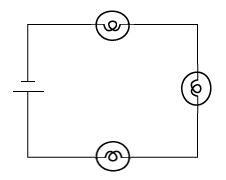
The picture shows an electrical circuit. This circuit is a series circuit because: 
a)
It has 3 light bulbs.
b)
The same current flows through all three light bulbs.
c)
It uses a single battery.
d)
The electrical current has more than one path to flow through
18.
In a parallel circuit if one of the light bulbs burns out the rest _________.
a)
stop the flow of electricity
b)
 can still light up
c)
 will go out
d)
of the light bulbs burn out also
19.
What size resistor would produce a 3 Amp current flow with a 12 Volt battery
a)
1 Ohm
b)
3 Ohms
c)
4 Ohms
d)
12 Ohms
20.
What is the Voltage of a circuit that has a resistance of 5 Ω and a current of 2 A?
a)
25 V
b)
10 V
c)
2.5 V
d)
0.4 V
21.
Current times Resistance equals
 (I X R)
a)
Power
b)
Voltage
c)
Amperage
d)
Ohm
22.
If the Voltage is increased and the resistance stays the same, Current will
a)
Increase
b)
Decrease
c)
Stay the same
d)
X
23.

What is a kilowatt hour?

a)

A boat burning fuel.

b)

A way to tell time.

c)

Using a kilowatt for one hour.

d)

Singing outside.

24.

How do you calculate total resistance in a parallel circuit?

a)

R1 + R2 + R3

b)

R1 - R2 - R3

c)

1/R1 +1/R2 + 1/R3 = 1/RT

d)

R1 = R2 = R3

25.
Surrounding every magnet is a __________  __________.
a)
magnetic field
b)
electrical current
c)
another magnet
d)
an enemy
26.
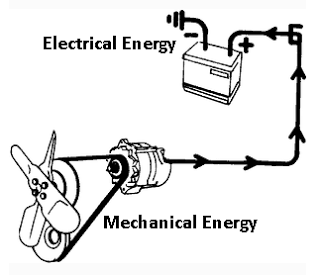
Generators are devices that convert _____ energy into _____ energy.
a)
chemical; mechanical
b)
mechanical; electrical
c)
electrical; mechanical
d)
potential; kinetic
27.

What is the transfer of energy in when you plug in a motor and it spins?

a)

chemical to mechanical

b)

electrical to mechanical

c)

mechanical to electrical

d)

physical to potential

28.
True or False: A magnetic field is invisible.
a)
True
b)
False
29.
Magnetic field lines are closet together at the __________.
a)
poles
b)
lines
30.
What happens when two north poles of a magnet are placed together?
a)
they repel
b)
they attract
c)
they cancel each other out
d)
the strength of the magnet is doubled
31.

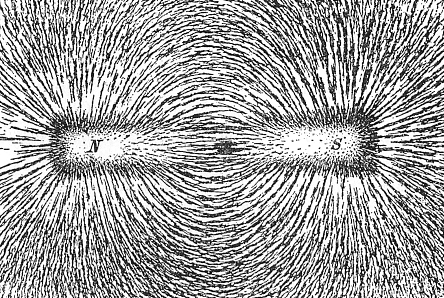
Are the magnetic field lines in the picture correct?

a)

Yes, because they point from north to south.

b)

No, because they point from north to south (they're supposed to go the other way).

c)

Yes, because the North pole is on the left in all pictures.

d)

No, because the North pole is on the left in all pictures (it's supposed to be on the right).

32.

The strongest part of a magnet is...

a)

the bars .

b)

the force field.

c)

the poles.

d)

the middle.

33.

What is the Doppler Effect?

a)

A change in frequency due to the relative motion of a wave source and an observer

b)

When a wave overlaps with another wave

c)

When a wave bounces off of another object

d)

When a wave bends due to traveling through a different medium

34.

The pitch of a sound wave relates to the wave's _________________.

a)

Amplitude

b)

Frequency

c)

Wavelength

d)

Period

35.

An ambulance is driving towards you as you stand on the sidewalk. What happens to the pitch of the siren as it comes towards you?

a)

It increases

b)

It decreases

36.

You are driving in a car and honk the horn at a person standing in the street. As you approach the person, what happens to the pitch of the horn according to you in the car?

a)

It increases

b)

It decreases

c)

It stays the same because you are in the car moving with the sound.

37.

You are standing on the side of the road when a police car races past you with its siren on. After the police car passes you, what happens to the pitch of the siren?

a)

It increases

b)

It decreases

c)

It turns red

38.

____________ is the number of occurrences over a period of time.

a)

Wave

b)

Vibration

c)

Frequency

d)

Sound

39.

Herts (Hz) refers to the number of

a)

Wave Cycles

b)

Water Cycles

c)

Tri Cycles

d)

Motor Cycles

40.
The lowest part of the wave is?
a)
trough
b)
crest
c)
point of origin
d)
compression point
41.
What is the measure of how many waves pass a point in a certain amount of time?
a)
frequency
b)
wavelength
c)
midpoint
d)
crest and trough
42.
The action of a wave bouncing off a surface is called __________________.
a)
rarefaction
b)
refraction
c)
reflection
d)
diffraction
43.

A _____________________ is the distance between two peaks or two troughs.

a)

amplitude

b)

wavelength

c)

frequency

d)

compression

44.
Which wave has a greater frequency?
a)
A
b)
B
45.

Waves that require a medium to travel are:

a)

mechanical waves

b)

transverse waves

c)

electromagnetic waves

d)

light waves

46.

What happens when you increase the amplitude of a sound?

a)

it makes the sound louder

b)

it makes the sound travel faster

c)

it makes the sound softer

d)

it changes the pitch or note of the sound

47.

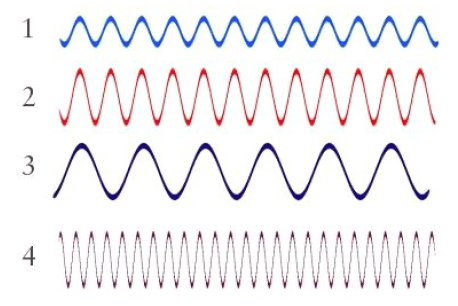
Which wave in the diagram has the greatest frequency?

a)

1

b)

2

c)

3

d)

4

48.

Which wave in the diagram has the longest wavelength?

a)

1

b)

2

c)

3

d)

4

49.

This sound has high pitch, which means it has a(n):

a)

Higher frequency

b)

Lower frequency

c)

Higher amplitude

d)

Lower amplitude

50.
The velocity of light in vacuum is _______ m/s
a)
3x10⁸
b)
3x10¹²
c)
3x10⁶
d)
3x10¹⁰
51.
How does light behave as it enters these mediums?
a)
continue its path as straight line.
b)
bends toward the normal
c)
bends away from the normal
d)
reflects
52.
According to the Law of reflection, a light ray striking a mirror
a)
continues moving through the mirror in the same direction
b)
moves into the mirror at a slightly different angle
c)
bounces off the mirror toward the direction it came from
d)
bounces off the mirror at the same angle it hits.
53.
Glass has a _____________ index of refraction than air.
a)
Equal
b)
Greater
c)
Less
d)
Impossible to say
54.
The fact the two angles are the same is an example of....
a)
Refraction
b)
Angle of Incidence
c)
Law of reflection
d)
Magnification
55.
Light has the lowest velocity in which medium?
flint glass n=1.70
barium glass n=1.60
crown glass n=1.523
water n=1.33
diamond n=2.45
a)
diamond
b)
water
c)
flint glass
d)
barium glass
56.
The image formed in a flat mirror is
a)
larger than the object and farther away.
b)
reduced and closer to the mirror.
c)
a real image of the object.
d)
equal to the height and distance of the object.
57.

What principle is responsible for light spreading as it passes through a narrow slit?

a)

refraction

b)

polarization

c)

diffraction

d)

interference

58.

What principle is responsible for alternating light and dark bands when light passes through two or more narrow slits?

a)

refraction

b)

polarization

c)

diffraction

d)

interference

59.
A converging lens is also known as a ____ lens.
a)
convex
b)
concave
c)
double
d)
refracted
60.
The point where the rays meet is known as....
a)
Fire
b)
the focal point
c)
refraction
d)
Plane of the lens
61.
This image is...
a)
Inverted and smaller
b)
inverted and bigger
c)
not inverted and smaller
d)
not inverted and bigger
62.

Which lens represents the path light takes through a diverging lens?

a)
b)
c)
d)
63.

A student draws three rays of light from point P through a converging lens. Each point labelled F is a principal focus of the lens. Which of the rays are drawn correctly?

a)

ray Y only

b)

ray Z only

c)

ray X and ray Y

d)

ray X and ray Z

64.
During beta decay, a nucleus .... 
a)
gives up two protons and two neutrons.
b)
  maintains the same number of protons and neutrons.
c)
  loses a proton and gains a neutron.
d)
gains a proton and loses a neutron. 
65.
Radioactive materials have unstable...
a)
electrons
b)
protons
c)
nuclei
d)
neutrons
66.
A helium nucleus with two protons and two neutrons is called a(n) ____.  
a)
alpha particle
b)
electroscope
c)
beta particle
d)
gamma ray
67.
Negatively charged particles emitted from a nucleus at a high speed are ____.  
a)
alpha particle
b)
gamma rays
c)
beta particles
d)
X rays
68.

In alpha decay, the mass number...

a)

increases by 2

b)

decreases by 2

c)

increases by 4

d)

decreases by 4

69.

The mass number of Neptunium (Np) is (a)   .

70.
Solve this equation for alpha decay.
85209At = ___ + 24He
a)
83205Bi
b)
86209Rn
c)
81207Tl
d)
85208At
71.
Solve this equation for beta decay.
614C = ___ + -10e
a)
410Be
b)
714N
c)
210He
d)
613C
72.

In beta decay, the mass number

a)

decreases by 4.

b)

increases by 1.

c)

stays the same.

d)

decreases by 2.