
 Worksheets
Cosmology
Total questions: 20
Worksheet time: 10mins
Which of the following ideas make up the Big Bang Theory?
The Universe is currently expanding.
The Universe was once hot and dense.
The Universe has a finite size.
The Universe is unbounded.
According to the big bang theory, the universe began as an explosion and is still expanding. This theory is supported by observations that the stellar spectra of distant galaxies show a
concentration in the yellow portion of the spectrum
concentration in the green portion of the spectrum
shift toward the blue end of the spectrum
shift toward the red end of the spectrum
In which list are celestial features correctly shown in order of increasing size?
galaxy, solar system, universe, planet
solar system, galaxy, planet, universe
planet, solar system, galaxy, universe
universe, galaxy, solar system, planet
Cosmic Background Radiation is...
Alpha Particles from the nearest black hole
The light from our sun
The leftover energy from the formation of our sun
The leftover energy from the Big Bang
Olber's Paradox states that if the universe is infinite in size and infinite in age, then...
The universe must be expanding
The night sky should be full of light
The universe must be contracting
Aliens must exist
Which of these waves has the longest wavelength?
X-ray
Gamma
Radio
Visible light
How old do we estimate the universe to be?
13.8 billion years old
25 million years old
13.8 million years old
8 billion years old
Which of these is NOT evidence of the Big Bang?
Red shift of the light from distant galaxies
CMBR
Doppler effect
Primordial elements

When we make a "budget of stuff" in the cosmos, what percentage is made of stuff we can't directly see?
5%
27%
68%
95%

Extremely distant galaxies are moving away from us at ___
half the speed of light
almost the speed of light
the speed of light
speeds faster than light

The most distant galaxies we see are now about 45 billion light years from us. We call this the ___
radius of the observable Universe
cosmic event horizon
maximum isotropic distance
cosmological constant
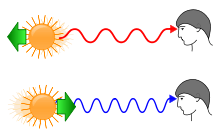

Is Galaxy A moving
Away
Towards
Stationary
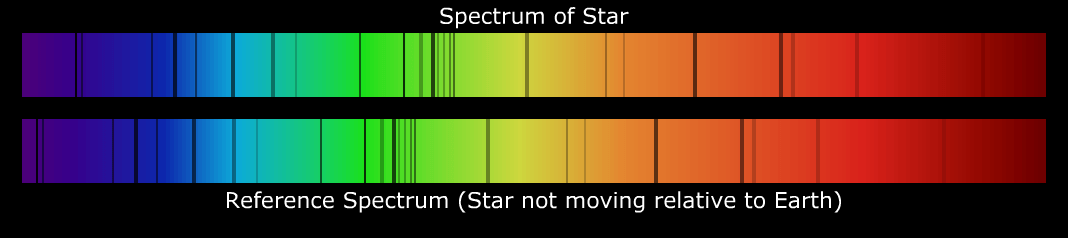
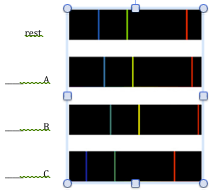

The picture below represents the line spectrum of hydrogen
Which of the following represents the spectrum of Hydrogen from a source moving away rapidly?
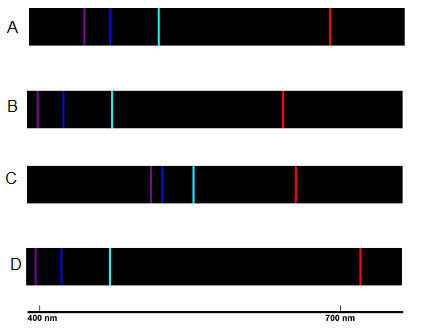
A
B
C
D
When redshift occurs, the perceived frequency of the wave would...
Increase
Decrease
Stay the same
When redshift occurs, the perceived WAVELENGTH of the wave would...
Increase
Decrease
Stay the same

