wayground logo

Free Printable Worksheets

Font size

S
M
L
XL
Worksheets

Biology SOL Review #3

Total questions: 58

Worksheet time: 56mins
Name
Class
Date
1.
What do we use pedigrees for?
a)
To look at families
b)
To make determinations about the offspring
c)
To track traits in families
d)
Nothing
2.

In a pedigree, which shape represents a male?

a)

circle

b)

square

3.

Which gender has an X and a Y chromosome?

a)

male

b)

female

4.

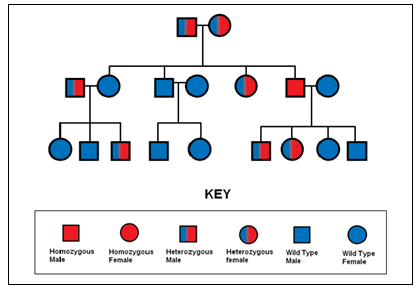
On a pedigree, this symbol represents a ----

a)

not affected male.

b)

not affected female.

c)

affected male.

d)

affected female.

5.

How many individuals are there in the 3rd generation?

a)

1

b)

2

c)

4

d)

6

6.

How are individuals III-2 and II-4 related?

a)

Brother and sister

b)

Dad and daughter

c)

Uncle and niece

d)

Grandfather and granddaughter

7.

On this pedigree, the allele for curly hair is dominant. The couple labeled 2 both have curly hair, but have a daughter who does not have curly hair. Therefore, we can tell from the chart that for the couple labeled 2 -

a)

the male is heterozygous and the female is heterozygous.

b)

the male is homozygous recessive and the female is homozygous dominant.

8.
How many kids did the mother and father from the first generation have?
a)
2
b)
4
c)
5
d)
6
9.
Is this trait (the shaded individuals) dominant or recessive?
a)
dominant
b)
recessive
10.

If this pedigree shows a recessive disorder, what MUST the genotype of individual 4 be?

a)

HH

b)

Hh

c)

hh

11.
What is the gender of the individual whose karyotype is seen in the image?
a)
Male
b)
Female
12.

What is a karyotype

a)

DNA wrapped around proteins and condensed and packaged

b)

An image showing the chromosomes in a cell

c)

A form of karaoke using only science songs

d)

A drawing of human genes

13.
Determine the sex of the individual whose karyotype is displayed in the image.
a)
female
b)
male
14.
Which two bat species are most closely related?
a)
 Bat 1 and Bat 2
b)
Bat 1 and Bat 3
c)
Bat 2 and Bat 3
d)
There’s no way to tell
15.
A short sequence of DNA can best be described as an _______.
a)
gene
b)
genome 
c)
chromosome 
d)
chromatin 
16.
The entire set of genes that belongs to an organism is called its ____.
a)
genome
b)
chromosome
c)
gene
d)
DNA sequence 
17.
GMO stands for
a)
genetically made organism
b)
genetically modified organism
c)
gene manipulated organism
d)
Genetic mutant organism
18.

What is the first cloned mammal?

a)

goat

b)

cat

c)

sheep

d)

cow

19.

Which suspect should be charged with the crime?

a)

Suspect 1

b)

Suspect 2

c)

Suspect 3

d)

None of these suspects

20.

The total amount DNA in a cell is called the ?

a)

DNA Fingerprint

b)

Introns

c)

Genome

d)

Restriction Enzyme

21.

Which of the following is a circular piece of DNA from bacteria that can hold a foreign gene?

a)

plasmid

b)

restriction enzyme

c)

ligase

d)

protein expression

22.
What process is shown in the picture?
a)
Gene therapy
b)
Cloning
c)
DNA Fingerprinting
d)
Gene Splicing
23.
The main goal of the Human Genome Project (HGP) was to:
a)
Identify the unique parts of each person's DNA.
b)
Identify genes responsible for human diseases.
c)
Identify genes responsible for human behavior.
d)
Determine the entire sequence of human DNA.
24.
Which best describes the impact that the Human Genome Project (HGP) has had on society?
a)
It has helped scientists determine that certain genes can cause diseases 
b)
It has led to discrimination against genetically flawed individuals
c)
It has led to the appearance of new diseases
d)
It has cost society billions of dollars without any major benefits
25.
What are the nucleotides made of?
a)
Sugar, Phosphate, nitrogen base
b)
Phosphate, Adenine, nitrogen base
c)
Thymine, Adenine, Cytomine
d)
Phosphate, Nitrogen, Adenine
26.
Adenine bonds with ______________.
a)
Guanine
b)
Thymine
c)
Cytosine
d)
Adenine
27.
Guanine bonds with ______________.
a)
Adenine
b)
Guanine
c)
Cytosine
d)
Thymine
28.
Why is DNA important?
a)
it is very small and very complicated
b)
it's in everything
c)
it serves as the blueprint for traits of all living things
d)
because we eat it every day for energy
29.
Which sequence of DNA bases would pair with this partial strand
ATG TGA CAG
a)
ATG TGA CAG
b)
TAC ACT GTC
c)
GTA AGT GAC
d)
CAT TCA CTG
30.

In eukaryotes, which organelle is DNA usually found in?

a)

cell membrane

b)

vacuole

c)

chloroplast

d)

nucleus

31.
What does DNA stand for?
a)
Deoxyribonucleic acid
b)
Denitrogenous acid
c)
Deribonucleic acid
d)
Diribonucleic acid
32.
Which of the following monomers are repeatedly joined together to form a strand of DNA?
a)
amino acids
b)
nucleotides
c)
fatty acids
d)
polysaccharides
33.
The two strands of nitrogenous bases in DNA are joined by which type of bond?
a)
polar bonds
b)
ionic bonds
c)
covalent bonds
d)
hydrogen bonds
34.
A long chain of amino acids is a/an
a)
protein
b)
nucleic acid
c)
tRNA
d)
mRNA
35.
If a DNA molecule consists of 29% Guanine, how much cytosine will it contain?
a)
29%
b)
58%
c)
21%
d)
I have no idea.
36.
A scientist observes a base sequence of AGCTAGCTAGCT.  Which of the following would be the complimentary strand?
a)
TGCATGCATGCA
b)
TCGATCGATCGA
c)
TAGCTAGCTAGC
d)
TTAAGGCCTTCC
37.
DNA replication results in two DNA molecules,
a)
each one with two original strands
b)
each one with two new strands
c)
each one with one new strand and one original strand
d)
one with two new strands and the other with two original strands
38.
The process of DNA replication is called semi conservative because it results in
a)
none of these
b)
Two DNA molecules.  One original molecule and one with two new strands
c)
two exact copies with new strands
d)
two identical molecules, each with 1 original strand and one new.
39.
If a strand reads:
3' A A A T T T C 5'
The matching strand would read...
a)
5' T T T A A A G 3'
b)
3' T T T A A A G 5'
c)
5' A A A T T T C 3'
d)
3' U U U A A A G 5'
40.
A process in which DNA has the unique ability to make an exact copy of itself.
a)
Replication
b)
Translation
c)
Transcription
41.
Why does DNA replicate?
a)
To create another copy for the new cell
b)
To create a duplicate copy in case the original gets damaged
c)
To create a new copy to replace the damaged original
42.

In what process is mRNA synthesized?

a)

Transcription

b)

Translation

c)

DNA Replication

d)

Mitosis

43.

Where does TRANSCRIPTION occur?

a)

Nucleus

b)

Ribosome

c)

Cytoplasm

d)

Mitochondria

44.

How many codons equals 1 amino acid?

a)

1

b)

2

c)

3

d)

4

45.

TRANSCRIBE this DNA sequence: TACGTTACT

a)

AUGCAAUGA

b)

ATGCAATGA

c)

AUGGATUGA

d)

TACGTTACT

46.

Which of the following are differences in the structure between RNA and DNA

a)

DNA uses deoxyribose sugar, RNA uses sugar ribose

b)

DNA pairs Adenine with Uracil, RNA pairs Adenine with Thymine

c)

DNA is a double helix, RNA is a single helix

d)

DNA pairs Adenine with Thymine, RNA pairs Adenine with Uracil

47.

Which organelle is the location where protein is made?

a)

Ribosome

b)

Nucleus

c)

Cytoplasm

d)

Nucleotide

48.

When these bond together, they form a protein

a)

Amino Acids

b)

Peptide Bonds

c)

Ribose

d)

Nucleotides

49.
What is the term for a three-nucleotide sequence that codes for an amino acid?
a)
base
b)
codon
c)
amine
d)
serine
50.
The process to go from mRNA to a protein is called ____
a)
transcription
b)
rRNA
c)
replication
d)
translation
51.
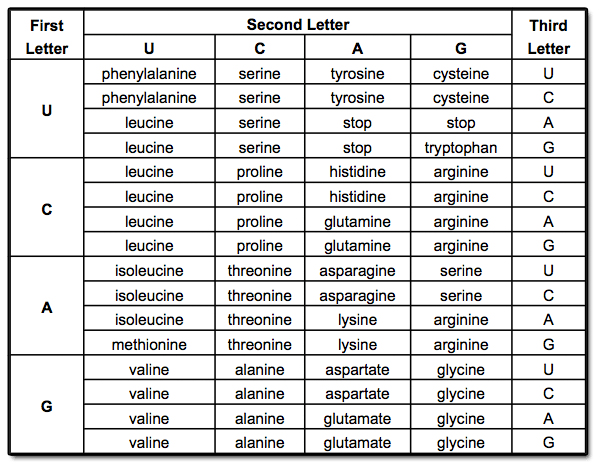
What amino acid is represented by the codon UUA?
a)
Phenylalanine
b)
Tyrosine
c)
Leucine
d)
Stop codon
52.

Which of the following sequences best describes the flow of information that takes place when a gene directs the synthesis of a cellular component?

a)

RNA-DNA-RNA-PROTEIN

b)

DNA-RNA-PROTEIN

c)

PROTEIN-RNA-DNA

d)

DNA-AMINO ACID-RNA-PROTEIN

53.

A mutagen is

a)

a gene that has an altered mutation

b)

something that causes a mutation

c)

any change in a nucleotide sequence of DNA

d)

the portion of the chromosome altered by the mutation

54.

Any change in the nucleotide sequence of a gene is called

a)

a mutation

b)

a codon

c)

a translation

d)

an anticodon

55.

What type of mutation happens to just one base.

a)

Chromosome mutation

b)

Point mutation

c)

DNA mutation

d)

Deletion mutation

56.

What type of chromosomal mutation loses genes?

a)

Duplication

b)

Inversion

c)

Deletion

d)

Translocation

57.

What type of chromosomal mutation gains a copy of the same genes it already has?

a)

Duplication

b)

Inversion

c)

Deletion

d)

Translocation

58.

What type of gene mutation has occurred here? Normal-

AGA-TTC-ATA-GCG

Mutant-

AGA-TTC-AAT-AGC-G

a)

Deletion (causing a frameshift)

b)

Insertion (causing a frameshift)

c)

Substitution

d)

Nonsense