
 Worksheets
8th Grade Review
Total questions: 91
Worksheet time: 1hrs 1mins

What is the main effect of Eli Whitney's cotton gin?
It reduced global demand for cotton and le US farmers to grow other crops
It made it possible to produce clothing by machine and led to the building of textile factories throughout the southern US
It allowed people to grow cotton in the western territories
It allowed cotton to be processed more quickly and profitably and led to the expansion of slavery in the southern US
Which statement best describes how the economic systems of the North and South rely on each other?
The North grew the food that the Southern slaves ate
The South produced the iron used to build the Northern railroads
The South grew the cotton and the North turned it into fabric in their factories
The North sent the skilled laborers and immigrants to the South to help build its railroads and plantations

The Missouri Compromise (1820), the Compromise of 1850, and the Kansas-Nebraska Act (1854) were all efforts to
end fighting between mid-western farmers and Native Americans
encourage manufacturing in the West
increase the number of people who voted in presidential elections
settle disputes over the spread of slavery to western territories

This poster from the 1850s appeared in response to the
start of the Civil War
issuance of the Emancipation Proclamation
passage of the Fugitive Slave law
enactment of the 13th Amendment
What was the purpose of the Kansas-Nebraska Act?
to admit Kansas as a free state and Nebraska as a slave state
to allow the citizens to decide if a state would be a free state or a slave state
to allow border ruffians to vote in Kansas elections to promote slavery
to negotiate a deal for territory with Native Americans in Oklahoma

In the 1850s, the phrase "Bleeding Kansas" was used to describe clashes between
pro-slavery and anti-slavery groups in Kansas Territory
Native Americans and new American settlers
Chinese and Irish railroad workers clashing over wages
freed slaves and white settlers out west fighting over slavery

What did the Supreme Court rule in the Dred Scott v. Sandford case?
Dred Scott was set free since he lived in a free state.
Dred Scott was property and not a citizen.
Dred Scott's owners were guilty of holding him against his will and were arrested.
Dred Scott's owners had to pay Dred Scott for work he completed.

The timeline above shows a number of important events in American History. Which of the following would be the best title for the timeline?
Creation of Jim Crow South
Events Leading to the Revolutionary War
Results of the Abolition of Slavery
Events Leading to the Civil War
What was the immediate cause of the secession of Southern states from the Union prior to the start of the Civil War?
election of Abraham Lincoln to the presidency
passage of the Kansas-Nebraska Act
raid on Harper's Ferry by John Brown
decision of the Supreme Court in the Dred Scott case


Which of the following connected the Eastern US to the Western US?
Erie Canal
Mississippi River
Transcontinental Railroad
Gulf of Mexico
The Homestead Act was written to encourage people to
move to eastern cities
mine and raise cattle in the west
settle and farm western lands
avoid border conflicts with Mexico
What was the MAIN reason the government wanted Native Americans on reservations
to keep them from starving
to take their land
to preserve the remaining buffalo
to teach them new skills

The Louisiana territory ______ the size of the United States!
Doubled
Tripled
Made Smaller
Quadrupled
All of the following were major changes brought about by the Market Revolution EXCEPT:
People moving from farms to factories
Movement of homes in the country to home in the city
Electricity in people’s homes
Easier communication and transportation
The steamboat and the railroad made life easier because:
They streamlined the process of creating goods
They helped business owners speak directly with consumers
They helped transport goods faster and easier
They greatly reduced the number of hours individuals spent on farm labor


The process by which a minority culture chooses to give up it’s own identity and replace it with the identity of a major culture is called
Modernization
Assimilation
Extinction
What are the lands that the United States government set aside for the Native Americans called?
Reserves
Parks
Reservations
Boarding schools purpose were designed to __________ Indian children’s lives.
change the culture
bring acculturation
learn the white man's ways
all of the above
Extending a nation’s rule over other territories and countries
Isolationism
Dollar Diplomacy
Roosevelt Corollary
Imperialism
The belief that a nation should stay out of the affairs of other nations
Isolationism
Imperialism
Expansionism
Colonialism
Select all of the reasons why the US went to war with Spain in 1898.
Spain's mistreatment of the Cubans who wanted independence
To avenge Spain's attack on the USS Maine
To give independence to Cuba and the Philippines
To add Cuba as a colony and take control of its natural resources
What role did the media(yellow journalism) play in the Spanish American War?
shaped public opinion to go to war
only covered facts of the events of the war
play no role in the war whatsoever
shaped public opinion to give the president war powers to declare war on Cuba
What were the two main locations of fighting during the Spanish-American War?
Alaska and Hawaii
Puerto Rico and Guam
Cuba and the Philippines
Spain and the United States
Why is the Spanish American War of 1898 often considered a major turning point in US history?
It revealed the US as an imperial power in the world.
It marked the first American victory over a European country.
It demonstrated the need for better communications in wartime.
It showed American support for European economic interests in East Asia.
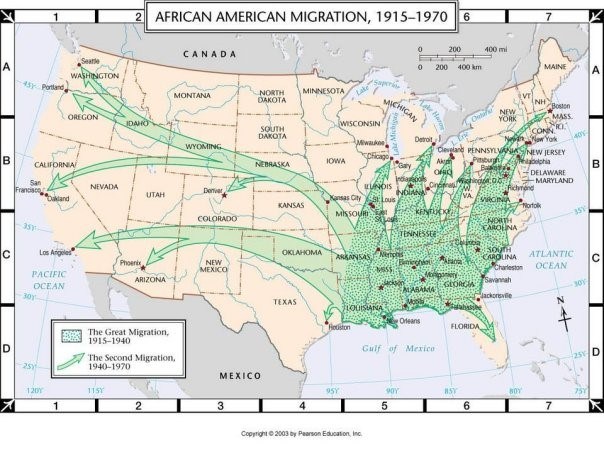
By 1910 where did the majority of African-Americans live?
The South
The North
The East
The West

It was hard for black people to find jobs in the south because of __________, which made segregation legal.
Jim Crow laws
Slave laws
Segregational Act of 1900
Civil Rights

The southerners moved to cities in what part of the country?
The west
The deep south
Canada
The north
The movement of African-Americans out of the South to other areas of the country from 1916-1970 is known as the
Critical Movement
Southern Migration
Harlem Renaissance
Great Migration
Which two northern cities had the highest black populations during the Great Migration?
Cleveland and Detroit
New York and Pittsburgh
Chicago and Philadelphia
Chicago and New York
Which of the following was a pull factor that led to African-Americans migrating out of the South during the Great Migration?
Job opportunities in factories
Social terror
Lack of voting opportunities
A decrease in wages
The Great Migration resulted in the spread of black culture to other areas of the country. One notable place that became a major platform for black culture and achievement was
Savannah
Nashville
Atlanta
Harlem
What was one of the results of Plessy v. Ferguson?
The Supreme Court ruled in favor of Plessy saying segregation was illegal.
The Supreme Court never made a ruling.
The Supreme Court ruled that segregation was legal.
What famous phrase came out of the Plessy case?
"Separate but equal"
"Give me liberty or give me death."
"By any means necessary"
The Plessy v. Ferguson case had what impact on the U.S.?
It legalized Jim Crow (Segregation) Laws throughout the U.S.
It made Jim Crow (Segregation) Laws illegal throughout the U.S.
It created more equality
Which of these questions is a stronger research question because it is open-ended?
Has the population of the world increased in the past century?
What factors have influenced population growth in the fastest growing countries?
Which of these questions is a closed question?
Does owning a pet improve quality of life for older people?
In what ways does owning a pet improve quality of life for older people?
What is anti-semitism
Discrimination against Christians
Racism against Jewish people
Allowing Jews into your home
Discrimination against a group based on their religion
A place where prisoners were taken by the Nazis to either work or be put to death. Auschwitz was one of the worst.
death camp
forced-labor camp
concentration camp
Final Solution
The genocide of millions of people during World War II
Allied Powers
Axis Powers
Anti-Semitism
Holocaust
Which of the following is NOT an example of anti-Semitism from history?
Being forced to wear a patch with the star of David
Being sent to separate parts of cities called "ghettos"
Having rights taken away
Being given special travel privileges across Europe

In which system is the GOVERNMENT in control of land, resources, and factories?
Socialism
Capitalism
Communism

In which system are INDIVIDUALS in charge of owning land, resources, and factories?
Communism
Socialism
Capitalism

The government is only involved to a small extent in which economic system?
Communism
Capitalism
Socialism

There is a great divide between people with high incomes and low incomes in which system?
Socialism
Communism
Capitalism

Competition is encouraged in which system?
Communism
Capitalism
Socialism
In which system is there a mix of government control and free market competition?
Socialism
Communism
Capitalism
Who did Hitler blame for Germany's problems after World War I?
Jewish People
Communists
Austrians
Americans
The treaty of Versailles punished Germany in all the following ways EXCEPT
Forced Germany to abolish their military
Blamed Germany for WWI
Took away territory from Germany
Forced Germany to pay reparations for WWI
The situation of skyrocketing prices in Germany after WWI is known as
price influx
hyperinflation
depression
growth
Which best explains the policy of appeasement?
The policy of staying neutral and out of the way
The policy of giving in to someone in order to prevent other conflict
The policy of invading another country to acquire resources
What is one of the main reasons Americans were against getting involved in WWII?
Americans supported peace over war
The American military was not strong enough to compete
A war would be too costly, hurt the economy, and increase the national debt
Americans were sympathetic to the Germans

Britain and France had this policy toward Nazi Germany
neutrality
appeasement
isolationism

What event started World War II, setting off war in Europe?
Battle of Britain
Germany invaded Poland
Japan bombed Pearl
Japanese aggression in East Asia

Which of the following events during WWII brought the United States into the war?
Germany's invasion of Poland
D-Day invasion of Normandy
Nazi Germany's treatment of the Jewish people
Japan's bombing of Pearl Harbor
During World War II, which of the following nations fought on the side known as the Axis Powers?
Germany
Soviet Union
Japan
Italy
Great Britain

During World War II, which of the following nations fought on the side of the Allies?
Great Britain
Soviet Union
United States
Japan
Spain
Women helped the war effort by
Working in ammunition factories
Working on farms
Driving and repairing vehicles
All of the above
What was the name for the secret project to build an atomic bomb?
Manhattan Project
Tuskegee Airben
Secret Boom
Normandy
At first many Americans were against the war and supported ________________________.
fascism
communism
isolationism
internationalism
What was the term for the action of Britain & France giving in to Hitler's demands?
appeasement
militarization
nationalism
unification

.
Winston Churchill’s remark above on the “iron curtain” in Europe is describing what?
Which of the following is usually a characteristic of a Communist economy?
Entrepreneurs sell shares in their companies to the government
The role of the government in the economy is restricted by law
Government agencies are in control of production planning
Investment is encouraged by the promise of large profits.

The countries in RED represent which Cold War era organization?
League of Nations
Justice League
USA
Warsaw Pact
What are Proxy Wars?
Indirect conflicts between the 2 superpowers
Wars between Communist China and Russia
Wars between the US and Canada
Wars that US citizens greatly supported the involvement of US troops
How did the Marshall Plan try to prevent the spread of communism?
it provided nuclear weapons to NATO members
It provided funds for economic recovery of war torn European nations
it proved refugee housing
it provided military assistance to Vietnam

