
 Worksheets
Harmonic Motion Test Review
Total questions: 55
Worksheet time: 45mins
Position at which the body would come to rest if it were to lose all of its energy refers to
equilibrium position
maximum displacement / amplitude
periodic position
good position
The number of cycles or oscillation made in one second is defined as
time taken
period
frequency
amplitude


In the diagram which letters represent the nodes
A B C
A C E
B D
B D E
A C D

The figure represents a string of length L, fixed at both ends, vibrating in several harmonics. Which string shows the 4th harmonic?
A
B
C
D
E

The figure represents a string of length L, fixed at both ends, vibrating in several harmonics. Which string shows the 3rd harmonic?
A
B
C
D
E
As the wavelength increases, the frequency ____
increases
decreases
remain same
none of the above
The highest point of the transverse wave is called _____
trough
amplitude
crest
wavelength
The lowest point on the transverse wave is called_______
trough
crest
wavelength
frequency

This is the distance from the equilibrium position to the crest or to the trough.
crest
trough
wavelength
amplitude
In a transverse wave, particles vibrate perpendicular to the direction that the wave is traveling
True
False
none of the above
What do all waves transmit
energy
matter
frequency
water

The wavelength can be measured from ( check all that apply)
crest to crest
crest to trough
trough to crest
trough to trough

Which transverse wave has the highest frequency?
1
2
3
4

Which behavior of light does the image represent
refraction
reflection
diffraction
interference

Bouncing back of a light ray from a mirror is called
refraction
reflection
diffraction
interference
This is the distance between two consecutive troughs or crests.
wavelength
amplitude
crest
trough
A wave in which the wave’s medium is compressed in the same direction as the movement of the wave
Transversal wave
Transverse wave
Frequency wave
Longitudinal wave

What type of wave is pictured?
Transverse wave
Longitudinal wave
Wave, what wave?
Slinky wave

Sound travels in which kind of wave?
Longitudinal waves
Transverse waves
Water waves and light waves are both examples to ___
Longitudinal Wave
Transverse Wave
Frequency wave
Sound Wave
What is the beat frequency of two waves with frequencies of 258 Hz and 262 Hz?
2 Hz
8 Hz
4 Hz
260 Hz
Beats are the result of:
Diffraction
Destructive interference
Constructive and destructive interference
Superposition of two waves of nearly equal frequency
The pitch of a sound wave relates to the wave's _________________.
Amplitude
Frequency
Wavelength
Period
What is the Doppler Effect?
A change in frequency due to the relative motion of a wave source and an observer
When a wave overlaps with another wave
When a wave bounces off of another object
When a wave bends due to traveling through a different medium
An ambulance is driving towards you as you stand on the sidewalk. What happens to the pitch of the siren as it comes towards you?
It increases
It decreases
You are standing on the side of the road when a police car races past you with its siren on. After the police car passes you, what happens to the pitch of the siren?
It increases
It decreases
It turns red
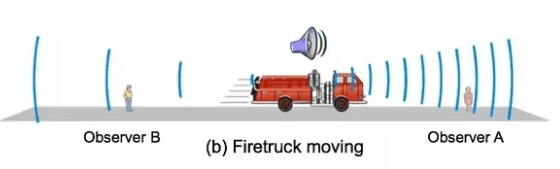
Look at the picture. Who is experiencing a higher pitched sound?
Observer A
Observer B
There's no difference
Which of these sound waves has the highest frequency?
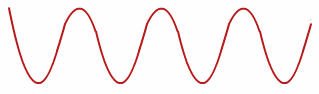
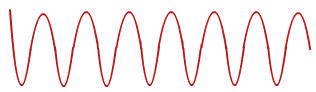
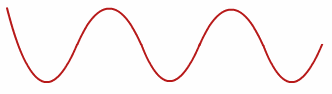
The ______ of a sound depends on the medium through which it's moving.
pitch
vibration
speed
loudness
Amplitude affects which characteristic of sound waves?
frequency
pitch
loudness
wave speed
Why does sound travel faster in solids than in liquids or gases.
They are harder.
The particles are closer together.
Solids have more energy.
Gases fill their container.
Roughly what is the speed of sound in air?
The speed of light.
About 10 m/s
About 340 m/s
About 1 500 m/s

A teacher tries to work out the speed of sound. She bangs two bits of wood together. She hears an echo from a wall. The wall is 25m away. How far has the sound travelled?
340 m
25 m
50 m
12.5 m
When 2 waves meet on the same medium, how do they interact?
They bounce off one another
They travel through one another
They refract off one another
When 2 waves meet and create a bigger wave
Constructive Interference
Destructive Interference

What type of interference is represented in this diagram?
Constructive
Destructive

What type of interference is represented in the diagram?
Constructive
Destructive

Some (or all) of the energy of the wave is lost inside the object after collision resulting in a smaller wave
Reflection
Transmission
Absorption
Retraction

This image depicts which of the following wave behaviors?
Reflection
Refraction
Diffraction
Resonance
Definition: The spreading out of waves as they pass through an opening or around objects.
Reflection
Refraction
Diffraction
Resonance

